Last Updated: 2026-09-11
A label that lifts at one corner, or a code that fails to scan at the distribution centre, stops a shipment and raises questions about everything else on the pallet. SHICAI is a label printing machine manufacturer building label coding and rewinding equipment in house, alongside the inkjet and laser coders used on the lines those labels feed, so a buyer gets one accountable partner for print method, stock range, verification, and spares. Five checks below separate a manufacturer who can deliver from one who can only quote.
Why SHICAI
A label printing machine manufacturer earns an order on four things at once: the print method matched to your label stock, the web handling to run it without waste, verification that the code actually scans, and support that reaches your region when a line stops. Label work is narrower than general packaging coding but less forgiving, because the label is a finished surface the customer sees and a scanner reads.
Label stock varies more than most buyers expect. Paper labels, synthetic film, silver foil, PVC, and adhesive tape each take print differently, and a machine set up for porous paper will produce weak marks on coated film. A manufacturer who asks which stock you run before quoting a configuration is doing the job properly; one who quotes a standard unit to every enquiry is selling hardware rather than solving a marking problem.
The second reason buyers consolidate here is that label coding rarely stands alone. Labels are printed, coded, rewound, counted, and then applied on a packaging line that also needs date and lot codes on cartons and cases. A supplier holding both the label equipment and the wider coding range can specify the whole flow instead of leaving the buyer to integrate three vendors.
Working with a label printing machine factory rather than a trading intermediary changes what happens after the sale. Factory-direct supply means the people who built the machine answer the technical question, and it removes markup layers that inflate a quote without adding capability. The wider portfolio context is covered in the inkjet printer manufacturer guide.
5 Checks Before You Commit
Run these five against your own labels before money moves. Each one is answerable in a single conversation, and the answers tell you more than a specification sheet:
| Check | What good looks like |
|---|---|
| 1. Stock range | Named label widths and materials the machine is rated for, including yours |
| 2. Print method fit | Recommendation based on your stock, not on the unit in stock |
| 3. Verification | Scan-grade testing on your artwork, not a visual check |
| 4. Web handling | Rewind capacity and tension control matched to your roll size |
| 5. Spares and support | Named channel, stated lead time, and consumables that ship to you |
Check 3 is the one most often skipped and the one that causes the most expensive failures, because a barcode that looks correct and scans poorly is discovered by a customer rather than by you. Ask for a sample run on your actual label stock with your actual artwork, then verify with a grader rather than by eye.
Check 4 decides whether the machine fits your workflow at all. A coder that prints beautifully but cannot rewind your finished roll size simply moves the bottleneck to the next station.
Label Coding Range
Four anchors show what a single label printing machine supplier should be able to cover, from roll-fed label coding to line coding for the cartons those labels go into:
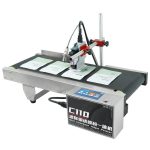
- Automatic label spray coding rewinding machine: 2-12.7mm print height, available in 7 ink colors, and rated to mark paper labels, stickers, PVC film, tape and silver foil.
- L10-FJ30 rewinding inkjet printer: handles label widths from 20-300 mm, rewinds finished rolls up to 500 mm outer diameter, and counts labels with a 1-15 digit counter.
- S1000 small character inkjet printer: prints up to 400 Meters Per Minute with a 2-20mm print height, for the cartons and cases that labelled products ship in.
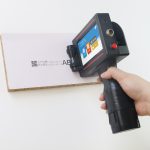
- M100 Handheld inkjet printer: 2-100 mm print height and a 2500 mAh battery for full-shift runtime, for offline and correction work.
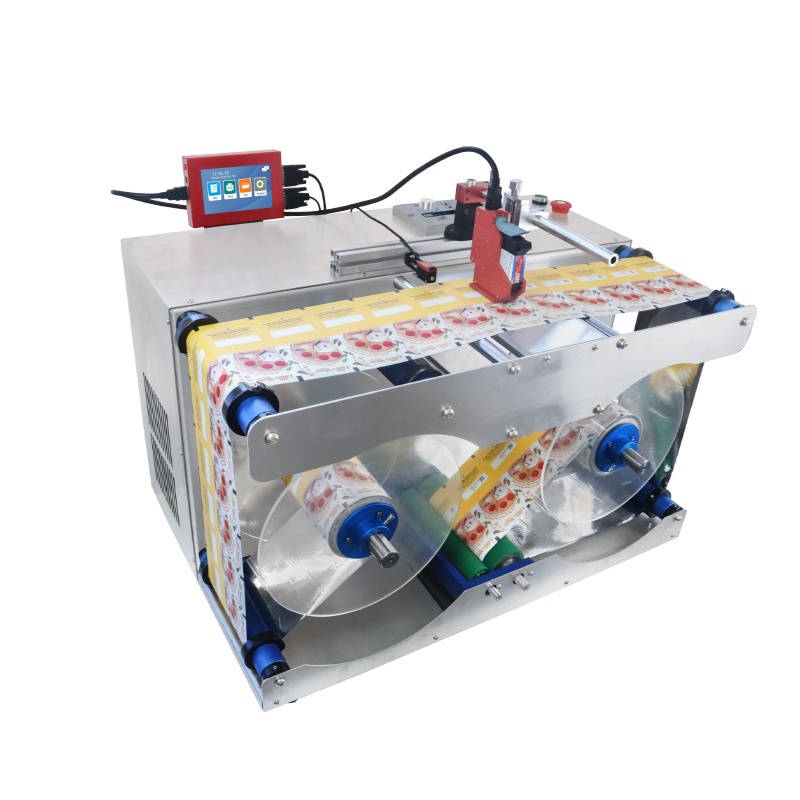
Automatic label spray coding rewinding machine
- 2-12.7mm print height
- Available in 7 ink colors
- Marks paper labels, stickers, PVC film, tape and silver foil
Beyond label stock, the same range covers date and batch coding, QR and barcode marking, egg coding, large-character case coding, and conveyor and pagination systems. That breadth matters for label buyers specifically, because the label is usually one step in a flow that also codes the carton, the case, and sometimes the product itself.
Quality and Compliance
Every unit ships tested against a documented quality system, and the portfolio carries the certification industrial buyers expect, including ISO 9001 quality management. Ask for the certificate scope rather than accepting the claim, because scope tells you which activities are covered and that is the detail an auditor asks about.
For labels the verification standard is scan grade rather than appearance. Pressure-sensitive labels carry the code through handling, stacking, and transit, and a mark that passes at the machine can fail after a week in a warehouse. Ask any supplier to test the way the label will live, not the way it looks on the rewind.
Consumable supply is the quiet risk in label work, because coloured and special formulations are less commonly stocked than standard black. Ask which colours ship to your region and on what lead time before committing to a design that needs them.
For buyers who need their own branding or a custom configuration, OEM and ODM arrangements are scoped per project, with label stock, artwork, print height, and rewind capacity defined up front and sample runs completed before any commitment.
Related Questions
- How do I verify a label printing machine manufacturer?
- Ask for a sample run on your actual label stock and artwork, verified with a scan grader rather than by eye, plus the rated web width, rewind capacity, consumable lead times, and the certificate scope. Specific answers to all five are the signal.
- Can one machine handle paper and film labels?
- Often yes, with the right formulation for each. Paper is porous and forgiving; coated film and silver foil need a formulation made for low-energy surfaces, so confirm both are covered before buying rather than assuming one setting suits both.
- Does label coding need a separate machine from carton coding?
- Usually yes, because web handling and print scale differ. Many plants run a label coding and rewinding unit alongside a line coder for cartons and cases, sourced from one supplier so the two stay compatible.
Request a Quote
Send your label stock, web width, artwork, and roll size for a configuration and a price. Call +86 17625427465, email kuangcy@126.com, or request a quote online. Free sample runs on your labels, a SHICAI engineer replies within 24 hours, and no commitment is required.