Last Updated: 2026-11-06
A laser marking machine OEM build is decided in the configuration sheet, months before a price is argued. Six checks on source power, lens set, rotary axis and paperwork decide whether a private label fleet behaves the same in three markets.
Why a Laser Marking Machine OEM Order Lives or Dies in the Config Sheet
A distributor who resells a standard cabinet can quote from a catalogue. A distributor who sells a private label range has to promise a behaviour: the same mark, on the same part, in every market the range covers.
That promise is a configuration, not a price. Source power, lens focal length, rotary axis and software version together decide what the machine can mark, and a price negotiated before those four are frozen is a price for a product that does not exist yet.
So the useful first meeting is technical. Take the three parts the range must handle, size the mark on each, and let the configuration follow from that list rather than from a competitor datasheet.
Six Checks Before a Tooling Order
| Check | What to freeze | What it prevents |
|---|---|---|
| Source power | The band, not a single wattage | A range that cannot engrave one part |
| Lens set | Focal length and work area per model | Two models sharing one field size |
| Rotary axis | Chuck size and whether it is standard | An axis quoted as an accessory |
| Extraction | Whether fume extraction is included | Hazed optics in month four |
| Files and software | Import formats and job storage | A layout rebuilt at every site |
| Paperwork | Declaration set and manual language | A shipment held at customs |
The third row is where a range quietly collapses. A rotary axis offered as an add-on means the entry model cannot mark a round part, so a distributor who sold the range on flexibility ends up selling an upgrade on every round job.
The sixth row has nothing to do with marking and everything to do with arrival. A declaration set that names the wrong model number is a container that waits, and the cost of the wait is never in the freight quote.
Power, Lens and the Figure That Actually Matters
A fiber source between 20W and 100W covers hardware, electronics and metal parts, and the number that changes with power is not the top speed on a polished sample. It is how long the head sits over a hard mark, which becomes seconds per part and then becomes the price of the job.
The lens is the second half of that equation. A short focal length concentrates energy into a small field, which suits a 30 mm logo and a dense code, while a long focal length spreads the same energy over a wider area and loses the depth that a deep engraving needs.
Fixing a single lens across a whole range is the cheapest configuration and the most expensive decision. Two models with different focal lengths cost less than one model that disappoints half the market, because a returned cabinet costs freight in both directions.
The cutting mechanism is explained under fiber laser, and a build for export should follow the ISO 9001 quality management route. Neither says whether your heaviest part needs 60W or 80W, which is why the sample run belongs in the contract.
Rotary Axis, Fixtures and the Sample Nobody Sends
A rotary axis turns a round part under a fixed head. The figure to freeze is the chuck capacity, because a range that stops at a 50 mm diameter excludes hand tools and bearing housings that the same distributor already sells.
Fixtures are the part a buyer usually leaves out. A bracket that locates the part by its outside diameter marks the same place on every piece, while a part located by eye produces two hundred marks that are each slightly different, and a laser cannot hide a two millimetre error the way ink can.
Ask for the sample run in the contract rather than in an email. Twenty parts, marked at the production setting, photographed with the height written beside them, are the only evidence that the configuration on paper survives contact with your metal.
Extraction is the check buyers delete and later restore. Coatings, oils and plasticisers all leave a deposit on the optics, and a lens that hazes loses power quietly for weeks before anybody notices that the marks have gone shallow.
How We Freeze a Private Label Configuration
A private label programme leaves our floor with one written configuration per model: source band, focal length, work area, chuck size and the software version that was tested. That sheet travels with the first shipment rather than with the third.
What recurs across our export orders is a range that grew without the sheet being revised. The distributor adds a wider model, the artwork is carried across, and the first customer discovers the field size changed and the layout no longer fits the panel.
The Source We Build a Range Around
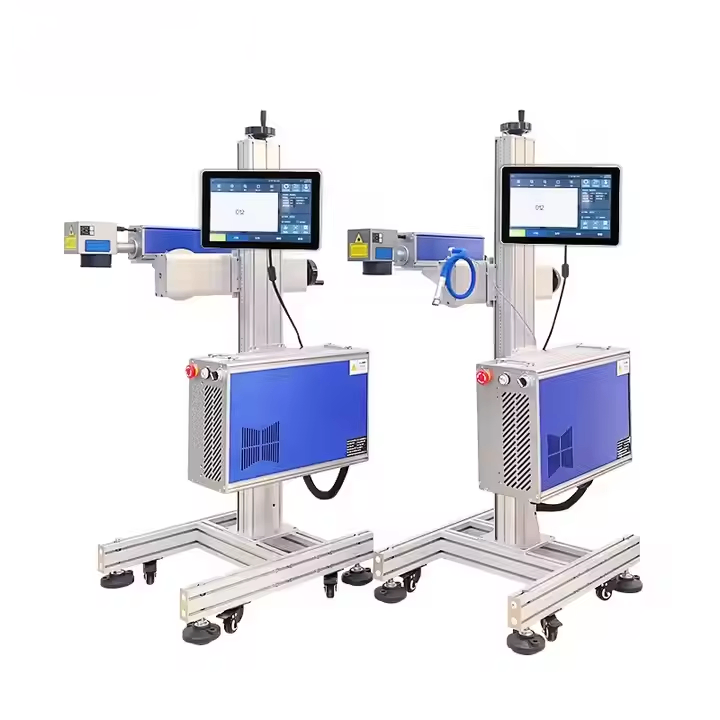
G-20 Fiber laser inkjet printer
the source most ranges are configured around:
- Fiber laser output options from 20W to 100W
- Permanent marks on metal without consumables
- Air-cooled design for continuous duty
- Marks hardware, electronics and metal parts
Air cooling is the spec that simplifies a range. A distributor who must add a chiller at every site is selling two products and supporting both, and a cabinet that cools itself travels better into markets with uneven power.
Buyer Questions
- Is one lens enough for a range
- Rarely. Two focal lengths cost less than a returned cabinet, and the wider field is what buyers ask for later.
- Which figure is frozen first
- The source band, because every lens and axis choice downstream is sized against it.
- Does the declaration differ by market
- Yes, and the model number on it has to match the configuration sheet exactly.
Ask for the Config Sheet, Not a Quotation
A quotation tells you what a cabinet costs today. A configuration sheet tells you what the range will do in year three, when a customer sends a part the first model cannot mark and the second one can.
Send the three parts the range must handle, the mark depth on each and the markets you intend to sell into. We will return the source band, the focal length and the chuck size in writing, so the laser marking machine OEM programme you sign is one your own sample parts have already survived.
Next Steps
- How a small shop sizes the same cabinet: five cost traps for a first laser.
- Start at the contact page, on +86 17625427465 or kuangcy@126.com. We reply within 24 hours.