Last Updated: 2026-11-05
A marking machine OEM order is priced per unit and settled in tooling. Seven terms decide whether a private label order lands as a product or as a cabinet with another firm logo on it, and most of them are agreed before the first drawing.
Why a Marking Machine OEM Order Is Different
A standard order is a cabinet with a specification. A private label order is a product with a document set, and the document set is what a distributor actually sells: the manual, the box, the label plate and the spare parts list all carry the same name.
That is why tooling sits beside unit price in the negotiation. A panel that needs a new die, a manual that needs translation and a box print that needs a plate are all one-time costs, and where they land decides whether the second order is cheaper than the first.
The commercial question is not what the factory can print on a case. It is which of those items the buyer owns after the relationship ends.
Seven Terms to Fix in Writing
| Term | What to write | What it prevents |
|---|---|---|
| Panel and plate | Artwork files, and who owns the die | A die held by the factory forever |
| Firmware language | The languages shipped, and who updates | A menu nobody in the market reads |
| Manual | Source file and translation owner | A manual rewritten per shipment |
| Packaging | Box print, insert set, pallet layout | A carton that fails a retail audit |
| Marking plate | Serial format and model naming | Two fleets with clashing numbers |
| Golden unit | One signed reference machine | Drift nobody can prove |
| Spares promise | Years, parts list, order channel | A fleet orphaned in year three |
The fifth term is the one distributors underestimate. A serial format that collides with a parallel product line turns a service record into a guessing game, and the fix afterwards means relabelling machines that are already installed.
The seventh term is the reason a private label programme survives. A distributor who cannot supply a lens assembly in year three owns a fleet of cabinets with no support path, and no discount on the first order pays for that.
Tooling, Samples and the Golden Unit
Tooling is usually a one-off charge with a production life attached: a die for the panel, a plate for the carton, a screen for the plate. Ask for the life in cycles, because a die rated for two thousand panels is a die that has to be replaced inside a growing programme.
The golden unit is the cheapest insurance in the whole order. One machine, marked with the reference settings, signed by both sides and kept on the factory floor, settles every later argument about whether a change was made.
Ask where the golden unit lives and who may touch it. A reference machine that is also a demo machine is a machine that gets re-set the first time a visitor wants to see a deep engraving.
The process itself is described under laser engraving, and a private label build should carry records under the ISO 9001 quality management route. Neither names the die owner, which is why the first term in the table matters most.
How SHICAI Runs a Private Label Order
We quote a private label programme as a unit price plus a tooling list, and we send the artwork files with the first shipment so the buyer holds the source rather than a photograph. The marking plate format is agreed with the distributor before the first serial is cut.
What recurs in our export orders is the manual. Buyers plan the panel and the box in detail and leave the manual to a translation agency that has never seen the machine, and the first support call arrives in a language the manual does not cover.
The Cabinet Behind Most Programmes
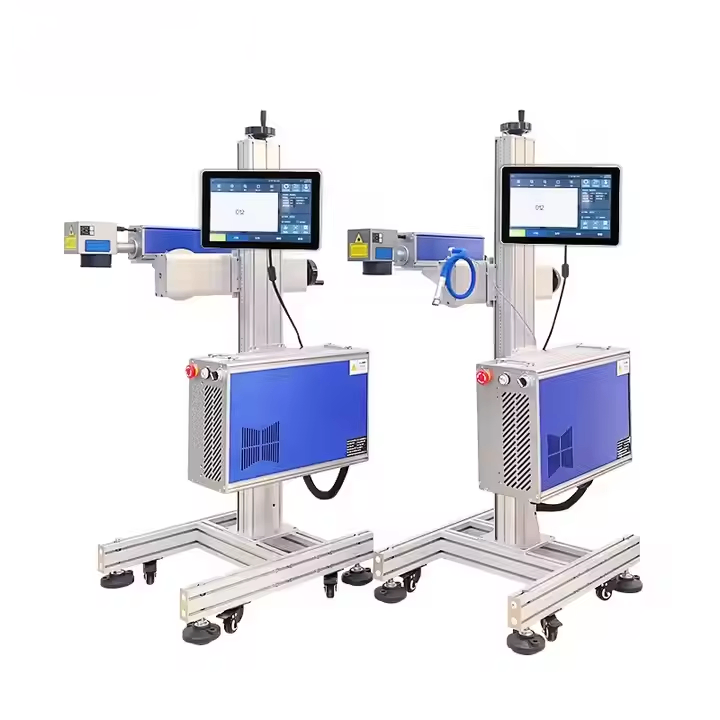
G-20 Fiber laser inkjet printer
the cabinet a private label programme is usually built on:
- Fiber laser output options from 20W to 100W
- Permanent marks on metal without consumables
- Air-cooled design for continuous duty
- Marks hardware, electronics and metal parts
The air-cooled design shortens the private label argument. A distributor who has to specify a chiller for every installation is selling two products, and the simpler cabinet is the one that survives a market with mixed electrical supply.
Buyer Questions
- Who owns the tooling
- The buyer, where it is paid for, and the agreement should say so.
- Can the panel change later
- Yes, and a second die is a second charge unless the term fixes a revision count.
- Is a low minimum a good sign
- Only with tooling priced separately, since tooling spread across few units is the real cost.
Ask for a Tooling List, Not Just a Price
Send the market, the volume and the name that will appear on the plate. We will return a unit price and a tooling list with the die life and the audit record beside it, so the marking machine OEM programme you start is priced for the second order as well as the first.
Next Steps
- What a laser cabinet costs to own: six terms on a wholesale order.
- Start at the contact page, on +86 17625427465 or kuangcy@126.com. We reply within 24 hours.