Last Updated: 2026-10-22
A TIJ printer cost arrives as a single figure and leaves the business through three separate invoices, which is why two plants with identical machines report numbers that differ by a factor of four. The figure on the quotation is the smallest of the three, and it is the easiest one to negotiate.
Why a TIJ Printer Cost Figure Travels Well
A thermal unit is cheap to build because the expensive part of an inkjet head lives inside the cartridge. The nozzle plate, the firing elements and the ink come as one sealed item, so the machine itself is a controller, a carriage and a screen. That is why a bench build with a 12.7 mm head and a 10 cm print block can be quoted at 549 USD and still be a serious tool rather than a toy.
The same design makes the entry figure a poor guide to ownership. Every cartridge carries a head with it, so the consumable line on the invoice is really a machine renewal payment disguised as ink. A buyer who compares only the first invoice is comparing the wrong two numbers.
The Three Invoices That Make the Real Number
| Invoice | What it contains | Who usually forgets it |
|---|---|---|
| Consumables | Cartridges at your block size, plus freight and duty on the order | The buyer, who compares unit prices instead of codes per cartridge |
| Downtime | Minutes per cartridge change, per blocked head and per unplanned stop | The production manager, who treats the swap as free |
| Rework | Packs rejected for a faint or unreadable code, and the labour to re-mark them | The quality lead, who sees only the rejection rate after it is measured |
Add the three and divide by the codes actually shipped, not the codes attempted. That quotient is the only figure that can be compared honestly with a second supplier, a second technology or the cost of buying nothing and marking by hand.
A Ledger for One Bench
Suppose a packing room prints 30,000 codes a month on corrugated cases, using a four-field block about a third of the available height. Assume a cartridge delivers roughly 600,000 codes at that coverage and costs a little over a hundred dollars landed. The consumable line then lands near five dollars a month, which looks almost irrelevant, and it is.
Now add the second and third invoices. If a cartridge change takes ten minutes and the bench is idle for it, four changes a year is under an hour. If a shift instead runs until a code goes faint, the stop happens mid-pallet, the last twenty cases need reading, and the true cost of the same cartridge is suddenly the twenty cases plus the operator time plus the supervisory conversation. Nothing about the machine changed between those two scenarios; the maintenance habit did.
This is the reason a plant that tracks rejection rate buys the same machine as a plant that does not, and reports a different cost of ownership. The difference sits in the second and third invoices, and neither appears in a quotation.
What Moves the Figure Fastest
Four variables dominate, and only one of them is under a buyer control at the order stage.
Coverage. Consumption scales roughly with printed area. A block that uses the full 12.7 mm height and the full 10 cm length can consume several times the ink of a two-line date, and a supplier who quotes yield at a compact block is quoting a number the plant will never reproduce. Height used. Printing a 4 mm date on a head that can print 12.7 mm wastes nothing; printing a 12 mm block where a 4 mm one would read costs ink on every unit. Shift pattern. A single shift lets a cartridge sit between runs, and a long idle period costs a purge or a swap. Three shifts keep the head wet and the consumption smooth. Colour changes. A build offering seven ink colours is a sorting aid, and every colour change carries a purge, so seven colours used daily is a different cost from seven colours available.
Comparing Two Suppliers Without Being Fooled
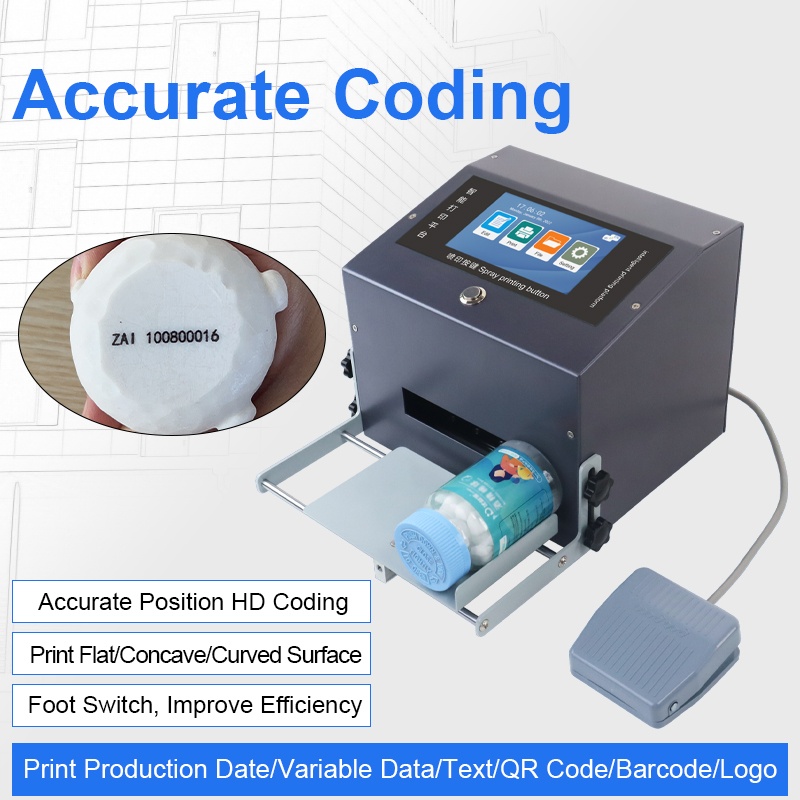
G12 Desktop inkjet printer
the bench build used in the ledger above:
- 2-12.7mm print height
- 2-5mm throw distance
- Available in 7 ink colors
- Marks carton, plastic, metal, wood and pipe
Ask each supplier the same three questions and write the answers down. How many codes does one cartridge deliver at this exact block size. What does a cartridge cost delivered to our door. What does a swap take, in minutes, including the first good mark afterwards. A supplier who answers all three is quoting a cost, and that answer is the only TIJ printer cost figure worth putting beside a competitor. A supplier who answers only the second is quoting a price.
The build above is quoted at 549 USD with imported ink, a 5 inch touch screen and a 10 cm print length, and it runs at 2 to 5 mm to the product. Builds follow the route described in the ISO 9001 quality management standard, and the drop mechanics that set consumption are covered in the general account of inkjet printing.
Cost Questions
- Is a cheaper cartridge always the cheaper code?
- No. A short yield at your block size raises the cost per code even when the shelf price is lower, and freight on small orders hides the difference further.
- Does a wider block cost more to run?
- Yes, roughly in proportion to area. That is the honest budget line behind a logo, and it is why a demo mark rarely matches a production invoice.
- When does a plant outgrow a cartridge unit?
- When the consumable line exceeds the lease or depreciation of a larger build. That point arrives with duty, block size and shift count, not with the calendar.
Send the Block and the Monthly Count
Give us the exact string, the height it prints at and the codes per month. We will return the yield at your block size and the TIJ printer cost per thousand codes, so the comparison against any other supplier starts from the same baseline.
Next Steps
- Send your block size and monthly code count. We return yield, cartridge price and cost per thousand codes in one table.
- Start at the contact page, on +86 17625427465 or kuangcy@126.com. We reply within 24 hours.