Last Updated: 2026-10-03
A printed code can be rubbed off; a coded mark cannot. A laser coding machine alters the surface it meets, which is why the conversation is about the part rather than the machine, and why the mark stays once made.
The Short Answer
The beam is generated in a fibre source and delivered to the part through a scanning head, where it heats the surface enough to change it: by removing a coating, or by oxidising a thin layer of the base material so the mark sits inside the part instead of on top. Nothing is transferred, so nothing washes off.
Output is the variable that decides the job. A frame offered between 20W and 100W covers etched identifiers on hardware and deeper marks on coated parts; beyond that, material and finish decide.
The result is a permanent mark that survives handling, cleaning and outdoor exposure. The limit is as clear: heat-sensitive stock, thin foil laminates and some transparent plastics are not this technology’s ground, and the four drivers below settle where it is.
Where a Laser Coding Machine Price Comes From
Four things set the specification, and only one of them is on the invoice:
| Field | What it answers | What is lost without it |
|---|---|---|
| Source and output | Fibre source, rated 20W to 100W for this class | A mark that will not deepen on demand |
| Duty cycle | Air-cooled for continuous running | Throttling mid-shift |
| What the part is | Metal, hardware, electronics, coated surfaces | A mark that lifts with the coating |
| What must not move | Whether the part or the head is positioned | Fixtures built by the customer |
A laser coding machine price is therefore quoted against a sample, because the gap between a 20W and a 100W frame is decided by whether the mark must survive a wash cabinet or only a warehouse: a fibre laser is a light source with a duty rating, not a pen. ISO 9001 quality management is the framework under which that result is validated and recorded per part number, and the counter-case is next.
How SHICAI Specifies a Fibre Marker
SHICAI commissions laser work on the customer’s own parts: output is stepped until the mark reads at the intended distance, the cycle runs long enough to see whether cooling keeps up, and the result is checked after handling rather than straight off the bench. Frames in this class are built around a fibre source with air cooling for continuous duty, and mark hardware, electronics and metal parts without consumables.
The most common correction we make is a customer arriving with a printed-code problem and a laser quotation for a heat-sensitive pack. The answer there is an inkjet frame, and the reason is in the three questions below.
Related questions on laser marking
- Does a laser mark need any consumables?
- No. The mark is produced by altering the surface, so there is no ribbon and no cartridge to keep stocked. That is the trade: a higher starting cost against no recurring consumable.
- Can it mark plastic as well as metal?
- Some plastics take a fibre mark well and others scorch or lose colour, so material and pigment decide it. Mark your own parts before agreeing an output.
- When is a laser the wrong choice?
- Where the stock is heat-sensitive, very thin, or coated in a way the mark would damage, and where the code must sit on a surface that flexes. There a printed code is safer.
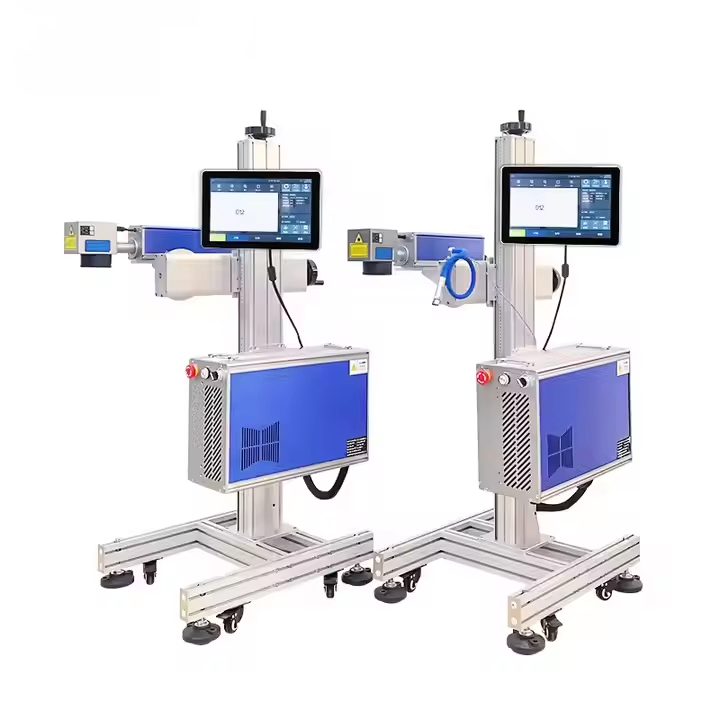
G-20 Fiber laser inkjet printer
the fibre frame in this class:
- Fiber laser output options from 20W to 100W
- Permanent marks on metal without consumables
- Air-cooled design for continuous duty
- Marks hardware, electronics and metal parts
Where to Go From Here
- See the product: G-20 Fiber laser inkjet printer
- Read next: how long a laser mark actually lasts under handling and cleaning
- Talk to us: send two parts you need marked through our contact page. We mark them and report the output that held, free of charge, reply within 24 hours.
Need help choosing the right printer?
Talk to our engineers for a free production-line assessment and quotation.
Request a Quote