
Last Updated: 2026-09-12
Solvent, flushing and make-up fluid are the running cost of some continuous coders. A thermal inkjet printer avoids all three: it heats a tiny volume of ink inside a nozzle to fire a droplet only when a code is due, and the cartridge carries the nozzle with it.
The Short Answer
The plain question, “what is a thermal inkjet printer”, has a mechanical answer: it is a coder that forms each droplet by heating ink inside a nozzle until a bubble pushes a measured volume out. Suppliers call the mechanism thermal foaming, and the abbreviation is TIJ.
| Aspect | How a TIJ unit behaves |
|---|---|
| Droplet formation | A heater vaporises a small volume of ink on demand, so droplets exist only where a code is printed |
| Resolution and height | 300-600 dpi class, 2-12.7 mm from one cartridge, spliced wider where a machine carries several |
| Throw distance | 2-5 mm from nozzle to product, so the product has to be presented steadily |
| Consumable and care | A 42 ml cartridge contains the nozzle, so the print path is replaced rather than cleaned; there is no pump, filter or solvent loop |
The short throw distance is the trade. TIJ suits lines where a surface passes a fixed point, not deep recesses or tumbling products, where a continuous system throwing several centimetres wins.
What to Know in Practice
Substrate decides the ink. Porous stock such as cartons and untreated paper takes a water-based formulation and dries fast. Non-porous stock such as coated board, film and foil needs a solvent-based or fast-drying ink; the wrong pairing wipes off when the product is handled.
Speed is not the constraint most buyers expect. A TIJ unit fires on trigger from an encoder, so code position stays fixed as the line speeds up within the machine rating. The real limit is head count: one 12.7 mm cartridge prints a small code, and taller codes need spliced heads.
Cartridge handling matters more than machine handling. Keep spares sealed until use, note the date a cartridge is opened, and store it at room temperature, because one left uncapped on a bench prints weakly and the blame usually lands on the machine. Match the technology to the job: TIJ for cartons, labels, coated board and light film, a continuous system where a line runs very fast or marks a recessed surface.
About SHICAI
SHICAI builds industrial coding and marking equipment across inkjet and laser lines, for production and warehouse use. Machines ship with genuine components and tested consumables, and service and spares are arranged for export markets. The technical team answers directly rather than through a reseller chain.
Related Questions
- What is a thermal inkjet printer, and how is it different from CIJ?
- A TIJ unit forms each droplet by heating ink in the nozzle and fires only when a code is due. A continuous inkjet system runs a constant stream and deflects what it does not need, so it throws further and suits higher speeds.
- Can a TIJ printer mark plastic and film?
- Yes, with a formulation made for non-porous surfaces. Water-based ink beads on film, so a solvent-based or fast-drying ink is used instead, verified on your material first.
- Do thermal inkjet cartridges dry out?
- Not in normal use, because the nozzle is part of the cartridge and is capped when idle. A cartridge left uncapped on a bench will skin over.
A TIJ Coder Worth Looking At
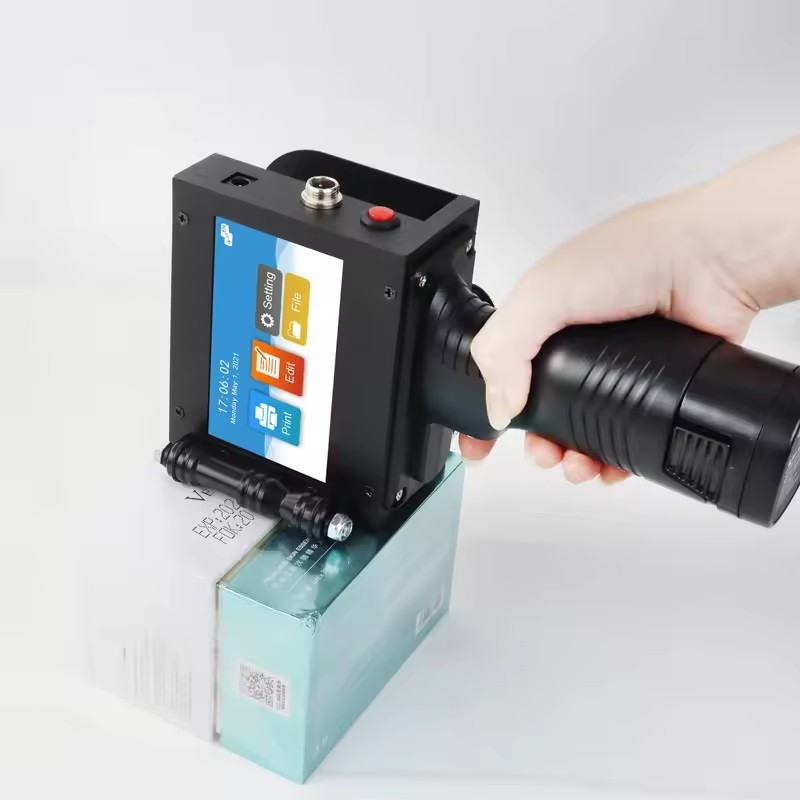
K3S Handheld inkjet printer is a cartridge-fed TIJ unit for cartons, bags and labels:
- 300-600dpi print accuracy
- food-grade/water-based/oil-based/42ml ink cartridge ink
- Prints Chinese and English characters and dynamic QR codes
Learn more about inkjet printing technology and ISO 9001 quality management.
Next Steps
- Read how a thermal inkjet printer works in four steps for the firing sequence.
- Compare technologies in why you would choose a TIJ printer over CIJ.
- Ask for a free sample print on your own material. No commitment, and an engineer replies within 24 hours.
Need help choosing the right printer?
Talk to our engineers for a free production-line assessment and quotation.
Request a Quote