Published 2026-09-08 · By the SHICAI technical team · Industrial marking & coding equipment guide
Last Updated: 2026-09-08
Most coding downtime is not mechanical; it is someone noticing a problem after a pallet is already printed wrong. An automatic coding machine removes the operator from that loop by triggering, positioning, and verifying without hands on the head. Here is what automation and AI assistance genuinely change, and what they do not.
What Automatic Actually Means
An automatic coding machine prints without an operator presenting each product. The line moves the item, a sensor detects it, the controller times the firing, and the code lands. That has been standard on production lines for years.
The newer layer is verification and adjustment. Automatic positioning keeps the print aligned when product placement varies, and detection catches a missing, faint, or misplaced code while the item is still on the line rather than in the warehouse. That shifts coding from open-loop, where quality is discovered later, to closed-loop, where the machine corrects or flags in real time.
Which raises the practical question: what changes on the floor, and what stays exactly the same?
Where the Automation Pays
High-speed lines gain the most, because a human cannot verify codes at 100 metres a minute while a machine checks every one. Mixed-SKU operations gain next, since automatic positioning absorbs the variation that otherwise produces crooked codes at format change.
Unattended and night shifts are the third case. A coder that flags its own faults and holds alignment lets a line run with fewer interventions, which matters more than the headline speed rating.
Automation does not remove every variable. Substrate, formulation, and mounting still decide whether the mark adheres, and no intelligence compensates for a head mounted too far from the product. That is why the fundamentals below stay on the checklist.
What to Verify Before You Buy Automatic
| Claim | Ask for |
|---|---|
| Automatic positioning | How much product placement variation it absorbs, measured |
| Detection or verification | What it detects, and what it does when it detects a fault |
| Unattended running | Which faults still need a person, and how they are alerted |
| Speed rating | Rated against your code size and surface, not the maximum |
| Integration | Encoder input, message control, and data export to your systems |
The pattern to watch for is automation that works only under ideal conditions. A verification function that flags nothing on your real substrate is decoration, so test it on your product with your codes, including deliberately bad ones, before believing the specification.
Line speed and code content change the configuration. Share your setup for a free fit check and we will tell you plainly which automation features your line will actually use.
Where SHICAI Fits
SHICAI builds industrial coding and marking equipment across inkjet and laser lines, including the K series online coders and an AI-assisted automatic coding configuration at the top of that range. The design approach is the one in the table above: state what the automation does and does not handle, size the machine to the code and the line speed, and keep consumable and spares supply organised for export markets. The technical team answers directly rather than through a reseller chain.
Capability claims are easy to make and hard to verify. The next section shows the specification behind the flagship configuration.
Recommended Model
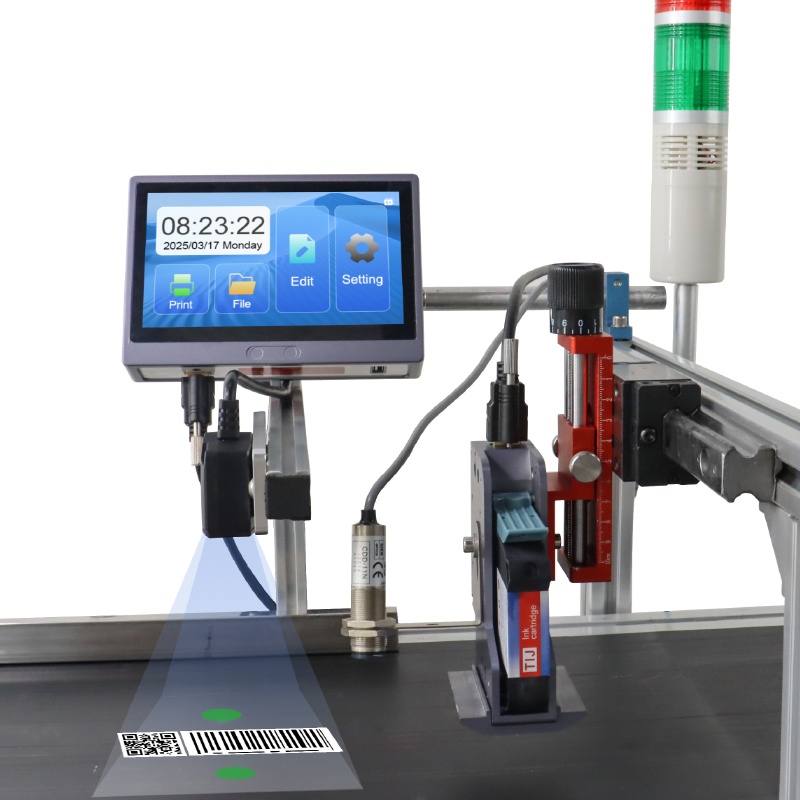
K110+AI automatic coding
- 600dpi HD print accuracy
- 2-12.7mm print height
- 2-5mm throw distance
The flagship automatic configuration in the K series: AI-assisted recognition for positioning and detection, running at up to 120 m/min on a 7-inch touchscreen controller. Built for lines that need codes verified as they print, not checked afterwards.
Frequently asked questions
- Does an automatic coding machine remove the operator entirely?
- No. It removes the operator from triggering, positioning, and inspection, but consumable changes, cleaning, and fault clearing still need a person. The gain is fewer interventions and earlier fault detection.
- What does AI assistance add to a coder?
- Recognition for automatic positioning when product placement varies, and detection of missing or poor codes while the item is still on the line. Verify both on your actual product before relying on them.
- Is automatic coding worth it on a slow line?
- Sometimes. On slow lines the labour saving is smaller, but verification still prevents bad codes reaching customers, which is worth more in regulated or high-value products than in simple date coding.
Next Steps
- See the K110+AI automatic coding unit for full specifications.
- Read related solution guides on online coding and line integration.
- Share your line setup for a free fit check. No commitment, reply within 24 hours.
Learn more about inkjet printing and ISO 9001 quality management.