Last Updated: 2026-10-26
A bottle coding machine portable is rarely bought for a 500 ml bottle. It is bought for the pail, the 20 litre jerrycan and the drum that arrives at a filling bench without a conveyor, where a fixed head has nothing to mount to and the run is too short to justify one.
Why a Bottle Coding Machine Portable Is Really a Drum Tool
Small retail bottles run in thousands and belong on a conveyor with a fixed print head and a reject station. Containers above four or five litres run in tens or hundreds, arrive by hand, and sit at whatever angle the person put them down. That is the shape of work a portable unit fits: one operator, no fixture, a block large enough to read from a forklift.
Industrial benches add a second reason. A 25 litre drum of cleaning concentrate carries a batch number, a fill date and often a hazard panel, and a four-line block on a 100 mm body is no job for a 12 mm date stamp.
The Height Number Buyers Get Wrong
| Block wanted | Height needed | What people buy instead |
|---|---|---|
| Date and batch, two lines | Under 13 mm | An entry unit, correctly |
| Four lines plus a lot code | 25 to 40 mm | A standard unit that forces two passes |
| Batch plus a hazard word | 60 to 100 mm | A large character build, not a date unit |
The gap between the second and third row is the purchase people regret. A unit that tops out at 25 mm can print a lot code in a stack, but it cannot stack a code beside a warning word, and the workaround is two passes with a visible seam or a stencil cut by hand.
Curvature, Gap and the Two Pass Problem
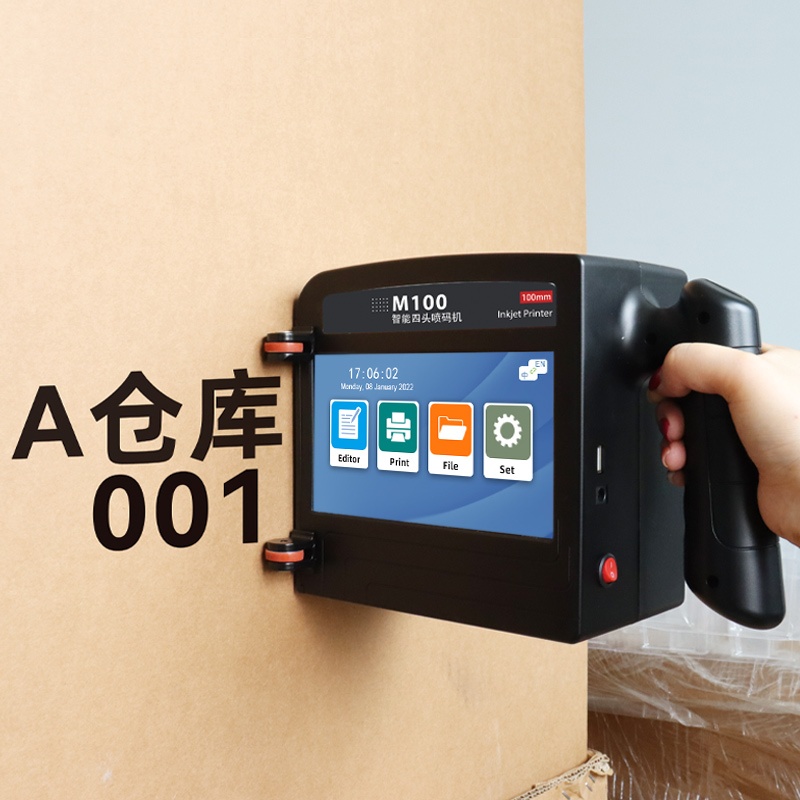
M100 Handheld inkjet printer
the tall build for pails and drums:
- 2-100 mm print height for large characters
- 600 dpi print accuracy
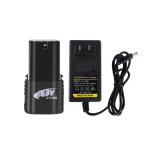
- 2500 mAh battery for full-shift runtime
- 7-inch touch screen
- Prints Chinese/English, numbers, pictures, QR codes and barcodes
A body this tall carries one consequence. On a curved drum the head sits square to the crown of the arc, so a 100 mm block on a 300 mm drum still walks away from the nozzle at the edges. The workable compromise is a three or four line block at 40 to 60 mm with the container held against a V cradle.
A 2500 mAh pack covers a shift of intermittent work, and a pail line is exactly that: twenty drums, a pause for filling, another twenty. Builds follow the route described in the ISO 9001 quality management standard.
Where Portable Stops and Inline Starts
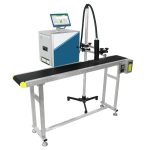
The crossover is a count, not an opinion. When a bench marks more than a few hundred containers a day and the same block repeats all shift, the operator’s arm becomes the bottleneck before the printer does, and the next step is a fixed head over a small conveyor rather than a faster hand-held.
Below that count, the portable build wins on two costs that never appear in a comparison table: there is no integration, and there is no stoppage while a line is changed over. A filling room that runs three products a week changes the block three times, and a unit that fits in a locker handles that better than a frame bolted to a belt.
Filling Bench Questions
- Will one cartridge cover a shift of drums
- A 42 ml cartridge covers a large block for a day of intermittent work at this size, and a spare on the shelf costs less than a lost afternoon.
- Does a pail need a different ink to a bottle
- HDPE and PP pails take an oil-based grade, glass takes either, and a water-based grade on a glossy plastic will dry but not bond.
- Can it print a QR code beside the batch
- Yes, at 600 dpi, and the code needs to be at least 20 mm square to scan from a metre away on a curved surface.
Send the Container and the Block
Tell us the container, the volume per day and the block you need, including any hazard wording. We will return the height setting, the ink grade and a marked sample, so the bottle coding machine portable is proved on your own pail rather than on a brochure.
Next Steps
- Send a container and the block text. We mark it and return the height and ink grade in writing.
- Start at the contact page, on +86 17625427465 or kuangcy@126.com. We reply within 24 hours.