Published 2026-09-15 · Last Updated 2026-09-15 · SHICAI technical team · Coding and marking equipment guide
Asking for a coding machine high speed rating usually means asking for three unglamorous things: ink that stays at viscosity through a full shift, triggering that follows the conveyor rather than a timer, and stand-off wide enough to clear an uneven surface. Speed is the result, not the specification.
What 400 m/min Actually Demands
A coder can print a clean mark slowly on almost anything. Holding it while product moves at hundreds of metres a minute depends on ink staying at working viscosity, on an encoder telling the head when to fire, and on the nozzle sitting far enough back to clear a shoulder, seam or lid rim.
The upgrade build addresses all three: stand-off widens to 3-30 mm so the head tolerates uneven product, the mark range stretches to 2-20 mm to cover small date codes and larger lot marks on one frame, and rated power sits at 120 W for a standard line supply.
Bottling, Canning and Cable Lines
The step pays where lines are long and changeovers short. Beverage runs print on cold, wet containers at high rate, and a weak mark becomes a returns problem. Cable and conduit extrusion prints metre marks and serials on a jacket that never stops. Food and pharmaceutical packaging adds a traceability code that has to be read, not merely present.
All three share one test: does a scanner read the code first time, which is what wider stand-off and ink duty cycle protect.
Coding Machine High Speed: What the Rating Covers
| Item | Upgrade build | Why it belongs with speed |
|---|---|---|
| Mark height | 2-20 mm on one frame | Avoids a second machine for larger characters |
| Stand-off | 3-30 mm nozzle to product | Clears shoulders, seams and lids without re-mounting |
| Operator interface | 10.1-inch industrial touchscreen | Job edits happen at the line, not on a laptop |
| Rated power | 120 W | Installs on a standard supply and adds less heat |
Four Upgrades a Fast Line Should Ask For
Read these as specification questions. First, a wider printable range, so date codes and lot marks share one machine. Second, longer stand-off, because fast lines rarely present a flat surface. Third, an industrial screen rather than a small one, since most wrong codes start as a mistyped job. Fourth, a body built for washdown: the upgrade frame uses 304 stainless construction and supports food grade ink, which is what a beverage or food room asks of a machine inside the splashing zone. The material is covered in the public reference on stainless steel.
Configuring the Upgrade Tier
SHICAI configures this tier against your line: ink by substrate, mount by stand-off, job content by what has to be scanned downstream. Orders are quoted per configuration, and the documented quality system behind the build is available for buyer review ISO 9001 quality management.
The Upgrade Build
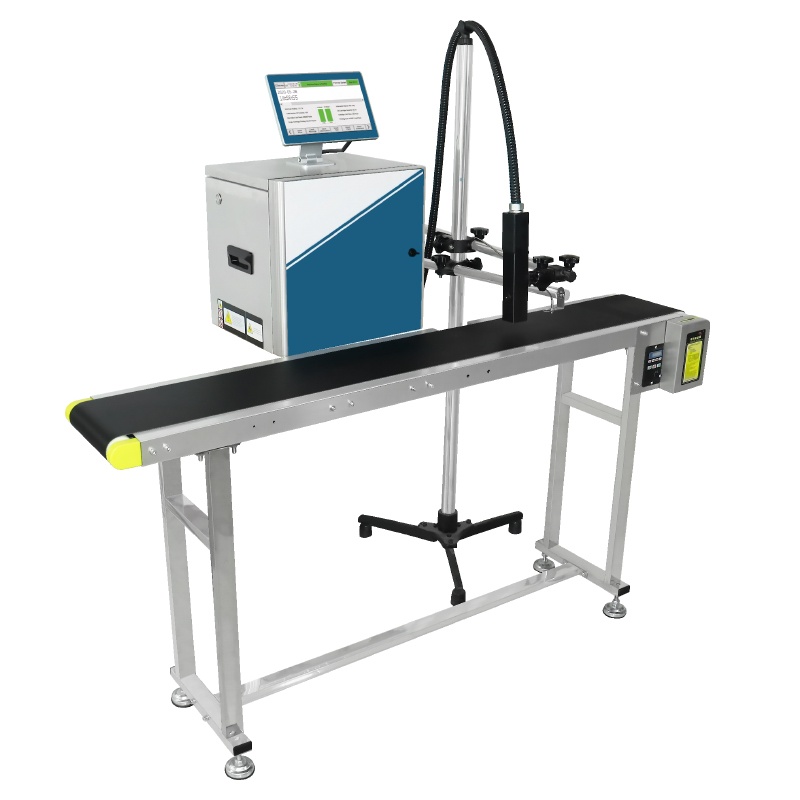
S1000 small character inkjet printer
The CIJ upgrade build: same 400 m/min class with a 2-20 mm mark range, wider stand-off and a 10.1-inch industrial touchscreen.
- Prints up to 400 Meters Per Minute
- 3-30mm throw distance
- Low 120W rated power
Duty and Service Questions
- What makes a coding machine high speed rather than average?
- Three things: how fast ink recirculates and stays at viscosity, how the head triggers from an encoder rather than a fixed timer, and how much stand-off the print path allows between head and product.
- Is a bigger touchscreen worth it on a coding machine?
- On a line that changes products it is. A 10.1-inch industrial screen means an operator edits a job at the machine instead of carrying a laptop to the line, which is where most small coding errors are actually created.
- Why does rated power matter on a continuous coder?
- Power sets where the machine can be installed. A 120 W rated unit sits on a standard line supply without a dedicated circuit, and it adds less heat to a room that already runs warm.
Three Ways to Proceed
- Compare the standard frame first if your codes stay small and your line is moderate: Small character inkjet printer.
- If the gap is verification rather than speed, how an industrial coding machine catches bad codes.
- Send line speed, container geometry and code content to +86 17625427465 or kuangcy@126.com. We mark a sample on your own container, recommend the stand-off and screen size, and quote the configuration; the sample is free and nothing is committed.