Last Updated: 2026-10-15
A coder that loses register on one pallet can cost the shift its output. A continuous inkjet printer high speed build is judged on four costs that never reach the quotation, and the same four turn up on glass, vials or film.
Where the Money Leaves a Fast Line
Speed does not wear a CIJ head out; it removes the slack that hides a wrong setting. At 400 m/min a pack crosses the print window in milliseconds, so a trigger that lags stretches a character instead of dropping it, and the fault gets read as a print quality complaint.
The same speed punishes the ink. A solvent that dries before the drop lands writes a broken pattern; one that stays wet travels through the tunnel and smears against the pallet. Where the pack reaches a pharmacy or a food hall, the record behind it is checked under ISO 9001 documentation rules, and the published mechanics of inkjet printing cover the drop formation behind both faults.
Three Halls Where Downtime Hurts Most
These are the lines where a stopped coder stops everything behind it:
- Pharma vials and blister foil. An expiry date and a lot number in a 2 mm field, camera-read before the tray is sealed.
- Detergent and personal care. Batch and date on HDPE that has to survive a solvent wipe at the labeller.
- Snack and confectionery film. A small date on flexible film at packer speed, the seal closing a second behind it.
Each of the four bites hardest on one of these three.
Four Hidden Costs on a Continuous Inkjet Printer High Speed Build
None of them appear on a quotation for a continuous inkjet printer high speed build, and each is cheaper to settle on paper.
| Hidden cost | What it takes off the shift | How to lock it down |
|---|---|---|
| Trigger lag | 8 to 15 minutes at every changeover | Measure the delay on your fastest pack, not on a bench |
| Ink cure in the tunnel | 20 to 40 minutes, once a shift | Match the solvent to the tunnel temperature before the trial |
| A restart after washdown | 30 to 60 minutes | Specify a body you can flush without opening a cabinet |
| A coder sized on the mean | A rejected pallet and a rework pass | Size for the peak minute the line has reached |
Over a month, one of those four costs more than the gap between a cheap coder and the right one. What is left is who sizes them.
What SHICAI Sets on the Pack
The installs behind this page run pharma, household care and snack film, and the pattern holds: what stops a hall is rarely the head, only a number agreed in an office.
So the S1000 is specified on the pack. It prints at 400 m/min, holds a 2-20 mm character height across a 3-30 mm throw distance, and runs from a 10.1-inch industrial touchscreen at a rated power of 120W. On a wet line the frame is settled by the body: an IP55-level 304 stainless cabinet, food-grade ink and a 100-240V supply that needs no separate panel. A continuous inkjet printer industrial grade build is the specification you should be handed, not the one you have to argue for. The questions below come back from the line most often.
Questions From a Fast Install
- Where does the time actually go on a fast line?
- Rarely in the head. Trigger delay at a changeover, an ink that cures too early in the tunnel, and a nozzle that needs the cabinet open to reach account for most of it.
- How do we work out what a stoppage costs us?
- Multiply the output per minute by the minutes lost. On a filling line at 400 m/min that arithmetic usually settles an argument faster than a spec sheet does.
- What does industrial grade add on a wet line?
- A protected body, a stainless frame and a supply built for a hose-down. On a washdown line that is often the difference between a clean-down and a repair.
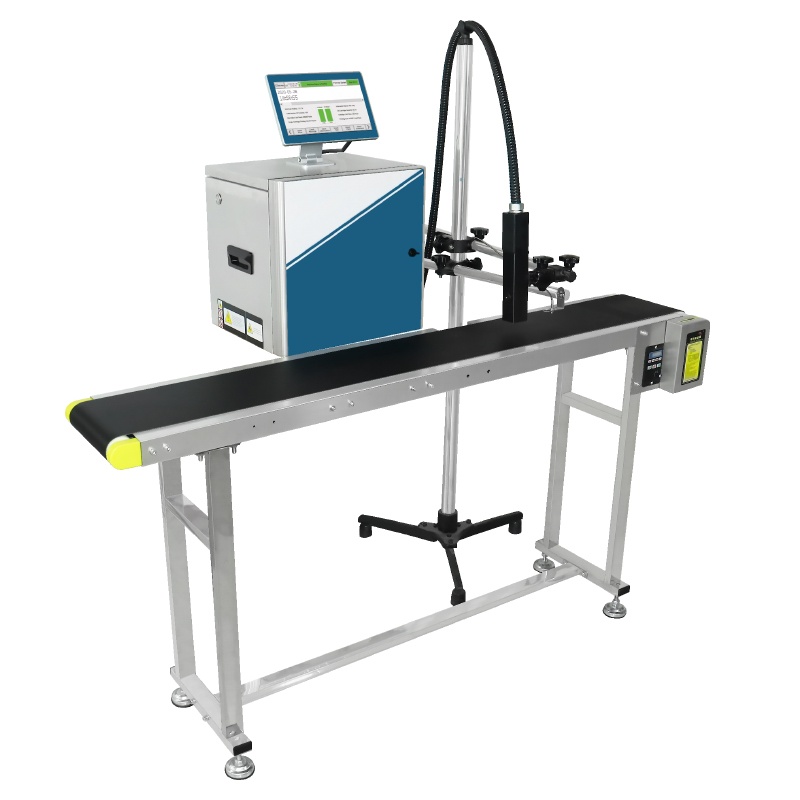
S1000 small character inkjet printer
the frame sized on a running pack:
- Prints up to 400 Meters Per Minute
- 2-20mm print height
- 3-30mm throw distance
- 10.1-Inch Industrial Touchscreen
Time Your Own Changeover
- See the coder: S1000 small character inkjet printer
- Read next: the same 400 m/min question from the small-code side
- Talk to us: send the pack you run and the minutes you lose through our contact page. We come back with the settings attached to a free quote.