Published 2026-09-22 · Last Updated 2026-09-22 · SHICAI technical team · Coding and marking equipment guide
A desktop inkjet printer fails quietly on short runs: one operator, one bench, and a batch that still needs a date and a lot code before the carton is taped shut. Five checks decide whether a compact unit earns that bench space or becomes a shelf ornament.
Where a Desktop Inkjet Printer Actually Fits
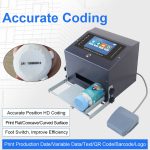
Not every code travels past a conveyor. Hand-packed cartons, laboratory sample bags and pre-production batches all carry a date or a lot code, and none of them justifies a line installation. A compact coder fills that gap: a fixed head on a bench, and an operator who places the work under it.
Throughput is whatever one person can feed, so the class suits batches of tens or hundreds. What it returns is setup time: no line stop, no conveyor integration. Whether that trade pays off comes down to five checks.
Bench, Lab and Workshop Work
Three scenes cover this class. A bakery packing eighty sample boxes still owes the customer a best-before date and a lot code. A laboratory filling sample bags needs a lot that survives a fridge. A warehouse splitting a pallet needs one crate barcoded, the job that otherwise ends in permanent marker.
All three share one trait: the part comes to the coder. Print height, ink and bench space matter more here than conveyor speed.
Five Checks Before You Buy
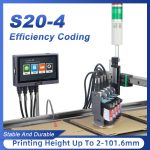
- Text block against print height. A date and a lot code fit inside 4 mm; a barcode sharing the pass does not. The class spans 2 to 12.7 mm, so measure your tallest block.
- Throw distance. Head-to-surface gap runs from 2 to 5 mm, and a recessed lid or domed cap eats it.
- Ink and drying. Seven colours are common, and the choice is functional: porous board wicks ink, glossy film needs a formulation that keys in.
- Substrate list. Carton, plastic, metal, wood and pipe are the usual spread. Ask what the coder does on the surface you actually run.
- How the part is held. Repeatability comes from a jig or a fixed tray, not from speed.
| Where it fits | Desktop coder | Handheld coder | Inline CIJ coder |
|---|---|---|---|
| Batch size | Tens to hundreds | One-offs, awkward parts | Continuous production |
| Setup | Part placed by hand | Operator aims each pass | Line integration |
| Running cost | Ink and cartridge | Ink and cartridge | Ink, solvent and make-up |
Substrate and fixture decide whether the mark repeats; who stands behind the machine decides whether it still works next year.
How SHICAI Builds a Compact Coder
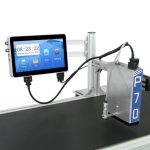
In our export builds the compact coder is usually the second unit a customer buys, after the line machine, because the short-run corner rarely gets a budget of its own. SHICAI builds the class for that: a 5-inch touch screen and 100 mm of print length on the G12.
Buyers inside a quality management system, such as the framework in the ISO 9001 overview, ask three questions: does the mark repeat, is the ink documented, and does a spare arrive without a line stop. How a thermal head forms a dot is set out in this reference on inkjet printing.
The Compact Build
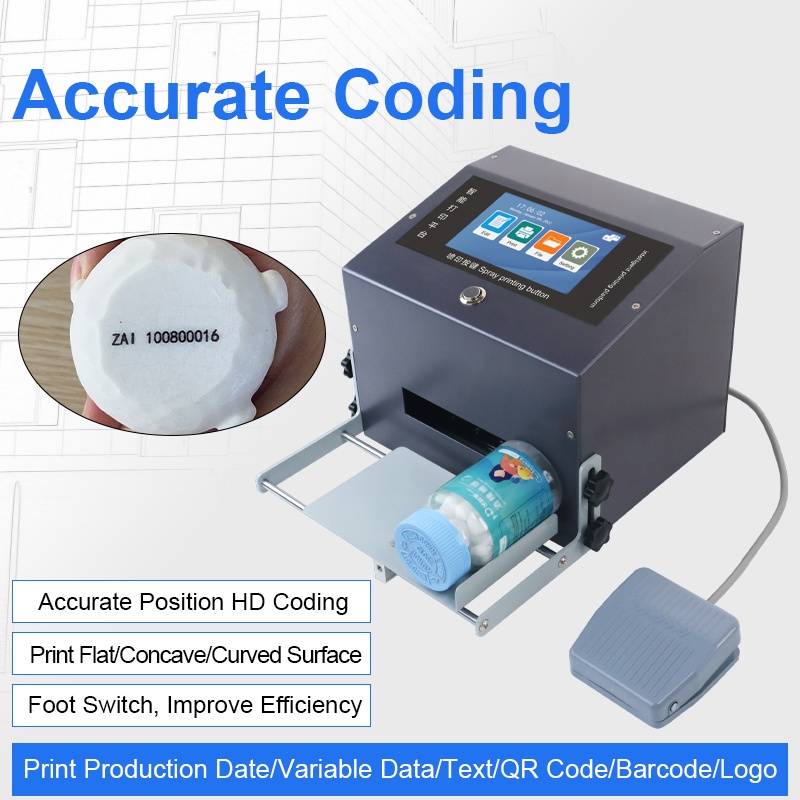
G12 Desktop inkjet printer
covers the bench cases above:
- 2-12.7mm print height
- Available in 7 ink colors
- Marks carton, plastic, metal, wood and pipe
Configuration decides the quote, because ink, screen and print length are chosen together. Send the substrate and the code, and the answer comes back as a specification.
Short-Run Questions
- Can a compact coder print a barcode?
- Yes, at short lengths. A compact head prints a date, a lot code and a short barcode in one pass. Long or dense barcodes belong on a faster coder or a label printer.
- What print height does a lot code need?
- A single line of 3 to 4 mm covers most lot, date and expiry codes. Allow more when a barcode or a second line shares the pass, since the class spans 2 to 12.7 mm.
- Is a cartridge coder expensive to run?
- Cost sits at the entry end of the market. There is no solvent, no make-up and no filter schedule, so running cost is ink and the occasional head.
Next Steps
- See the machine itself: G12 Desktop inkjet printer.
- Read next: how the S20 thermal inkjet heads compare.
- Send the substrate, the code you must print and the batch size to +86 17625427465 or kuangcy@126.com. We print your code on your own material and return the sample free, with a written quote inside 24 hours.