Last Updated: 2026-10-02
A date half a centimeter off is a rejected pallet. An expiry date printer with conveyor is therefore bought on placement discipline: trigger, gap, line speed and layout, in that order. Speed is the easy number; holding position through a shift is the one that costs money.
Why an Expiry Date Printer With Conveyor Is a Placement Problem
A coder mounted over a belt fires at product that arrives at it, and the only thing keeping the mark in the same place is the relationship between the sensor, the encoder and the head. Once that relationship is set correctly the date sits where it was placed on the first pack and on the thousandth. When it is not, the mark creeps as the line warms, as packs are spaced differently, or as a different SKU changes the distance to the face.
Character height is the second constraint. A taller date block needs more room to stay crisp, which is why an online frame is chosen by its upper height limit rather than by its fastest figure.
Where a Conveyor Date Coder Is Used
Short shelf-life food and dairy lead, because an expiry is read by a customer at a shelf and cannot be corrected later. Then cosmetics and household goods where the date is the only trace between a batch and a market. Finally any line running to a retailer code of practice, where the date, the lot and the barcode have to agree on every pack without a manual step.
Four Rules That Hold the Date in Place
| Rule | What it protects | What to ask for |
|---|---|---|
| Fire on a repeat, not a timer | Position when pack spacing changes | Sensor on a seam or edge, plus encoder on the belt |
| Hold the gap tight | Edge sharpness of a small date line | 2-5mm throw distance on the S10-4 frame |
| Choose height before speed | Legibility at the reading distance | 2-50.8mm print height, set at your block size |
| One layout for date and symbol | Agreement between scanner and inspector | Prints Chinese, English, date, QR code and barcode |
The Wikipedia article on inkjet printing covers why droplet spread widens with distance, which is the reason the gap rule outranks the speed rule in practice.
How SHICAI Sets It Up
SHICAI builds online coding equipment for export markets, and commissioning on a date job is placement work before it is printing work. The sensor position, the encoder ratio and the head angle are set against your own packs and re-checked after a warm run, because drift that appears on hour three is the failure buyers least expect from a demonstration. On an expiry date printer with conveyor, that setting step is the deliverable. Builds are governed under ISO 9001 quality management.
Placement questions
- Why do expiry codes drift along a line?
- Usually the trigger, not the head. If the coder fires on a timer rather than on something the conveyor repeats, every change in product spacing moves the mark, and the drift shows up first at the end of a long run.
- Does the distance from head to pack matter that much?
- It decides everything downstream. A wider gap lets the droplets spread before they land, so edges soften and a narrow date line becomes unreadable at the far end of the range.
- Can one frame print a date and a symbol together?
- Yes, where the layout is agreed up front. The human-readable date and the scannable symbol have to share one block so a scanner and an inspector are reading the same truth.
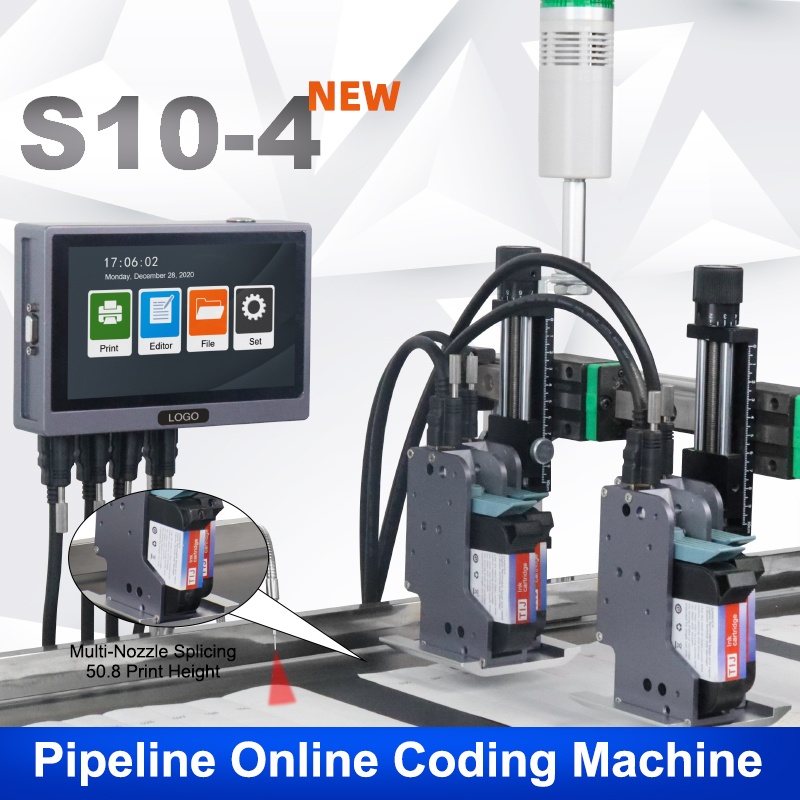
S10-4 online inkjet printer (standalone)
the standalone build for a fixed line position:
- 2-50.8mm print height
- Prints Chinese, English, date, QR code and barcode
- 2-5mm throw distance
What to do next
- See the product: S10-4 online inkjet printer (standalone)
- Read next: what a date code is and how to read one.
- Talk to us: send pack dimensions and your belt speed through our contact page. We print and measure placement after a warm run, with no commitment.