Last Updated: 2026-10-21
A fiber laser printer is usually sold on wattage and judged on heat. The number that decides whether a unit survives a three-shift week is not the peak output but the path that carries the heat away from the source, hour after hour.
Duty Cycle on a Fiber Laser Printer Is a Thermal Number
Every source is rated for an output, and every output produces heat that has to leave the cabinet. Two units with the same rating behave differently in July, because one moves that heat through a fan and a fin stack and the other moves it through a chiller and a hose. Neither is wrong. They suit different rooms.
This is why an air-cooled design is worth reading carefully. It removes a water circuit, and in exchange it makes the ambient temperature part of the specification. A workshop at 40 degrees is a different duty cycle from the same workshop at 22.
What Air Cooling Actually Covers
The build below uses an air-cooled design for continuous duty, with fiber output options from 20W to 100W and marks that stay on metal without consumables. In practice the useful question is what the unit is doing while it cools: marking at a low duty ratio for eight hours at a time is well inside an air-cooled envelope, while a continuous full-power raster on a wide field is not.
Two rules of thumb help size the job honestly. Count the seconds of actual marking per minute rather than the hours the line is switched on. Then add the ambient temperature, because a warm room quietly removes headroom the datasheet assumed. A fiber laser printer bought for an eight-hour shift and one bought for a humid summer are two different purchases.
| Job shape | Marking share of the minute | What to check |
|---|---|---|
| Code or serial on parts | Under 20 percent | Ambient temperature and filter cleaning interval |
| Mixed code and deep engraving | 20 to 50 percent | Whether the field is fully used, and the fan path |
| Full-field raster | Above 50 percent | A chilled option rather than an air-cooled one |
The third row is where quotations go wrong most often, and it is cheaper to discover on paper than in the second week of August.
Three Plant Conditions That Change the Answer
Dust. An air-cooled cabinet pulls the room through its fins, so a foundry needs a cleaning interval written into the schedule rather than discovered as a fault. Airflow. A unit boxed into a canopy recirculates its own hot air and behaves like a smaller machine. Voltage. A long cable run to a remote corner drops the supply, and the fault only appears under load.
None of the three appears on a specification sheet, and all three are answerable by walking the plant once with the drawing.
Where a Laser Marking Machine for Metal Earns Its Place
A laser marking machine for metal is bought where the mark outlives the part. Hardware and metal parts that go through handling or heat lose a surface mark and keep a laser mark, which is the whole argument.
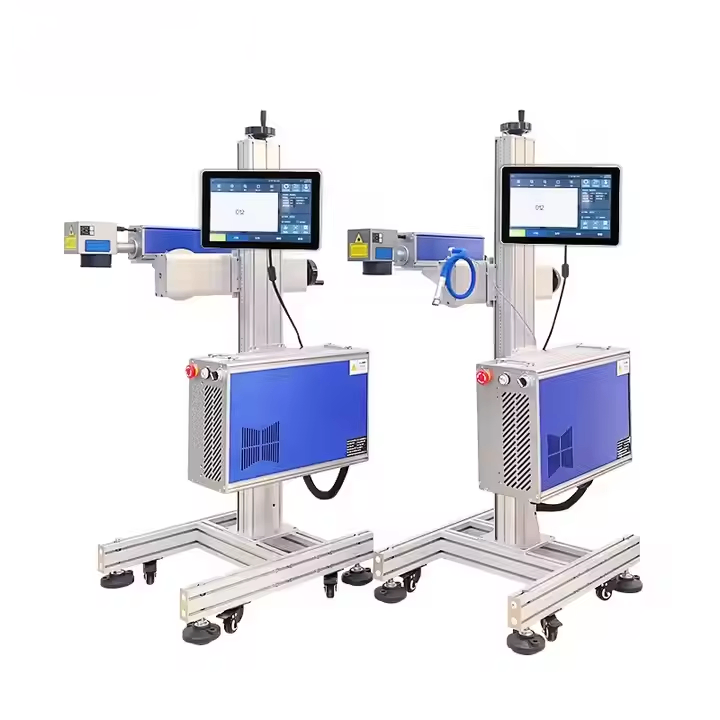
G-20 Fiber laser inkjet printer
the air-cooled build for a metal line:
- Fiber laser output options from 20W to 100W
- Permanent marks on metal without consumables
- Air-cooled design for continuous duty
- Marks hardware, electronics and metal parts
The mark is produced by the material rather than laid on top of it, which is why nothing is bought per part after installation. Fabrication and testing follow the route described in the ISO 9001 quality management standard, and the general background on the process sits in the reference entry for laser marking.
Line Questions
- Does air cooling limit the power available?
- It limits the share of the minute spent marking at full output. A code job in a normal workshop sits well inside that limit; a full-field raster does not.
- How often do the fins need cleaning?
- Set the interval by the room, not by the calendar. A dusty plant may need it weekly, a clean assembly hall monthly.
- Can the unit run unattended overnight?
- Only with a fume path and a fire-safe enclosure agreed by the plant, in addition to the thermal check.
Send the Duty Profile
Tell us the marking share of the minute, the ambient temperature and the material. We will say whether an air-cooled build holds that profile for a full shift, and what changes if it does not.
Next Steps
- Send three sample parts and your hourly marking estimate. We return a marked sample with the duty calculation.
- Start at the contact page, on +86 17625427465 or kuangcy@126.com. We reply within 24 hours.