Last Updated: 2026-10-30
One unreadable pallet code can hold a shipment at the gate for a day. An industrial printer portable enough to carry to the product solves that, once the buyer knows which three conditions it cannot meet and where a fixed head still wins.
Where an Industrial Printer Portable Pays for Itself
Most coding decisions assume the product arrives at a fixed point at a steady speed. That assumption fails in five places: sealed drums, pipe bolted to a wall, pallets on a forklift, oversized crates, and goods re-marked after a warehouse move.
In each case the mark travels to the product, not the other way round. A fixed head with a conveyor is cheaper where volume justifies it, and wrong where one drum has to be marked before a truck leaves.
That is the case for a unit you can carry, but only if the mark survives the surface it lands on. The checks come next.
Five Checks Before You Carry One Onto Site
| Check | Pass looks like | Fail looks like |
|---|---|---|
| Block inside a flat band | Code fits the drum panel | Code runs over a rib or a seam |
| Character height | Large block stays crisp | Small batch code blurs |
| Reach | Operator stands square to the face | Mark made at arm’s length overhead |
| Battery per shift | One pack covers the job | Second pack half used by lunch |
| Ink grade for the surface | Keys to steel, film or board | Smudges at the first thumb |
The second row catches buyers who assume a portable unit is a small printer. It is the opposite: a wide block forgives a change in hand speed that a 3 mm batch code amplifies.
The third row is a safety point too. A mark made overhead on a ladder gets skipped on the second shift.
The Three Limits That Decide Where It Stops
Volume is the first. Past a few hundred pieces a shift, fatigue shows in the last hour of codes before it shows anywhere else, and a fixed head on a conveyor is the honest answer.
Surface speed is the second. A hand-held unit fires on a fixed clock while the operator moves the head, so a steady sweep gives a clean block and a fast one gives a stretched block. Any line running continuously belongs to a triggered head, not a hand.
Repeatability is the third. A code reconciled against a production record needs a trigger that fires at the same point on every item, and a person cannot promise that in an audit.
What SHICAI Ships With a Portable Build
Our portable builds leave with a printed reference block at the character height the buyer sent, so a new operator compares against a known good mark instead of guessing. Spares and support are organised for export markets, and the inspection record follows the ISO 9001 quality management route.
In our export work the repeated surprise is ink, not hardware. A grade chosen in a warm office re-wets on a cold loading bay.
The Unit Most Site Jobs Land On
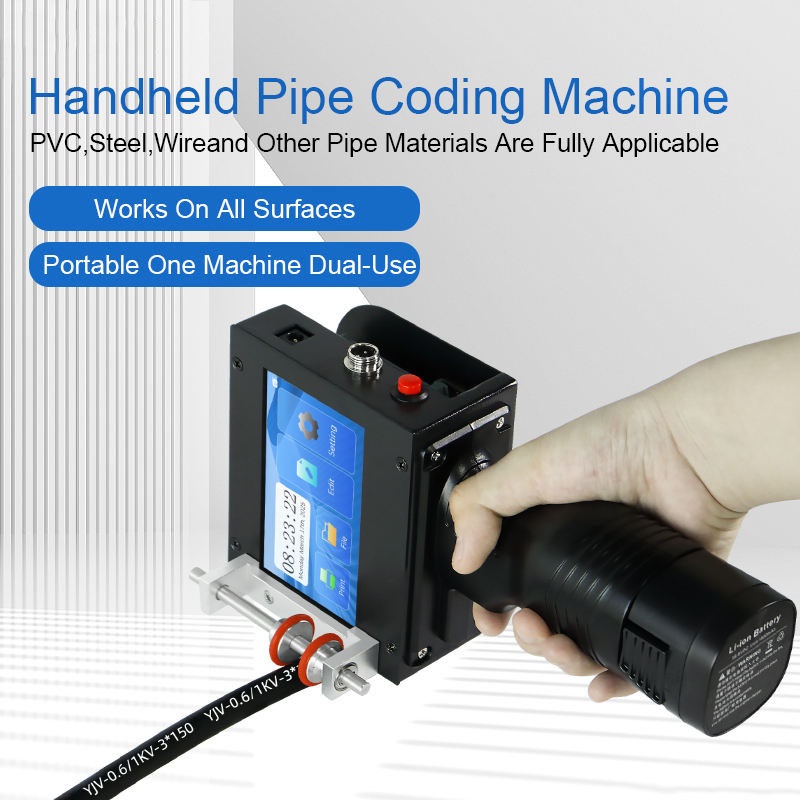
MX3-G Handheld Inkjet Printer
the carry-anywhere build for drums, crates and installed pipe:
- 600dpi print accuracy
- 2-12.7mm print height
- 4.3 Inch Touch Screen
- 2-5mm throw distance
- Available in 7 ink colors
The screen matters on site. A 4.3-inch panel can be driven with a glove on, and a job needing two hands waits for the one person who knows the menu.
Send a Photo of the Part in Place
- Can it mark installed pipe
- Yes, on the flat band of the pipe face, with the block kept off the curve.
- Is one battery enough
- For a normal shift at moderate volume, and a spare pack belongs in the kit for cold bays.
- Will it replace a conveyor line
- No. It handles the exceptions, and a triggered head keeps the run.
Send a photo of the part where it sits, the character height and the marks per shift. We will say whether an industrial printer portable or a fixed head is the honest answer, and which ink grade the surface needs, before anything is ordered. The mechanics behind the head are described under inkjet printing.
Next Steps
- See where hand-held work ends on a moving line: what 50 m/min hides.
- Start at the contact page, on +86 17625427465 or kuangcy@126.com. We reply within 24 hours.