Last Updated: 2026-11-04
Codes on bearings vanish in a parts washer. An inkjet printer for bearings has to survive oil film, solvent and a fixture that repeats to a tenth of a millimetre, so the buying questions are mechanical before they are electronic.
Why an Inkjet Printer for Bearings Is a Fixture Problem
A bearing reaches the marking station in a tray of fifty, already ground, oiled and wrapped in a rust preventative. Nothing about that presentation suits a coder built for a carton face, and the two failures that follow are predictable.
The first is spacing. Fifty pieces in a tray means a gap measured in millimetres, and a head needing a clear run of a hundred marks every second piece or none.
The second is the surface. A rust preventative is designed to stop a drop from keying, so a mark that looks complete wipes off at the first degreasing bath, after the pallet is wrapped.
Five Tests Before You Order
| Test | Pass looks like | Fail looks like |
|---|---|---|
| Fixture repeat | Fifty marks in the same spot | Two marks ten millimetres apart |
| Degreasing | Code survives the wash | Block fades to a smear |
| Character height | A serial number legible at reading distance | Digits closing up on a curved race |
| Cycle time | Tray cleared inside the takt | Queue forming at the station |
| Format | Heat number plus serial on one line | Two passes for one identity |
The first row decides the project. A bearing has no flat reference edge, so the fixture locates on the outer race or the bore, and one that locates on neither wanders across a hundred pieces.
The third row is a geometry argument. A race is curved, so the head meets it at a tangent, and the effective character height falls as the block moves away from that tangent point.
Oil, Solvent and the Grade That Holds
The grade has to cut through the film rather than sit on it. A solvent grade keys to a machined surface and then resists the wash, while a water-based grade on an oiled race beads and dries in droplets that read as a broken character.
Degreasing is the test nobody runs until the first claim. Take ten marked pieces through the actual wash the plant uses, at the actual temperature, and read them afterwards with the gauge the customer uses.
The hardware is described under ball bearing construction, and a build for export should carry inspection records under the ISO 9001 quality management route. Neither document predicts whether your rust preventative will hold a drop, which is what a wash test is for.
How SHICAI Runs a Bearing Trial
The trial we run for a bearing order starts with the tray rather than the head. A buyer sends twenty pieces in the oil the plant actually uses, and the returned photograph shows the block with the height written beside it, because the drawing rarely names that oil.
What goes wrong most often in those orders is the pitch. Buyers measure the part and forget the spacing of the tray it travels in, so a fixture gets designed around a gap the line does not offer.
The Head for Small Metal Parts
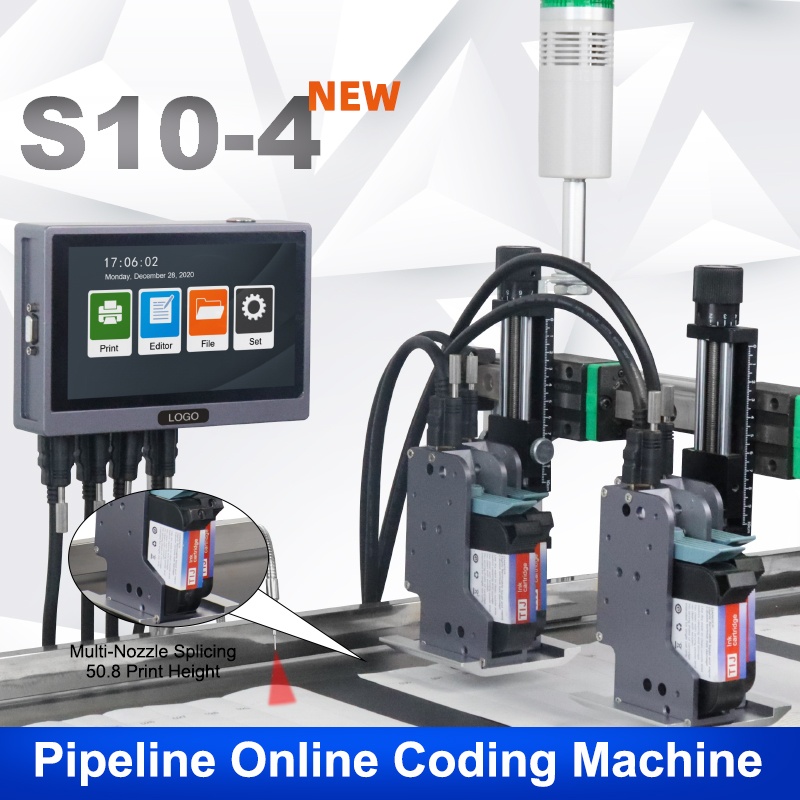
S10-4 online inkjet printer (standalone)
the four-head build for a heat number and a serial:
- 2-50.8mm print height
- 2-5mm throw distance
- Prints Chinese, English, date, QR code and barcode
- Marks metal, plastic, pipe, foam and carton
- Industrial Grade Standard Protective Body/Aviation Aluminum/Industrial Stainless Steel body
Two figures matter for a bearing tray. The 2 to 5 mm throw lets the head sit clear of a fixture that clamps from above, and the 50.8 mm height means a heat number and a serial fit in one pass instead of two.
Send Twenty Bearings, Oiled as They Run
- Will the code survive degreasing
- A solvent grade on a machined race does, and the wash test is the proof rather than the datasheet.
- Does a bearing need a fixture
- Every one does, because there is no flat edge to locate against.
- Can the head touch the part
- Better not: a 2 to 5 mm throw keeps the nozzle clear of oil mist.
Post twenty bearings in their production condition, plus the heat number format and the wash the plant uses. We will mark them, run them through a wash cycle and photograph the block, so the inkjet printer for bearings you order has met your oil already.
Next Steps
- How a wide block behaves on a soft surface: five crush tests on foam.
- Start at the contact page, on +86 17625427465 or kuangcy@126.com. We reply within 24 hours.