Last Updated: 2026-10-12
Push the belt and the code stretches before anyone notices. An inline inkjet printer high speed reel keeps its register only when the trigger reads the drive, so five rules settle the settings before the line is run flat out.
Why Speed Changes the Code Before It Changes the Print
A head fires on a trigger, not on a clock. When the belt accelerates, the window between trigger and print shrinks, and a code that looked clean at walking pace can stretch or slide at full rate.
That is why speed is a rewind problem as much as a print problem. The finished roll has to grow at the same rate the web is laid down, or tension wanders and the code moves across the label. A batch coding machine high speed line is specified around that match, and the record it produces is checked against ISO 9001 quality management in most buyer audits.
Three Fast-Reel Jobs
Three jobs run a reel line at speed:
- High-count label runs. Thousands of self-adhesive labels coded per shift, where a small drift turns into a reprint.
- Continuous tape and foil. Coated stock that runs without a pause, so any tension change shows as a wandering code.
- Serialised reels. Consecutive numbers that must stay in order as the line speeds up and slows for changeovers.
All three are judged on whether the last label of the shift matches the first, not on the peak speed the motor can reach.
Five Rules for an Inline Inkjet Printer High Speed Reel
Set these before the line is taken to full rate, because each one decides how the code behaves when speed changes.
| Rule | What it settles | What it prevents |
|---|---|---|
| Read the drive, not a clock | Trigger timing at any speed | A code that drifts when the line slows |
| Match rewind to web rate | Tension across the reel | A code moving across the label |
| Keep throw distance fixed | 2 to 5 mm from head to stock | Soft edges as the web lifts |
| Size the counter for the run | A 1 to 15 digit range | A reel that closes at the wrong count |
| Cap print height for the label | 2 to 12.7 mm | Clipped characters at the edge |
The first rule and the second carry most of the risk, because both involve speed changing after the job is set. A line run flat out on a fixed trigger will shift the code the moment the operator slows it for a changeover.
How SHICAI Holds Register at Speed
SHICAI sets rewind coders for label shops that run continuous stock, and each unit is scoped against the reel the customer ships rather than a default rate. The trigger is tied to the drive so the code holds its position as the line accelerates, and the rewind is matched to the web rate to keep tension steady.
On this line the frame carries stock from 20 to 300 mm wide and winds reels out to a 500 mm outer diameter. The print head runs a thermal foaming nozzle across a 2 to 12.7 mm height, and the label counter spans 1 to 15 digits so a run can be closed at any count the order calls for.
Speed Questions
- Does speed affect print quality?
- Only if the trigger is timed from a clock. When the trigger reads the drive, the code holds its position whether the line runs slow or fast.
- How fast can the reel run?
- Fast enough to hold register on continuous stock, provided the rewind is matched to the web rate. The rate you ship at matters more than the ceiling.
- Why does the code compress at high speed?
- Usually a trigger aimed at the trailing edge, which times the drop from the wrong point. Reading the drive instead of the gap fixes most of it.
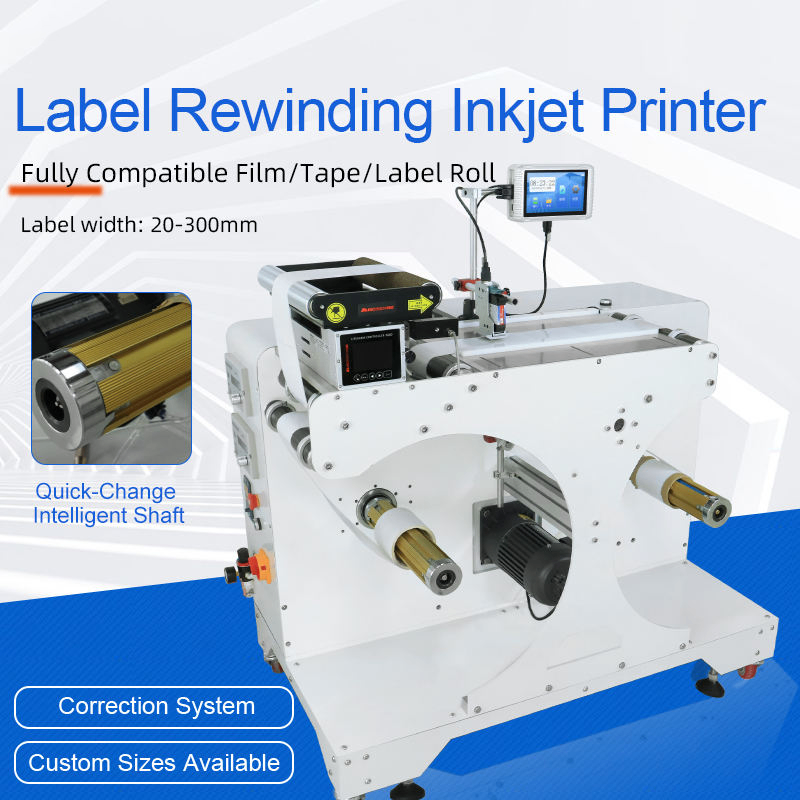
L10-FJ30 rewinding inkjet printer
a wide-web unit that holds register as the reel accelerates:
- Handles label widths from 20-300 mm
- 2-12.7 mm print height with TIJ thermal foaming nozzle
- Rewinds finished rolls up to 500 mm outer diameter
- Counts labels with 1-15 digit counter
Test Your Own Speed
- See the machine: L10-FJ30 rewinding inkjet printer
- Read next: the F320 rewinding machine, the narrower unit for short fast reels
- Talk to us: send your line rate and label pitch through our contact page. We reply within 24 hours with a trigger setup and a no-commitment quote.