Published 2026-09-10 · By the SHICAI technical team · Industrial marking & coding equipment guide
Last Updated: 2026-09-10
A coder that drifts out of alignment by the second shift costs more than the price gap between grades. An inline inkjet printer industrial grade is built for continuous conveyor duty, so codes stay in place from the first carton to the last. Five checks tell you whether the rating is real.
What Industrial Grade Actually Means on a Coding Line
The phrase gets used loosely, so it helps to define it by behaviour. A line-grade unit holds its print position while the conveyor runs for hours, keeps the gap inside the rated throw distance as brackets warm up and vibrate, and lets a sensor fire the head exactly once per product at full line speed.
Light-duty machines can print the same text in a showroom. What they cannot do is repeat it ten thousand times without an operator adjusting the head or clearing a mistrigger, and that difference is what a buyer is paying for.
Everything else follows from the enclosure, the mounting, and the service intervals. The checks below therefore ask about your conveyor, not the brochure.
Three Duty Cycles That Separate the Grades
Single-shift packing is the mildest case: a few hours a day, low dust, and almost any unit holds tolerance if the sensor is mounted rigidly.
Two-shift production separates the grades. Thermal drift, vibration, and repeated start-stop cycles punish a light bracket, and codes that were sharp in the morning drift off the mark by the afternoon.
Continuous and 24-hour lines remove the recovery time. Here the enclosure, the rated throw distance, and the cleaning interval decide whether the unit survives.
5 Buying Checks for an Inline Inkjet Printer Industrial Grade
| Check | What to confirm before you buy |
|---|---|
| 1. Duty rating | Continuous conveyor operation, not a duty cycle measured in hours per day |
| 2. Enclosure and mounting | Sealed against dust and washdown, with a bracket that resists vibration |
| 3. Trigger repeatability | Sensor fires once per product across the full line speed range |
| 4. Ink compatibility | A formulation list that covers your substrate, not a single general-purpose ink |
| 5. Service interval | Cleaning and consumable changes that fit your shift pattern |
Check 3 is the one buyers skip, and it is the one operators notice first. A repeatable trigger keeps the code in place; a marginal trigger turns every shift into a series of small corrections.
Substrate and line speed change the answer more than the grade label does. Send a sample and your conveyor details for a free fit check, and we will confirm the ink and the mounting before you commit.
Where SHICAI Fits
SHICAI builds industrial coding and marking equipment for packaging and production lines, from compact online units that fit narrow conveyors to multi-head arrays for wide case marking. Machines are configured to the code and the substrate rather than sold as a fixed package, and spares and support are organised for export markets.
Specifications are easier to judge side by side. The model below is a compact industrial unit built for continuous line work.
Recommended Model
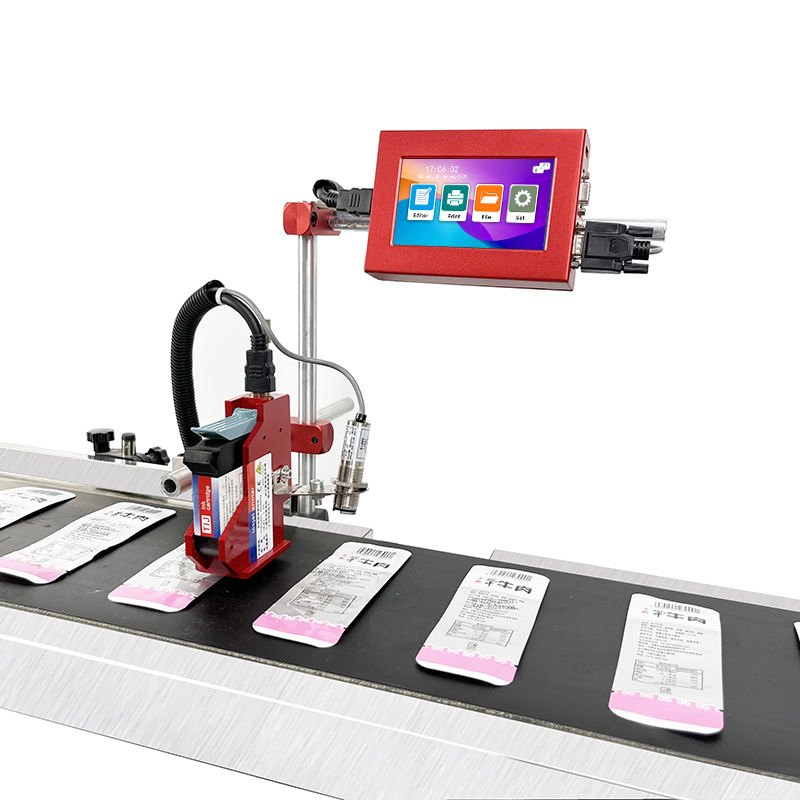
Y110 Online inkjet printer
- 300-600dpi print accuracy
- 2-12.7mm print height
- 4.3-inch touch screen
- Weighs only 3.0 kg
- food-grade/water-based/oil-based/42ml ink cartridge ink
A compact online coder that mounts on existing conveyors without a full frame, with 300 to 600 dpi print accuracy for date and lot codes and a print height adjustable from 2 to 12.7 mm. Food-grade, water-based, and oil-based cartridge inks cover the surfaces a mixed packing line runs.
Frequently asked questions
- Does industrial grade mean the print head lasts longer?
- It means the head is rated for continuous conveyor duty and the chassis keeps its alignment under vibration. Operators usually see the difference as stable codes across long shifts rather than as a longer head life on paper.
- Can a compact unit still be industrial grade?
- Yes. Compact refers to the footprint, not the duty rating. A small online coder with a sealed enclosure and a rated gap suits narrow conveyors where a full frame will not fit.
- What should I test before signing off a unit?
- Run a full shift at production speed on your real substrate, confirm the trigger fires once per product, and check that codes survive the handling step that follows.
Next Steps
- See the Y110 Online inkjet printer for print height and ink options.
- Read related solution guides on online coding on production lines.
- Share your conveyor details for a free fit check. No commitment, reply within 24 hours.
Learn more about inkjet printing and ISO 9001 quality management.