Last Updated: 2026-09-30
A code read at three meters fails for reasons a bench inspector never sees. A large character inkjet printer is chosen for that distance: coverage tall enough to read,
a stand-off wide enough for an uneven face, and an ink route that keeps running away from a fixed line. Four jobs make the case.
What Makes a Large Character Inkjet Printer Different
A large character inkjet printer is a volume problem. Covering a tall block means splicing heads or firing many
nozzles at once, so the machine lays down considerably more ink per meter of product than a date coder does. That lengthens drying, widens the tolerance needed for a steady pass and puts a ceiling on how fast the line can move before edges begin to bleed.
The mechanism behind it is drop on demand: droplets are fired only where the code needs them, which is why coverage can be tall without a continuous ink stream. The Wikipedia article on drop on demand printing covers the principle in more detail.
Four Jobs It Fits
| Job | What the mark has to do | What the machine must carry |
|---|---|---|
| Case and carton faces | Be read across a loading bay without a scanner | Tall coverage, 25 to 60 mm on the portable build |
| Timber, pipe and profile | Hold placement on a long, uneven surface | A working gap wide enough for the stand-off |
| Pallet and crate marking | Mark goods that cannot be lifted onto a table | Hand-carried weight, 1.6 kg with ink and battery |
| Yards without fixed services | Run where there is no air line | Built-in air pump feeding ink without external supply |
What Each Job Asks
Read the four rows above as a filter rather than a wish list. Where the mark has to be scanned as well as read, the human figure and the symbol have to share one layout, and the GS1 application identifiers fix what sits inside the code. Where goods travel outdoors, the grade matters more than the height, because a tall mark that rubbers off at the customer is a taller problem.
How SHICAI Specifies It
SHICAI builds coding and marking equipment for export markets, and on a tall block the honest first question is how tall and on what. We specify from that answer: coverage, grade, stand-off and whether the site has compressed air at all. A sample of your own board or pipe is printed and inspected before anything is quoted, and where an inline frame would serve better, we say so. That order is recorded because a large character inkjet printer is sized from your board, not from a
catalogue page.
Large character questions
- How tall does a large character mark need to be?
- Tall enough to be read where it is read. A block inspected at a loading bay is a different problem from one inspected on a bench, which is why 25 mm and 60 mm are separate conversations rather than two settings on one machine.
- Does a large character coder need different ink?
- It needs the grade the surface demands, and more of it. A tall block lays down more ink per meter, so the drying window before the next handling step is what decides whether the mark survives.
- Can large characters be printed without a compressed air supply?
- Yes, where the machine carries its own pump. A built-in air pump feeds ink without an external supply, which is what allows the unit to be used away from a fixed line.
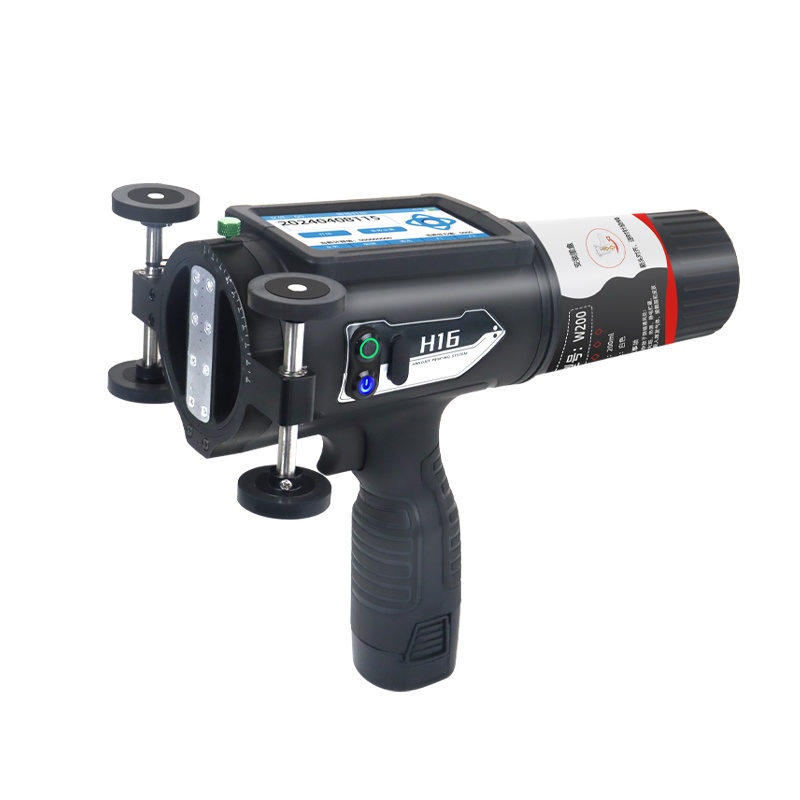
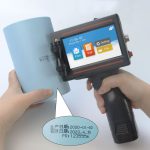
H16 Handheld inkjet printer
the self-contained large character build:
- Prints 25-60 mm large characters via DOD drop-on-demand
- Built-in air pump feeds ink without external supply
- Weighs only 1.6 kg with ink and battery
What to do next
- See the product: H16 Handheld inkjet printer
- Read next: what to verify on a barcode printer factory, which covers the code side of the same block.
- Talk to us: send the height you need and a photo of the surface through our contact page for a free sample print and a written parts list.