Published 2026-09-05 · By the SHICAI technical team
Last Updated: 2026-09-05
Faded date codes on shampoo bottles get whole pallets returned by retailers who scan at receiving. An online inkjet printer for bottles solves this by printing on each container as it passes the conveyor. The challenge is knowing which specs actually matter for bottle coding before you spend.
Why Bottle Coding Is Different
Bottles add two variables that flat cartons do not: curvature and condensation. A printhead set for flat cardboard will skip on a curved plastic bottle, and condensation on glass makes ink bead up and fail adhesion tests.
The fix is a TIJ 2.5 printhead mounted at the correct angle, with a fast-drying ink formulated for the specific bottle material. Line speed, trigger timing and print distance all complete the setup that keeps codes readable.
But knowing what makes bottles different is only step one. The real cost is in what buyers overlook when specifying the unit.
Where Bottle Coding Earns Its Keep
Plastic bottle lines for shampoo, detergent and beverage are the most common fit. A 120 m/min rated speed matches most filling line outputs, and the trigger sensor fires per bottle without missing gaps.
Glass bottle lines for pharmaceuticals and cosmetics need a different ink formulation. The same printhead works, but the ink must bond to glass and resist alcohol wiping in the quality control lab after filling.
Aluminum bottle lines, growing in beverage packaging, round out the applications. The ink adheres to coated aluminum at the 2 to 5 mm print distance.
Each material changes the ink choice and the cost, and that is where overspending starts.
How to Choose an Online Inkjet Printer for Bottles
The right unit does not need to be the most expensive on the market to perform well. Use this table to separate cost drivers from actual needs before you request a quote.
| Cost factor | What drives the price up | What to do instead |
|---|---|---|
| Extra printheads | Four heads when two cover your code height. | Match head count to your tallest code plus 20 percent margin. |
| Premium ink | Paying for universal ink when you run one material. | Specify ink for your top bottle material only. |
| Overrated speed | Paying for 200 m/min when your line runs 60. | Buy rated to your line speed plus 30 percent headroom. |
| Unused features | Paying for WiFi sync when a cable works. | List your integration needs before requesting a quote. |
Pricing depends on your bottle material and line configuration. Request a quote tailored to your setup, no commitment.
Once you know what to skip, the question is who builds a unit configured for bottle lines.
Where SHICAI Fits
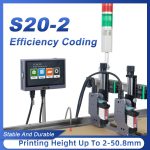
SHICAI builds the S20 series for export with a 12-month warranty. The S20-4 splicing configuration carries four TIJ 2.5 heads rated to 120 m/min, with a 2 to 101.6 mm print band that covers most bottle code heights.
Ink for plastic, glass and coated aluminum is stocked for export, along with cartridges and spare heads for your region. The S20-4 splicing model is what we recommend for bottle lines, and the details follow.
A Splicing Pick for Bottle Lines
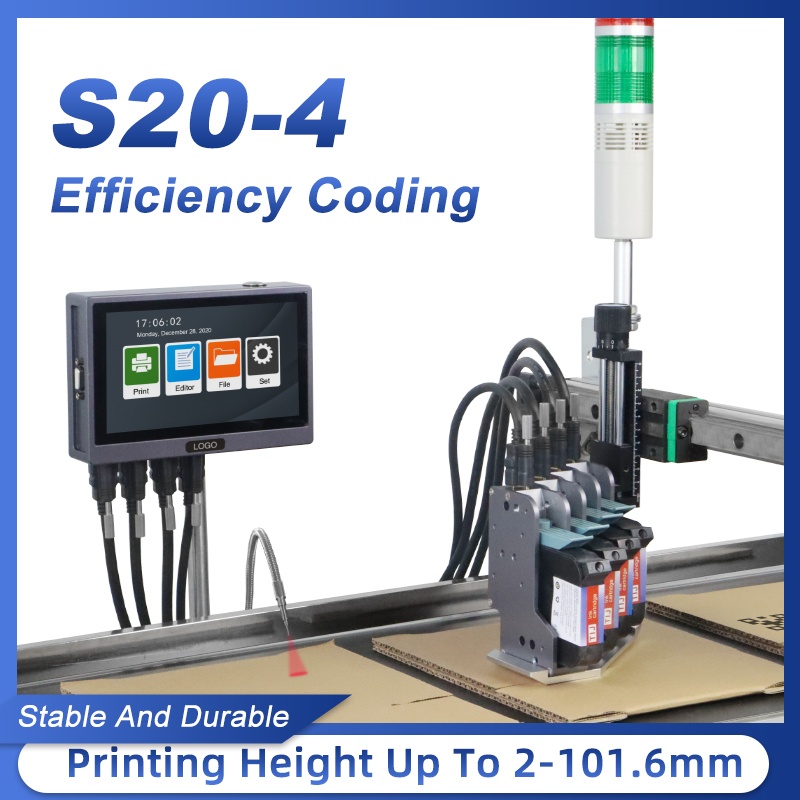
S20-4 online inkjet printer (splicing)
A four-head TIJ coder in splicing configuration, rated to 120 m/min with a 2 to 101.6 mm print band. It suits bottle lines that need wide code coverage and integration with an existing conveyor setup.
- Prints up to 120 m/min line speed
- 2 to 101.6 mm print height across 4 heads
- Codes on plastic, glass and coated aluminum
If you are comparing models, the questions below address what bottle line buyers ask most.
Frequently asked questions
- Can one online inkjet printer for bottles handle both plastic and glass?
- Yes, with the right ink. The S20-4 works on both, but you need fast-drying ink for each surface. Test both before ordering.
- What print height does the S20-4 cover?
- The S20-4 prints a 2 to 101.6 mm band across four TIJ 2.5 heads. That covers most bottle date codes, batch numbers and QR codes with room to spare.
- Does the splicing configuration need a separate conveyor?
- No. Splicing means the printer integrates with your existing conveyor line. The sensor trigger and mount are included, so you connect to your current setup.
Next Steps
- See the S20-4 splicing model for full specifications and options.
- Read related solution guides on bottle and packaging line coding.
- Request a free sample print on your bottles. Reply within 24 hours, no commitment.
Learn more about inkjet printing and ISO 9001.