Published 2026-09-03 · By the SHICAI technical team · Industrial marking & coding equipment guide
Last Updated: 2026-09-03
The brochure says 100 meters per minute; your line says otherwise. An online inkjet printer at high speed is limited by five physical factors that no spec sheet puts on the front page, and buying against the brochure number is how lines end up with smeared codes at half the rated pace. Here is what sets it.
What Speed Ratings Really Mean
A rated speed is measured under friendly conditions: easy substrate, generous character height, short code. Change any one and achievable speed drops. The rating is a ceiling, not a promise; plan backwards from the code you actually print at the speed your conveyor runs.
That matters because coding is rarely the slowest station on a line, until it is. A printer that cannot keep pace gates the whole line, and every slow minute is lost throughput for everything behind it.
The 5 Real Limits on Coding Speed
1. Drying time, not printing time. The head can lay down ink faster than the ink can set. If the product reaches the next station before the code dries, the limit is chemistry, not the rating. Fast-drying formulations exist for exactly this reason.
2. Character height and drop count. Tall codes need more drops per character, consuming the head’s firing budget. A printer holding 80 m/min on a 5 mm date code may drop well below that on a 15 mm batch-plus-logo code.
3. Trigger accuracy at speed. At higher belt speeds, trigger-to-fire delay and encoder resolution decide whether the code lands where it should. Poor synchronization shows up as creeping placement long before missing codes.
4. Duty cycle and thermal load. Sustained high-speed running is a thermal problem for the head. A printer rated for bursts may need pauses when the line runs flat-out all shift; industrial-grade builds handle this, light-duty builds do not.
5. Substrate and ink pairing. Glossy film, greasy surfaces, and dusty cartons each pull speed down as drop placement and absorption get harder. Sample printing on your real material is the only speed test that counts.
A Checklist for Buying Speed Honestly
| Check | Ask this |
|---|---|
| Rated vs realistic | What speed on my substrate, my code, my ink? |
| Duty cycle | Continuous rating, or burst with cooldown? |
| Encoder input | Does it track speed changes on the fly? |
| Drying window | Seconds between print and next handling step? |
| Sample run | Can we test at our actual line speed? |
Take this list to your next supplier conversation. A builder who answers all five with numbers, and offers a sample run at your speed, can be trusted with the throughput question. One who repeats the brochure figure is telling you they have not run your case. The same list is how to judge any online inkjet printer high speed claim: evidence at your speed, or it did not happen.
Where SHICAI Fits
SHICAI builds industrial coding and marking equipment and ships online inkjet systems to production lines worldwide. The high-speed story is told the way this guide recommends: speeds stated for specific codes and substrates, sample prints before purchase, and multi-head platforms that scale width and throughput together rather than pushing one head past its duty cycle. Spares and support are organized for export markets.
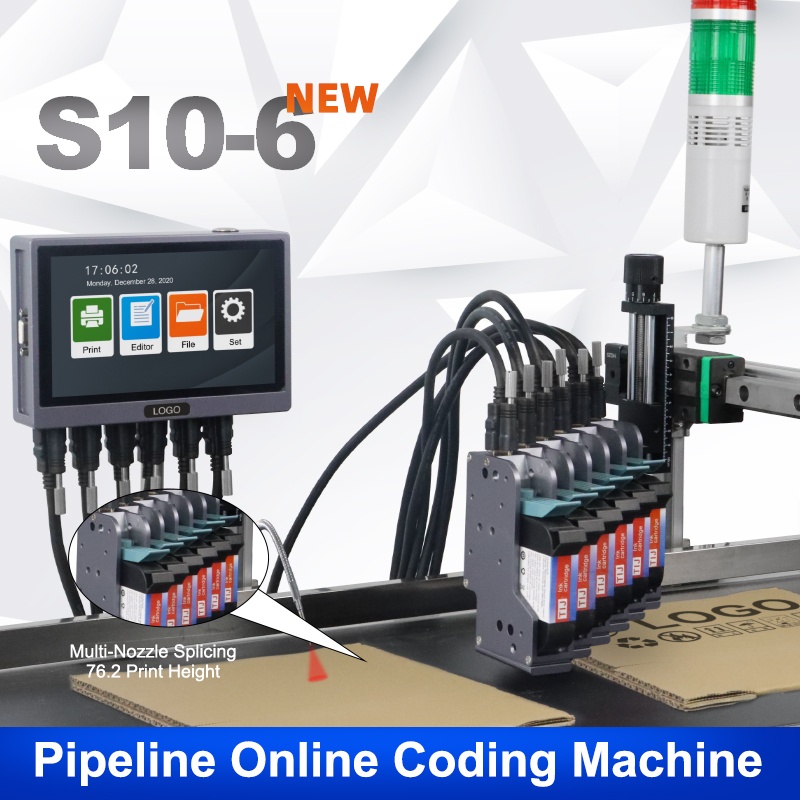
One model worth a look: S10-6 online inkjet printer (splicing)
A six-head splicing platform for wide, fast coding: heads tile to cover up to 76.2 mm of print height in one pass, keeping full-width codes crisp at production speed on large cartons, boards, and profiles.
Frequently asked questions
- What line speed can an online inkjet printer actually hold?
- Most industrial online coders hold clean codes between 40 and 100 meters per minute, but the honest answer depends on character height, ink, and substrate. A sample run at your speed settles it.
- Does a six-head printer print six times faster?
- Not exactly. More heads mainly buy print width and height in one pass, keeping large codes fast, and spread thermal load so duty cycle holds over a full shift.
- How do I stop codes smearing at high speed?
- Match the ink’s drying time to the gap between printing and the next handling step, and verify with a smear test at your real belt speed.
Next Steps
- See the S10-6 six-head splicing model for print width and configuration details.
- Read related solution guides on coding and marking applications.
- Send your substrate for a free sample print at your line speed. No commitment, reply within 24 hours.
Learn more about inkjet printing and ISO 9001 quality management.