Published 2026-09-04 · By the SHICAI technical team · Industrial marking & coding equipment guide
Last Updated: 2026-09-04
When a carton needs a code band taller than one print head can cover, most lines slow down or add a second station. A spliced online inkjet printer with conveyor mounting closes that gap in a single pass. Here are the four splicing facts that decide whether a two-head S20-2 belongs on your line.
What Splicing Actually Means
Splicing is not a bigger nozzle. The S20-2 splicing configuration joins two 25.4 mm-class TIJ head modules side by side, so the pair prints a combined 2-50.8 mm band in one pass over the conveyor. One controller treats them as a single system, keeping the message synchronized across the full width.
The four facts below change a buying decision more than speed or price, because splicing is decided by pass width, mounting and changeover, not by throughput alone.
Four Splicing Facts That Matter
- Splicing widens the pass, not the pitch. Heads run in parallel across the conveyor, so the band gets taller while product pitch stays the same.
- One controller drives both heads. Message changes and shift data are set once and apply to the whole band, so there is no second station to reconcile.
- Mounting is the real project. Brackets, clearance and the trigger sensor decide whether splicing fits your line.
- It earns its cost on wide or tall codes. If your tallest code fits one head, splicing is optional; if it does not, it removes a second station or a slow pass.
Where Spliced Heads Earn Their Keep
Splicing earns its place on batch packaging lines where products keep moving and codes must stay legible at speed. The 2-50.8 mm band covers wide cartons, cases and stacked pouches in one pass, and the spec sheet lists metal, plastic, pipe, foam and carton among printable surfaces.
Food and pharmaceutical packers use it the same way: one pass prints date, batch and expiry data across the message band, with room left for QR codes or serialization when retailers or regulators ask.
One trigger sensor fires both heads from the same product position, so a spliced line does not drift into misaligned codes the way two independent printers can after a changeover.
Sizing an Online Inkjet Printer With Conveyor Mounting
Run the same comparison we use in pre-sales: fill in your code size and line speed, then read the row that matches your plant.
| Question | Standalone S20-2 | Spliced S20-2 |
|---|---|---|
| Code band | Single-face codes up to 50.8 mm | Wide or tall bands up to 50.8 mm in one pass |
| Floor space | Own frame beside the line | Brackets over the existing conveyor |
| Changeovers | Easy to move between stations | Stays mounted; message changes by software |
| Best fit | Mixed products, frequent moves | Dedicated high-volume packaging lines |
Both S20-2 configurations share the same 600 dpi engine rated to 120 m/min; the choice is deployment, not capability. A supplier should be able to quote either configuration off that engine.
Where SHICAI Fits
SHICAI builds the S10 and S20 online families on one cartridge-based TIJ platform, so the spliced S20-2 shares 42 ml cartridges, the 7-inch touch screen and WiFi and Bluetooth data sync with the rest of the line.
A Spliced Model for Line Integration
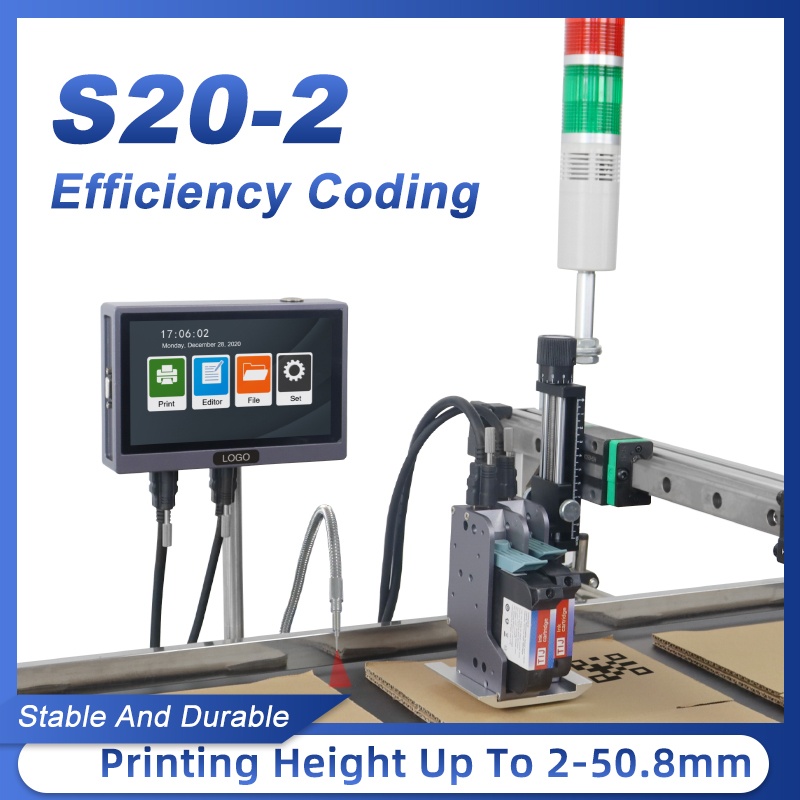
S20-2 online inkjet printer (splicing)
Two TIJ heads over the conveyor, a 2-50.8 mm print band in one pass, and a 7-inch touch screen for message control. The configuration to choose when a mid-size line wants wide-format coding without a second station.
- Prints up to 120 m/min
- 2-50.8mm print height
- 7-Inch Touch Screen
Frequently asked questions
- Is a spliced S20-2 two separate printers?
- No. Two TIJ head modules run from one controller as a single system, mounted side by side so the message band prints in one pass instead of two stations.
- Can splicing go onto an existing conveyor?
- Yes, that is the point. The heads mount on brackets above the conveyor with a sensor trigger, so most lines avoid a rebuild; confirm clearance and mounting points first.
- Standalone or splicing for the S20-2?
- Standalone suits single-face codes and changing layouts; splicing suits a wide 50.8 mm band or integration into an existing line without adding floor space.
Next Steps
- See the S20-2 splicing model for specifications and mounting options.
- Read related solution guides on online coding and wide-format marking.
- Send your code size and line speed for a free fit check. No commitment, reply within 24 hours.
Learn more about inkjet printing and ISO 9001 quality management.