Last Updated: 2026-10-11
A sheet that feeds crooked takes the code with it. A paging machine settles that before printing starts, separating stacked stock one piece at a time and holding each sheet beneath the head. Five checks decide whether it keeps that rhythm at production speed or only on a bench.
What a Paging Machine Has to Solve
A stack does not behave like a belt. Sheets arrive overlapped, fanned or lightly stuck, and a head that fires on a fixed timer will code two pieces at once or skip one.
That failure is easy to misread. A double-coded sheet looks like a print problem, so an operator adjusts the head while the fault sits in the feeder. The feed has to separate and time each piece before print quality is worth discussing, and a feeder that lifts the top sheet while a gate holds the rest follows the principle set out in general conveyor system references. The traceability a code supports is audited against ISO 9001 quality management.
Where the Feeder Earns Its Place
Three jobs account for most paging work in an export packing room:
- Tags and small labels. A fan of 50 to 216 mm tags is pulled apart, coded and stacked again without an operator lifting each piece.
- Flat cartons and mailers. Flat stock runs through a friction feeder so a date or a batch block never lands on a fold.
- Cards, coupons and sachets. Short runs where placing every piece by hand would cost more than the coding itself.
In each case the machine replaces a hand, not a head, and its value is the rhythm it holds across a shift.
Five Checks Before the First Run
Set the feed before the print head, because a feed fault shows up as a print fault from the operator’s chair. This order holds for any pagination machine, whatever head sits over it.
| Check | What good looks like | What a bad setting shows |
|---|---|---|
| Sheet pitch | One piece per cycle, no overlap | Two sheets coded, or one left blank |
| Friction gap | An even pick from the top of the stack | The sheet under it dragged along |
| Paging width | Set inside 8 to 200 mm for the stock | The sheet skews as it enters |
| Trigger position | Placed on the leading edge | The code begins off the sheet |
| Speed match | Feed rate suited to the line | A code stretched or squeezed |
Paging width and paper weight travel together, and the right friction gap depends on the stock rather than the model, which is a question best settled with a sample.
How SHICAI Sets a Paging Job
SHICAI builds paging frames for export packing rooms, and each unit is set against the stock the customer actually runs. Head height is fixed to the tallest piece, the friction gap is tuned to the paper weight, and the trigger is placed on the leading edge rather than the gap between sheets.
The paging machine on this line pairs a 4.3-inch touch screen with a 2 to 12.7 mm print height and a 2 to 5 mm throw distance, so the head clears a stack that is not perfectly flat. The frame weighs 16.6 kg and takes ink in seven colours.
Questions From the Packing Floor
- Does the unit print, or only feed?
- Both, in one frame. The feeder and the head share a trigger, so the code is laid down the moment a sheet is free rather than after the stack has been sorted.
- What stock can it separate?
- Tags from 50 to 216 mm on the tag build, and flat sheets up to the width the gate is set for. Heavy board and thin film need a different friction setting, not a different machine.
- Why does the code land off centre?
- Nine times in ten it is the trigger, not the head. A gap-triggered sensor waits for the trailing edge and times the drop from there, so any change in sheet length moves the code along with it.
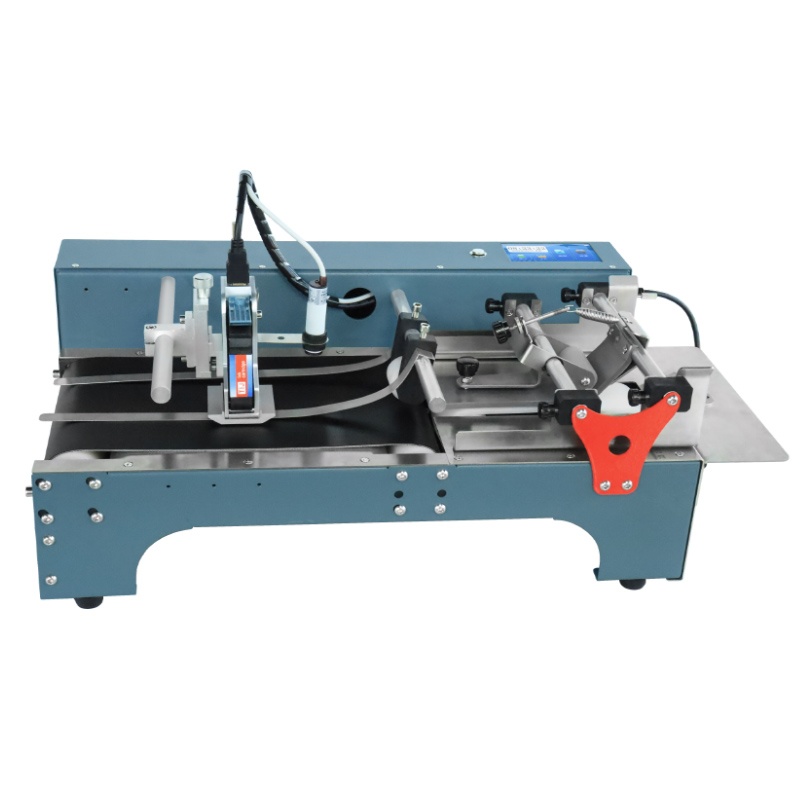
T110-FY Mini Paging Machine
a compact feeder and head for tag and carton work:
- 2-12.7mm print height
- Weighs 16.6 kg
- Available in 7 ink colors
Check Your Own Stock
- See the machine: T110-FY Mini Paging Machine
- Read next: what a coding conveyor adds to a paging setup, which decides where the head sits
- Talk to us: send a sample stack through our contact page. We measure the stack, then reply with the gate width and friction gap it needs.