Published 2026-09-22 · Last Updated 2026-09-22 · SHICAI technical team · Coding and marking equipment guide
A PIJ printer is the least understood of the four coding technologies, and the gap shows up at the specification table: buyers compare print height on paper, then find that the ink system, not the head, sets the running cost. Here is how piezo, thermal, continuous and laser coding actually differ.
What a PIJ Printer Changes on a Line
A piezo printhead uses a ceramic element that flexes under voltage and pushes ink out of the nozzle. Nothing boils and the ink is never heated. Thermal inkjet does the opposite, boiling a bubble to fire a drop, which is why thermal heads are cheap.
The second difference is ink freedom. A piezo head takes solvent formulations and lays down a tall block without stitching passes: 3 to 71.8 mm at 180 dpi on the P70 head.
Where that matters most is the substrate.
Where Piezo Beats Thermal
Tall codes on board. A thermal head stitches anything above its height limit, so a 50 mm panel becomes a patchwork. A piezo head prints 3 to 71.8 mm in one pass.
Coated stock. Film, laminated labels and varnished cartons need ink that keys into a sealed surface.
Lines that start and stop. A boiling chamber clogs when a coder sits idle, so job shops pay in cleaning time.
The decision still runs against three alternatives.
Four Technologies, One Table
Read across your substrate first, then down your production reality.
| Technology | How it marks | Substrate it favours | Watch for |
|---|---|---|---|
| TIJ, thermal | Heats a bubble | Porous board, plain carton | Ink menu tied to the head |
| PIJ, piezo | Ceramic element pushes the drop | Board, plastic, film, coated | Highest head cost in inkjet |
| CIJ, continuous | Charged drops deflected | Curved, uneven or fast surfaces | Solvent and make-up set running cost |
| Laser | A focused laser alters the surface | Metal, glass, coated board | Permanent; not every polymer takes it |
Five checks turn that into a decision.
- Substrate first. Porous board, sealed film, a curved bottle and bare metal point at different rows.
- Print height second. Measure the tallest block you will ever print, barcode included.
- Running cost third. Ink alone, ink plus solvent and make-up, or no consumable at all.
- Speed and mounting fourth. A moving line needs a fixed head and a trigger; a static part is placed by hand.
- Service access last. A coder that stops a line for three weeks costs more than the gap between two technologies.
Those checks narrow the field. What is left is who configures the machine.
How SHICAI Specifies a PIJ Printer
SHICAI runs a full inkjet range, thermal, piezo, continuous and large character. The piezo unit is specified when a customer needs more than 13 mm of print height or a barcode block on coated stock. The P70 head reaches 71.8 mm at 180 dpi and runs at 1 to 100 m/min.
Buyers inside a documented quality system, such as the framework in the ISO 9001 overview, ask three questions: does the mark repeat, is the ink documented, and does a spare arrive without a line stop. This reference on inkjet printing covers how each head forms a dot.
The Build
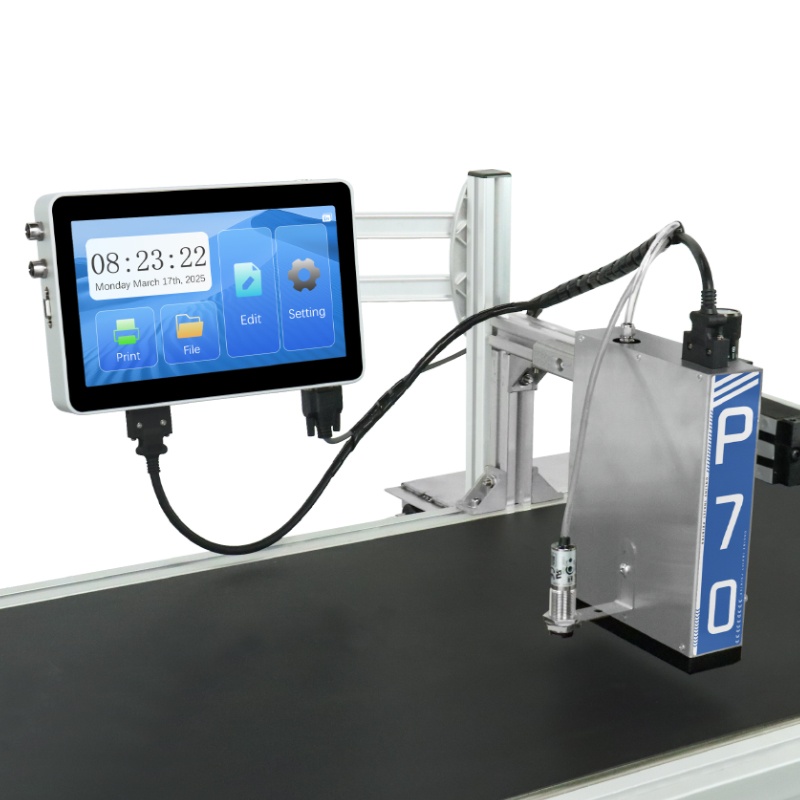
P70 Online inkjet printer
is the piezo build behind this class:
- Print speed 1-100m/min
- 180dpi print accuracy
- 3-71.8mm print height
Configuration decides the quote, because head count, print height and ink are chosen together. Send the code and the substrate, and the answer comes back as a specification.
Selection Questions
- Where does a PIJ printer beat a thermal head?
- Above roughly 13 mm of print height and on coated stock. A thermal head stitches tall blocks; a piezo head prints them in one pass and accepts a wider ink menu.
- Is laser marking cheaper than inkjet on metal?
- On metal the question is permanence, not cost. Laser marking uses no consumable and cannot be wiped off. Inkjet wins where the part cannot take a laser mark.
- What decides running cost between piezo and continuous?
- Consumables. A piezo unit runs on ink and the occasional head; a continuous unit adds solvent and make-up to hold the ink at viscosity.
Where to Go From Here
- See the machine itself: P70 Online inkjet printer.
- Read next: the five checks that decide a piezo build.
- Send the substrate, the print height and the ink you need to +86 17625427465 or kuangcy@126.com. We print your code on your own material and return the sample free, with a written quote inside 24 hours.