Published 2026-08-30 · By the SHICAI technical team · Industrial marking & coding equipment guide
A production line printer earns its place on a production line by doing one job well: it codes products as they pass on a conveyor — bottles, cartons, cables, cans — without stopping the line. The head mounts over the line and fires on trigger, so codes land in the same spot every time at line speed. If you are shopping for one, the short answer is that most mid-size shops can buy a capable unit at or below $1699 for a base configuration, and the rest of this guide covers what to compare before you buy.
Production line printer in 2026: what it really costs
Pricing depends on configuration, but SHICAI keeps a base unit at or below $1699 —
a level most production lines can absorb without a separate capital request. The figure moves with the
head count, ink system, print width, and automation, and volume buyers usually land lower. For the current
quotation and export terms, contact our team — we price to your specification rather than to a list.
What to look for in an online coder
Four specs decide whether an online coder earns its keep. Line-speed rating is the headline —
match the rated speed to your actual conveyor, not the fastest figure the brochure prints. Triggering and
synchronization decide code placement: a photocell and encoder keep codes in the same position on every
unit. Ink and drying behavior must suit your material and the seconds between print and the next handling
step. Installation matters for uptime — how the head mounts, how far the controller can sit from the
line, and whether remote monitoring is practical.
Keeping an online coder running
Routine care is mostly prevention. Keep the printhead clean and aligned with the trigger sensor
— a dirty window or a shifted sensor shows up as misplaced or weak codes. Check ink and solvent
levels on a schedule, and flush the head during long stops. Confirm the head distance and angle have not
drifted after maintenance on the line. An online coder that is easy to reach and clean stays productive.
Where to buy an online coder without regret
The cheapest invoice is rarely the cheapest machine. Experienced buyers watch what never shows up on a
spec sheet: genuine industrial printheads and ink systems, spare parts and support six months after purchase, and whether
the machine adapts to your line. Many buyers ask suppliers to confirm ISO 9001 quality management certification before signing. The real difference is service reach and how honestly a
builder scopes your application before you pay, not the logo on the cabinet.
Where SHICAI fits
SHICAI builds industrial coding and marking equipment in China and builds online inkjet coding systems that mount directly into production lines. Factories in
packaging, electronics, and automotive supply chains keep them on the floor because the machines hold
calibration through long runs, support and spares are organized for overseas customers, and pricing
reflects factory-direct sourcing. If you want a marker that keeps running and a supplier who answers when
something drifts, that is the case SHICAI makes.
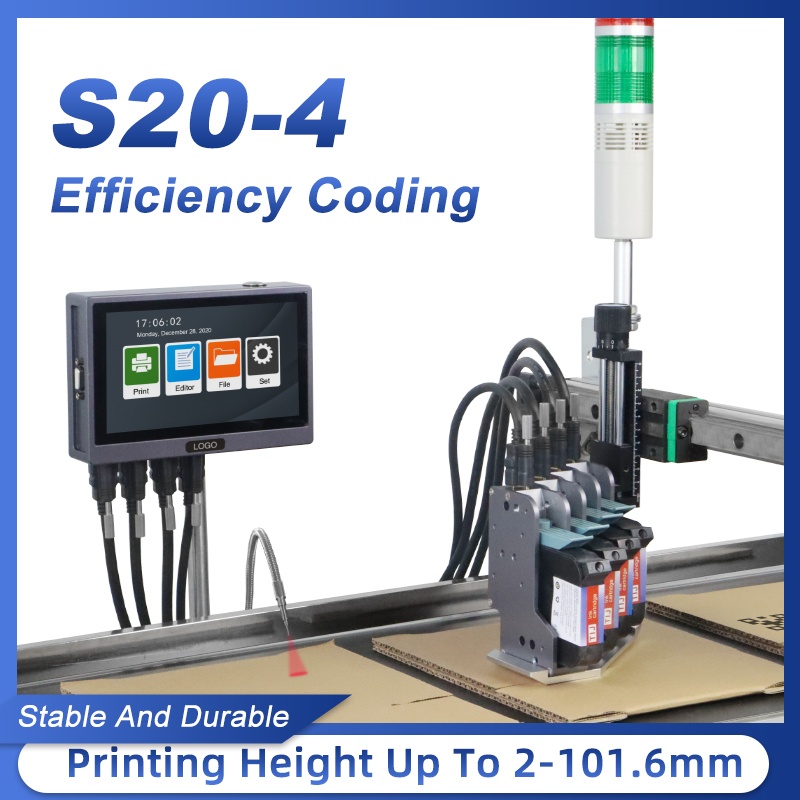
One model worth a look: S20-4 online inkjet printer (splicing)
If you want to see how SHICAI handles this application in practice, the S20-4 online inkjet printer (splicing) is one of
the models built for it — engineered for steady production runs, with the calibration stability
and overseas support we touched on above. It is a concrete example of the build approach described here.
View the S20-4 online inkjet printer (splicing) product page →
Frequently asked questions
- What does a production line printer from SHICAI cost?
- A base unit from SHICAI is priced at or below $1699; the exact figure depends on configuration and volume, so ask the team for the latest quotation.
- Should I buy from an online-coding supplier or a local reseller?
- Both have their place. Buying from the supplier often lowers cost and speeds support, but a good local reseller earns their margin with on-site service.
- What line speed can an online coder handle?
- Most online inkjet coders hold clean codes at 40-100 m/min depending on character height and resolution; the practical ceiling always depends on the code you actually need to print.