Published 2026-09-16 · Last Updated 2026-09-16 · SHICAI technical team · Coding and marking equipment guide
A QR code that repeats across a pallet proves nothing. A QR code printer worth specifying for brand protection emits a different symbol per unit, so a copied pack becomes two packs claiming one identity. Four checks separate the useful machines from the ones that only print pictures.
What the Code Has to Prove
A QR code printer earns its place in brand protection through data, not artwork: counterfeit and grey-market diversion are caught by records. Each unit needs its own identity, held in a record that links it to the order, the line and the shipment. Scanned at distribution or by an end customer, the identity either matches the record or it does not. Machine vision verification at the print station can check a printed code for presence and readability; uniqueness is a data and record problem, which is why the coder has to accept per-unit values from your system rather than repeat a stored message.
That makes the interface the decision point, not the print head. A coder that takes a serial stream over the network can run unique codes at line rate. One that holds a fixed message cannot, however sharp its marks.
Where Unique Codes Pay
Pharma and health packaging, where an unreadable or duplicated identity stops a consignment. Branded consumer goods sold through distributors, where the same code read at two retailers exposes market diversion. And electronics and hardware, where the identifier is applied direct to the part as well as to the carton, the practice covered in the public reference on direct part marking.
If your market has no scanning habit yet, the record is still worth building first, because the value arrives when a claim is made and nobody can prove which pack was legitimate.
Four Checks Before You Specify
| Check | Ask it this way | Why it matters |
|---|---|---|
| Variable data source | Does it accept dynamic serial-port or database data, or only a stored message? | Unique codes come from your data, not from the machine menu |
| Symbol quality at size | Can it hold a scannable module size at the print height you have room for? | A QR that will not decode at real pack size is decoration |
| Read-back at station | Is each code verified after printing and bad units rejected? | Otherwise the error is discovered by the customer |
| Substrate and ink | Is the ink matched to the surface, and does it survive the handling that follows? | Smudged identity is as useless as a missing one |
How SHICAI Sets the Job
Anti-counterfeit work is specified backwards: the record and the scan come first, then the coder. SHICAI builds small character CIJ machines in China, sells factory-direct, and configures the interface, the symbol size and the ink against the pack and the reader your customers already use. Buyers can request ISO 9001 quality management documentation with a quotation, and codes are verified against your data before the machine is signed off.
The Anti-Counterfeit Build
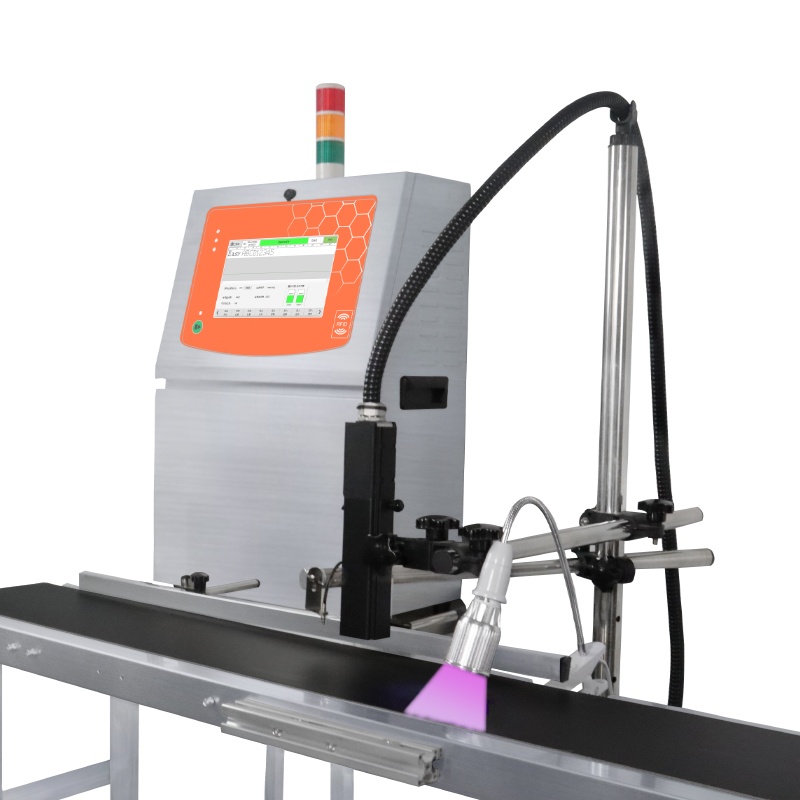
Anti counterfeiting small character inkjet printer
The anti-counterfeit build in the small character range: dynamic serial-port and database input, so each unit carries a different symbol.
- 2-20mm print height
- 3-30mm throw distance
- Prints text, date, pattern, dynamic barcode and QR code
Open the Anti counterfeiting small character inkjet printer page →
Questions on Unique Codes
- Does a unique QR code actually stop counterfeiting?
- It stops silent copying. A code that resolves to one known unit means a duplicate shows up as two packs claiming the same identity, which is what makes diversion and recall scope detectable.
- What makes a QR code scannable on packaging?
- Module size against print resolution, quiet zone around the symbol, and contrast against the surface. All three are set on the coder, so a sample on your own material is the test.
- Can one coder print a QR code and a human-readable date?
- Yes. Small character CIJ machines print both on the same pass, which keeps the scannable identity and the readable date in one mark rather than on two labels.
What to Do Next
- Send one sample pack and the code format you intend to issue, and we print a variable-data run on it.
- Compare mount options first if your product is round: Rotating inkjet printer.
- Or write to kuangcy@126.com with the reader your market uses; we confirm the symbol size and the data interface in writing. The sample run is free and commits you to nothing.