Last Updated: 2026-10-15
A blocked nozzle can pull a whole shift off a beverage line. A small character inkjet printer marks bottles, cans and cable at line speed, so what decides whether the line holds is the print window, the ink chemistry and how fast a head can be swapped.
What Continuous Inkjet Printing Faces on a Filling Line
Continuous inkjet printing never touches the pack. A pump pushes ink through a nozzle, a crystal breaks the stream into drops, and only charged drops land on the bottle. Nothing presses against the glass, which is why the method still owns carbonated and dairy lines running past 300 m/min.
The trade is upkeep. Solvent evaporates while the machine stands idle, viscosity drifts, and a head left through a wash cycle can open a shift with a plugged nozzle. The published account of inkjet printing covers the drop side of the same problem, and food and drink packs carry an audit trail under ISO 9001 quality management. On a real line, both trails break in the same place: a guard nobody has had time to open.
Three Jobs Where Small Characters Win
A small character is a constraint as much as a feature. A 2 mm code carries a date and a batch, and it must stay readable on a shoulder still wet from the filler.
- PET and glass filling. Batch and a two-line date on a 0.5 L bottle shoulder, printed mid-fill.
- Cans and ends. A short lot code on aluminium that survives a rinse, a shrink tunnel and nested trays.
- Cable and extruded pipe. Metre marks and a batch number on a moving surface, read by a camera downstream.
All three fail for the same five reasons the checks below cover.
Five Checks Before You Buy a Small Character Inkjet Printer
Settle these before the ink is ordered; each is cheaper on paper.
| Check | What good looks like | What it prevents |
|---|---|---|
| Print window | 2 to 20 mm on the pack face | A code clipped by the label or the cap |
| Speed headroom | A head rated past your fastest hour | Codes that stagger when the filler surges |
| Ink chemistry | Food-grade or solvent ink matched to the substrate | Marks that rub off in the chiller |
| Throw distance | 3 to 30 mm from head to pack | A print that drifts as bottles sway |
| Nozzle access | A guard that opens without tools | A restart turned into a lost shift |
Headroom is what buyers argue about: a coder sized on the average loses register when the shift catches up. Line speed and throw distance change the choice, so share your setup for a free fit check.
How SHICAI Sets a CIJ Job
Across more than 200 CIJ installs on food, beverage and cable lines, call-backs are rarely electrical. Ink and nozzle faults outnumber board failures by roughly four to one, and nearly all trace back to a specification set on a bench rather than behind a real pack.
So the range is set against the customer’s fastest hour, not the average. The coder below covers that job: a head rated to 400 m/min, multilingual characters with variable QR codes, barcodes, dates and serial numbers, and USB, RS232 and TCP-IP ports for existing controls. One detail rarely on a datasheet: the frame is set against a filled bottle before it ships, so the quoted throw distance has already run on a belt.
Buyer Questions From the Filling Line
- How often does a CIJ head need attention?
- On a single-shift line a weekly nozzle flush is enough. Across three shifts, check the stream daily and top up viscosity, because solvent loss, not wear, drives most faults.
- Can one coder handle glass and aluminium?
- Yes, with the right ink. Glass and aluminium need different adhesion chemistry, so the honest answer is one head, two inks.
- What if our line speed doubles next year?
- That is the headroom question. A build rated past your fastest hour takes the increase; a unit bought at the average gets replaced, and the second purchase costs more.
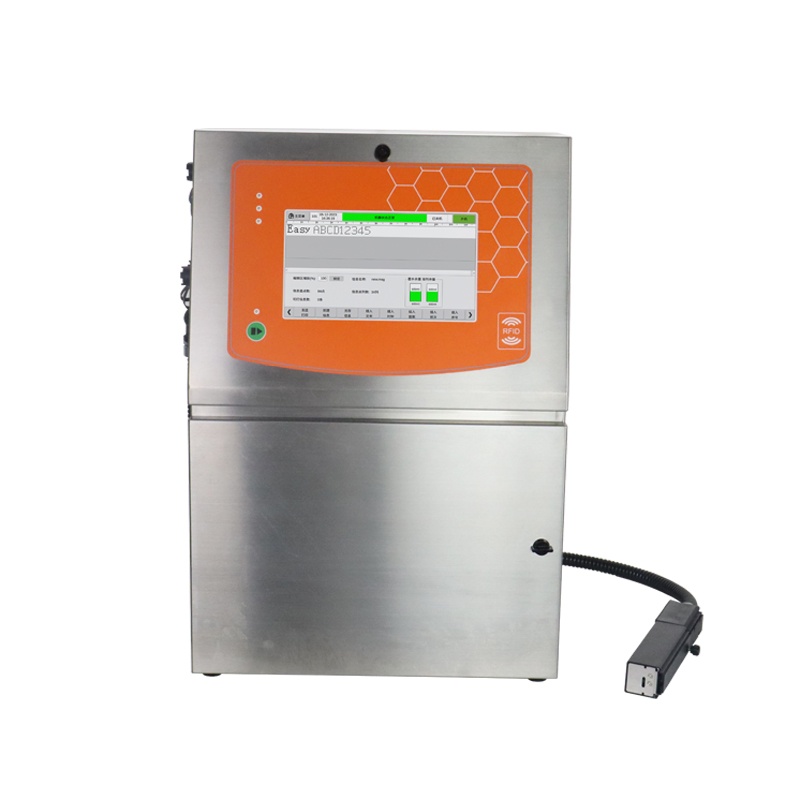
Small character inkjet printer
a CIJ coder for continuous filling lines:
- Prints up to 400 m/min
- Prints multilingual characters, variable QR codes, barcodes, dates and serial numbers
- USB/RS232/TCP/IP Network Interface connectivity
Send a Sample Bottle
- See the coder: Small character inkjet printer
- Read next: how a continuous inkjet printer works, pump to drop
- Talk to us: send one filled bottle and your line speed through our contact page. We return the throw distance and a free, no-commitment quote.