Last Updated: 2026-10-16
A part that will not sit flat never reaches the belt in the first place. An inkjet coder for that work has to be built around the fixture, the surface and the ink, because none of the three can be borrowed from a conveyor line.
Where CIJ Printers Fail on an Odd Shape
Most coding faults on a flat line come from timing. On a part that is curved, tapered, soft or too heavy to lift onto a belt, timing is the least of it: the part is held by hand or in a jig, and the head works at a distance set by the operator. The published account of inkjet printing covers the drop side of the same job.
The trade shows up in three places. Reach drifts when the part is not where the jig expects it; ink behaves differently on bare metal than on a carton; and the operator, not a PLC, decides when the trigger fires. All three are cheaper to settle before the unit ships.
Three Shapes a Conveyor Cannot Carry
An inkjet coder for this work is judged on reach and repeatability.
- Foam and sponge parts. A compressible face changes height under the head, so the setup has to allow for the surface as it is pressed.
- Tube and pipe sections. Long and often oily, held on a roller bench while the mark goes near one end.
- Cased and heavy goods. Items too heavy to lift onto a belt, marked where they stand at goods-out.
Five Rules for an Inkjet Coder on Awkward Parts
Settle these before a fixture is built; each one is harder to change once the jig exists.
| Rule | What to fix | Why the shape matters |
|---|---|---|
| Print height | 2 to 12.7 mm, sized for the tallest character needed | A mark sized for a carton overshoots a narrow tube |
| Ink adhesion | One ink per substrate family, not one ink for everything | Metal, plastic and foam each hold a mark differently |
| Colour | Choose from the seven inks on offer before the trial | Operators read a colour before they read a character |
| Fixture repeatability | A stop that places the part identically every cycle | A head cannot correct for a part that moves |
| Holding the part | Decide who holds it, and how | A mark that needs two hands costs a pause each time |
Get those five right and the coder runs at the rate an operator can feed it.
Where SHICAI Starts the Fixture
On the jobs behind this page the coder is not the hard part. Foam, tube and cased goods rarely arrive in the shape a drawing promises, and a quotation built from the drawing alone is the one that comes back. Where the part ends up as a food or drink container, the record behind the mark is checked under ISO 9001 quality management.
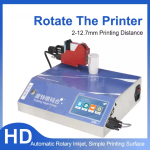
So the inkjet coder below is specified against the part. It holds a 2-12.7 mm print height, prints dates, QR codes, logos, numbers and both Chinese and English text, and marks metal, plastic, tube, foam and carton. Seven ink colours are available, which matters more than it sounds: an operator reads a colour before a batch number. The rotating fixture is what lets the head follow a shape instead of waiting for a flat face.
Odd-Shape Questions
- What decides whether a rotating unit is needed at all?
- Reach, not size. If the head can see the face it has to mark without the part moving, a fixed unit is cheaper; if the mark has to follow a curve, the part turns.
- Which ink should be tried first on metal and plastic?
- Start with the ink matched to the substrate family, then tune for cure. Metal and plastic hold a mark differently, and foam is a third case.
- How is print height chosen for a small part?
- Set it from the tallest character a reader has to see, not from the part size. The range runs from 2 to 12.7 mm, and a mark sized for a carton will not fit a tube.
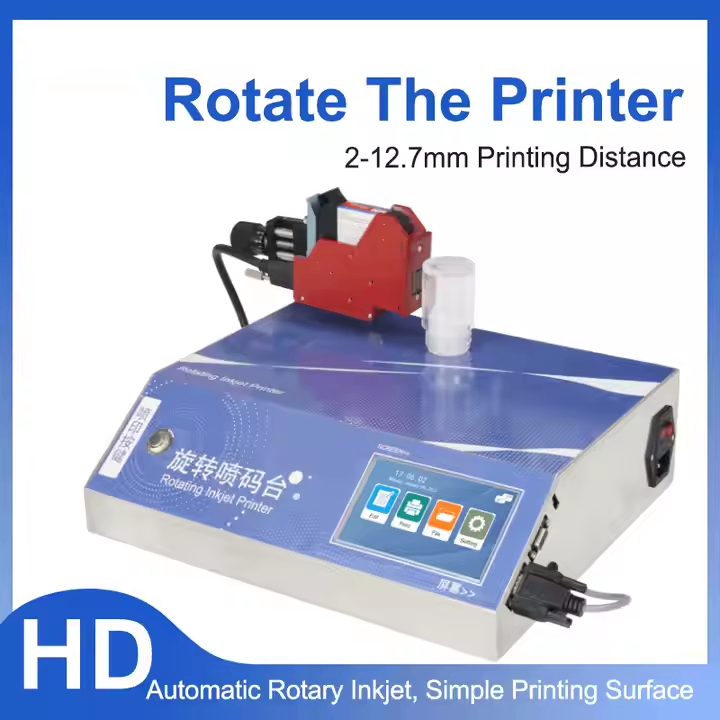
Rotating inkjet printer
a coder for parts that will not sit flat:
- 2-12.7mm print height
- Available in 7 ink colors
- Prints Chinese, English, date, QR code and logo
- Marks metal, plastic, tube, foam and carton
Send Us One Part
- See the coder: Rotating inkjet printer
- Read next: the round-surface case from the CIJ side
- Talk to us: send one part and we will mock the fixture before quoting, through our contact page. The ink trial result comes back with the quote.