
Last Updated: 2026-10-22
A date coder industrial grade label costs nothing to print and something to earn. Three things decide whether the claim survives a three-shift month: the duty the unit holds at line speed, the cabinet around the electronics, and whether a worn part has a name, a price and a delivery date.
What a Date Coder Industrial Grade Claim Should Prove
The phrase appears on units built for a workshop bench and on units built beside a filling line, and the two are not the same machine. The difference is rarely the print head. It is the cabinet around it, how the controller behaves in a warm room, and whether the consumable path was designed for gloved hands.
| Claim | Test a buyer can run | Weak answer |
|---|---|---|
| Holds duty | Print at production speed for one full shift | A top speed figure with no duration |
| Survives the room | Ask what the cabinet is rated against | It is built strong |
| Serviceable | Name the part, the price and the lead time | Full support provided |
Duty Is Measured at Line Speed, Not at Peak
A coder that reaches 400 metres per minute is not industrial because of that number. It is industrial if it reaches it on the eighth hour as well as the first, with the same mark height and the same trigger accuracy. Ask for the figure at the duty you run, not the figure on the datasheet.
Power draw is a useful proxy. A build rated at 120 W spends less energy as heat than a heavier one, and a cooler cabinet holds its timing longer in a warm filling hall. That is mechanical rather than marketing, and it shows up in the third shift.
The Room Decides More Than the Brochure
Three rooms break a bench unit quickly: a bakery with flour in the air, a dairy with washdown hoses, and a foundry with grit. In each, the failure is the electronics rather than the print. A 10.1 inch industrial touchscreen matters for a practical reason: an operator in gloves changes the date every batch, and a panel designed for a stylus will not take that input.
The mounting matters as much. A head set at 3 to 30 mm from the product tolerates a conveyor that runs slightly out of level, while a head specified at a narrow gap turns every wobble into a rejected pack.
A Named Spare Beats a Warranty Year
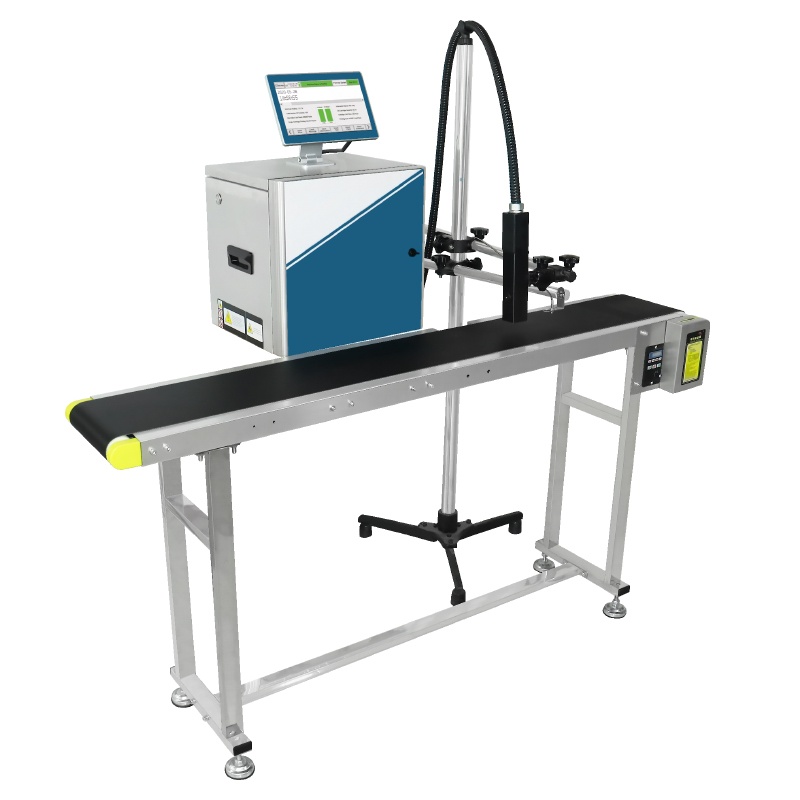
S1000 small character inkjet printer
the build these checks were written against:
- Prints up to 400 Meters Per Minute
- 2-20mm print height
- 10.1-Inch Industrial Touchscreen
- 3-30mm throw distance
- Low 120W rated power
Ask which module is stocked, what it costs and how long it takes to arrive. A supplier who answers in one sentence has a parts path; a supplier who answers with a warranty period has a warranty, and a warranty does not print anything on the day a line stops. Builds follow the route described in the ISO 9001 quality management standard.
Related Questions
- Is a date coder industrial grade if it runs on 220 V single phase?
- Yes. Supply type says nothing about duty. What matters is whether the unit holds its mark at line speed across a full shift.
- Does an industrial build need compressed air?
- Not necessarily. Some builds run without it, which removes a failure point in rooms where air quality is poor.
- How is the claim checked after installation?
- Mark fifty units at production speed, read every one, and count failures. Repeat after a two hour stop.
Send the Shift Pattern and the Room
Tell us the hours the line runs, the room it stands in and the speed you mark at. We will answer whether the date coder industrial grade claim holds for that duty, and which part you should keep on the shelf.
Next Steps
- Send the shift pattern, the room type and the line speed. We return a duty check and a stocked spare list.
- Start at the contact page, on +86 17625427465 or kuangcy@126.com. We reply within 24 hours.
Need help choosing the right printer?
Talk to our engineers for a free production-line assessment and quotation.
Request a Quote