Last Updated: 2026-11-02
A coder swap costs less in hardware than in the fortnight of doubt. Treating an alternative to KGK as a migration, with a written parallel window, a fluid handover and one named sign-off, turns that fortnight into a written plan the plant can follow.
What Moving to an Alternative to KGK Actually Involves
Nothing about the mark on the carton is meant to change. A continuous head still charges drops and deflects them through a gutter, and the code that lands is set by nozzle size, ink viscosity and trigger timing. What changes is everything the old machine quietly held together.
Five things travel with a coder and rarely appear on a quotation: the wiring into the line controller, the ink stock on the shelf, the log book the auditor asks for, and the operator who knows the flush routine.
Each of those is a handover item. Skip one and the new unit runs, but the line does not.
Five Steps in the Order They Matter
| Step | What good looks like | What goes wrong |
|---|---|---|
| Parallel window | Two weeks of double-run, both codes logged | Switch overnight, blame the coder |
| Signal reuse | Existing trigger and encoder kept | New bracket, new sensor, new fault |
| Fluid handover | Old ink drained as hazardous waste | Mixed fluids in a shared tray |
| Operator sign-off | One name per shift owns the first block | Nobody owns the first piece |
| Spares bridge | Old unit kept six months as a backup | Old unit sold in week one |
The second step is where money is saved and engineers disagree. A trigger sensor already mounted and proven is worth keeping, because a bracket that moves a millimetre a week is the commonest cause of a code landing on the flap.
The fifth step sounds sentimental and is not. A six-month bridge costs a square metre of floor and buys the plant the right to be wrong once, which is exactly what a first winter on new equipment needs.
Fluid, Flush and the Paper Trail
Continuous inkjet needs make-up fluid to hold viscosity, so a swap carries a waste question. Old ink and flush solvent are hazardous waste in most markets, and the drum leaves with a consignment note rather than through the general skip.
The flush routine is also the training document. Ask for the daily, weekly and monthly steps in hours, and who performs each one, because a routine that needs a technician twice a month is a different operating cost from one an operator can finish at shift end.
The print mechanism itself is documented under continuous inkjet, and the records that go with a build should follow the ISO 9001 quality management route. Both belong in the handover file, not in a brochure.
How SHICAI Runs a Changeover
SHICAI builds small-character and online systems for export markets, ships factory-direct, and quotes spares per part in writing so the bridge period has a real number attached. That is the part of an alternative to KGK a buyer can hold someone to.
In our export work the repeated delay is the sign-off, not the hardware. A line running a fortnight in parallel still needs one person to accept the first production block, and without that name both machines run for a month.
The Unit for Small-Character Lines
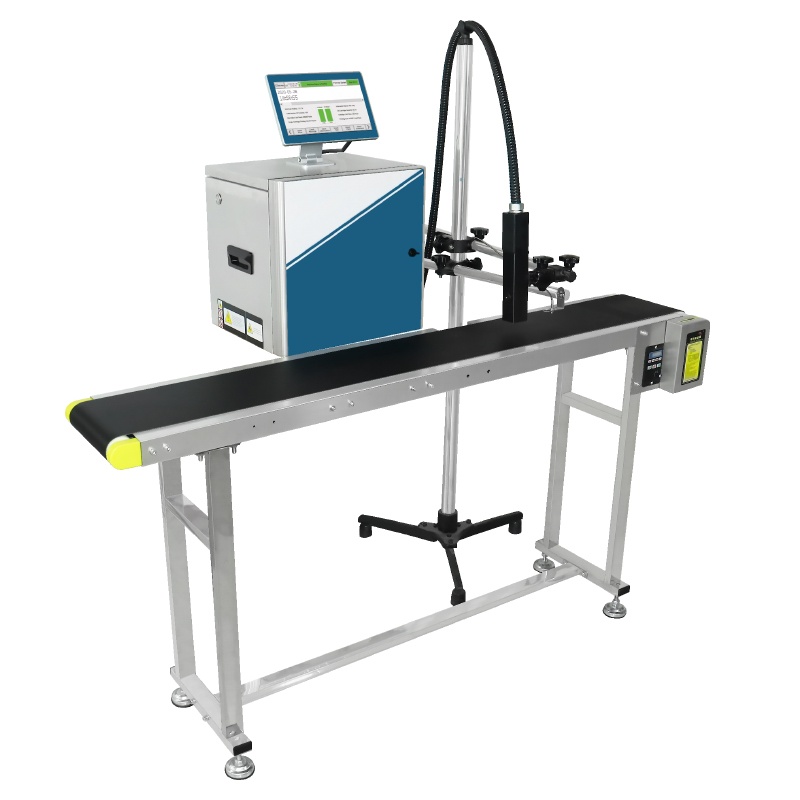
S1000 small character inkjet printer
the continuous head for a line that runs through the swap:
- Prints up to 400 Meters Per Minute
- 2-20mm print height
- 10.1-Inch Industrial Touchscreen
- 3-30mm throw distance
- Low 120W rated power
The throw distance is the migration figure. At 3 to 30 mm the head clears an existing guard rail, which usually means the old mounting arm can be reused instead of re-engineered, and a reused arm is one less thing to prove in the parallel window.
Send the Code Your Line Prints Today
- Can the old ink be finished first
- Yes, and it is cheaper than draining a partly used drum as waste.
- Does the interface need a converter
- Rarely, since a dry contact and an encoder signal are usually already present.
- How long should the bridge last
- Six months covers a seasonal run and one cold start.
Send the code your line prints, the belt speed at the head and a photograph of the existing mounting. We will mark a sample, set the trigger offset and return the figures, so an alternative to KGK is planned against your line rather than a generic install sheet.
Next Steps
- How the same head handles a round surface: coding a round surface.
- Start at the contact page, on +86 17625427465 or kuangcy@126.com. We reply within 24 hours.