Last Updated: 2026-11-03
A code pressed into foam reads badly at the dock, because the surface springs back. Choosing an inkjet printer for foam therefore turns on five tests, none of which is resolution: head pressure, rebound, wicking, static dust, and where the block sits.
Why an Inkjet Printer for Foam Behaves Differently
Foam is mostly air. An EPS block is a lattice of closed cells, an EPE plank a springier open structure, and both compress under a head a carton would simply meet. The mark lands on a surface that is still moving.
Two things follow that no spec sheet mentions. Contact pressure matters, because a head dragged across foam leaves a groove that reads as a second line. And the block spreads, because ink wicking along a cell wall travels further than on kraft board.
The rest of the line behaves normally: a trigger fires, the head writes, the pallet moves on, and the failure appears a day later at a warehouse scanner.
Five Crush Tests Before You Order
| Test | Pass looks like | Fail looks like |
|---|---|---|
| Head pressure | Mark with no groove beside it | A indented track along the block |
| Rebound | Block unchanged after an hour | Characters close up as cells recover |
| Wicking | Edges stay sharp on the cell wall | A soft halo that eats the quiet zone |
| Static dust | Surface clean at the head | Dust pulled in, drop lands off-centre |
| Block position | Code inside the flat face | Code crossing a mould seam |
The second row decides the character height. A three-millimetre batch code closes up as the cells recover, while a twelve-millimetre block carries enough white space to survive the same movement.
The fourth row is seasonal. Foam stored in a warm, dry warehouse carries a charge that pulls dust to the surface, and a drop landing on a dust particle goes where the nozzle did not aim.
Ink, Wicking and the Quiet Zone
Foam needs a grade that wets the cell wall without racing along it. A thin solvent ink on EPS can travel far enough to blur a barcode quiet zone, and a barcode without one is a barcode a scanner will argue about.
The answer is a grade tested on the actual foam at the actual height, read with the customer’s scanner. Water-based grades suit porous EPS and struggle on a laminated surface, so one sample is not enough if the plant packs two foams.
The print mechanism is described under inkjet printing, and a build for export should carry records under the ISO 9001 quality management route. Neither document tells you whether your foam will hold a code, which is what a sample is for.
How SHICAI Handles a Foam Trial
SHICAI builds online and small-character systems for export markets and marks the sample a buyer sends before quoting a head count. For an inkjet printer for foam the sample matters more than usual, because two EPS grades from two suppliers can hold a mark very differently.
What recurs in our export orders is the seam, not the ink. A code across the mould parting line splits as the halves spring apart, and moving the block twenty millimetres is the whole fix.
The Head for Wide Blocks on Soft Packaging
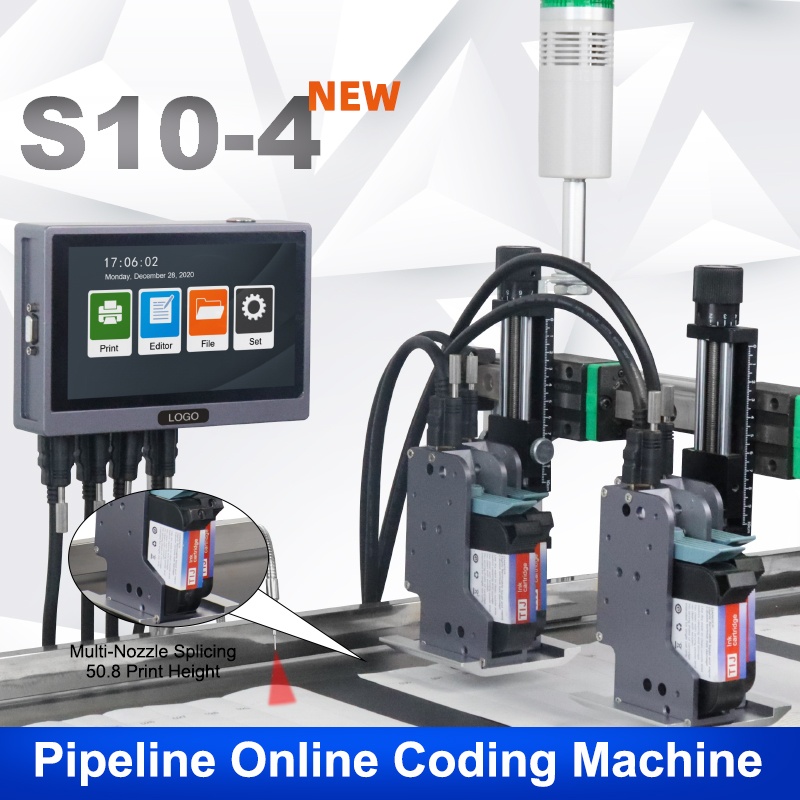
S10-4 online inkjet printer (standalone)
the wide-block build for foam and carton faces:
- 2-50.8mm print height
- 2-5mm throw distance
- Prints Chinese, English, date, QR code and barcode
- Marks metal, plastic, pipe, foam and carton
- Industrial Grade Standard Protective Body/Aviation Aluminum/Industrial Stainless Steel body
The height is the line that matters here. At 50.8 mm a block can be printed in one pass with generous white space around it, and white space is what survives the rebound that closes up a smaller code.
Send a Moulded Box, Not a Photo
- Will the code survive a squeeze
- At a large character height yes, and the sample is the only honest proof.
- Does foam need a special ink
- It needs a grade that wicks slowly, which is tested rather than assumed.
- Can the head touch the surface
- Better not: a 2 to 5 mm throw keeps the head clear of a compressible face.
Post one moulded box, the character height and the scanner your customer uses. We will mark it, leave it overnight, squeeze it and photograph the block, so the inkjet printer for foam you order has met the surface already.
Next Steps
- How a wide block changes cycle time: four speed traps on a conveyor line.
- Start at the contact page, on +86 17625427465 or kuangcy@126.com. We reply within 24 hours.