Last Updated: 2026-11-04
Plastic crates come back wet, stacked and scuffed. An inkjet printer for plastic crates is judged on how the code holds after a wash-down, a stack and a hundred trips from the shop floor, which is a different test from printing on a new box.
Why an Inkjet Printer for Plastic Crates Meets Three Lives
A returnable crate is marked three times over its working life and each occasion asks something different of the ink. The first mark goes on a new crate that has never seen a wash. The second goes on a crate still damp from the tray washer. The third goes on a surface scarred by years of sliding along a pallet.
Most coding failures on a crate line are the second and third mark, and both are invisible during a factory demonstration on a clean sample.
None of this is a printer fault in the usual sense. It is a question of whether the grade was chosen for the surface the crate is in, rather than the surface it arrived in.
Wet Surfaces and the Grade That Stays
Water on high-density polyethylene is the hardest case in packaging. The drop lands on a film rather than a wall, so a water-based grade beads and dries into a ring instead of a character.
| Crate condition | What usually fails |
|---|---|
| New, dry | Nothing, which is why demonstrations pass |
| Damp from the washer | Beading, then a broken character edge |
| Scuffed after a year | Drop follows a scratch instead of the block |
| Cold store return | Slow drying and a smear on the next stack |
The second row is solved by a grade that displaces water rather than mixing with it, and the fourth by drying time rather than by resolution. Neither is visible on a specification sheet.
The surface itself is described under high-density polyethylene, and an export build should carry records under the ISO 9001 quality management route. What that literature cannot tell you is how your washer behaves, which is why a used crate is the only useful sample.
Stacking, Scuffing and Where the Block Sits
A crate is handled by its faces. The block has to sit inside a recess or above the wear band, because a code on the running edge is a code that leaves with the first pallet.
Height matters here for a practical reason. A block that needs twenty millimetres needs a flat twenty millimetres, and a moulded crate usually offers one panel that size and four that do not.
How SHICAI Tests a Returnable Crate
SHICAI builds online and small-character systems for export, and asks for a crate that has already been in service. A new crate proves the printer works; a used one proves the grade works, and the second question is the one that decides a repeat order.
What recurs in our export orders is the panel, not the ink. Buyers photograph the face they intend to mark and forget the rib running through the middle of it, and a block printed across a rib loses a character to the shadow.
The Compact Head for a Crate Line
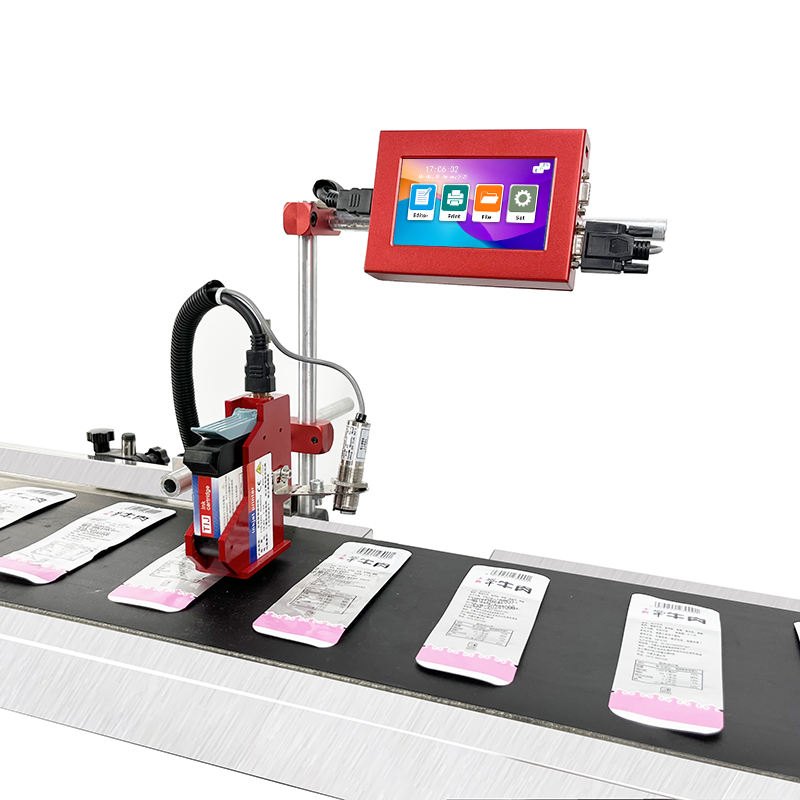
Y110 Online inkjet printer
the low-weight build for a line that moves between washers:
- 300-600dpi print accuracy
- 2-12.7mm print height
- 4.3-inch touch screen
- Weighs only 3.0 kg
- food-grade/water-based/oil-based/42ml ink cartridge ink
The weight is the line that matters on a crate line. At 3.0 kg the head mounts on a bracket that swings between two conveyor positions, and a heavy cabinet would need its own frame instead.
Send One Crate That Has Been in Service
- Will a code hold on a wet crate
- A grade that displaces water does, and a used crate through your washer is the test.
- Does colour matter on a crate
- Contrast does: a light grade on a dark crate reads better than the reverse.
- Can one head serve two lines
- At 3.0 kg it can be moved, provided the bracket is designed for it.
Post one crate that has already done a season, plus the wash temperature and where the block must sit. We will mark it damp, stack it and photograph the face, so the inkjet printer for plastic crates you order has met your washer rather than a sample shelf.
Next Steps
- When the part is small and oiled instead: five fixture rules for bearings.
- Start at the contact page, on +86 17625427465 or kuangcy@126.com. We reply within 24 hours.