Last Updated: 2026-11-11
A machine rated at a hundred metres still misses codes when the trigger fires late. A thermal inkjet printer automatic earns its speed in the gaps between packs, where the print window is short and the substrate changes twice a shift.
Where a Thermal Inkjet Printer Automatic Earns Its Speed
The rating on the page is a maximum, measured on a flat surface with one row of text. Real output is set by the three seconds between packs, not by the number in the brochure.
So the useful question is not how fast the head can fire. It is how much of each gap the head can use before the pack is gone.
Rule 1: Line Speed Is a Range, Not a Number
A belt that averages eighty metres a minute still peaks higher when a batch releases from an accumulator. Size the print window against the peak, or the codes thin out for ten minutes every hour.
Measure the peak with a stopwatch over a full cycle, not from the drive display, which shows the setpoint rather than the truth.
Rule 2: The Print Window at a Hundred Metres
At a hundred metres a minute a pack passes the head in a fraction of a second, so the window is a time budget, not a distance. Two rows of text need roughly twice the time of one row.
This is why resolution and speed trade against each other. Drop the dpi and the same window fits more characters, often right on a fast line and wrong on a retail pack.
Rule 3: Switching Substrates Without Stopping
Most lines run more than one material a shift: film, then board, then a labelled sleeve. Each change moves the ideal gap, and a head set for film prints soft on board until somebody adjusts it.
Save one recipe per substrate at the height and gap that worked, and the change becomes a recall rather than an adjustment. That saving is the real reason a standard machine beats a fast one on mixed runs.
Rule 4: Trigger Timing Across a Gap
A sensor sees the leading edge, and the delay between that edge and the print is fixed in milliseconds. Change the belt speed and the same delay lands the code somewhere else on the pack.
Some controllers compensate and some do not. Confirm which behaviour you have bought, because a line that ramps up through the shift will drift steadily if the delay is a constant.
Rule 5: What Slows a Fast Machine Down
Speed disappears in small places: a cartridge swapped mid-batch, a guard that has to be unbolted, a conveyor that carries the pack past the head before the operator can see the result.
None are print faults, and all show up as one. Treat mounting, access and sight line as part of the pace, not as details settled afterwards.
The Unit We Send for a Busy Line
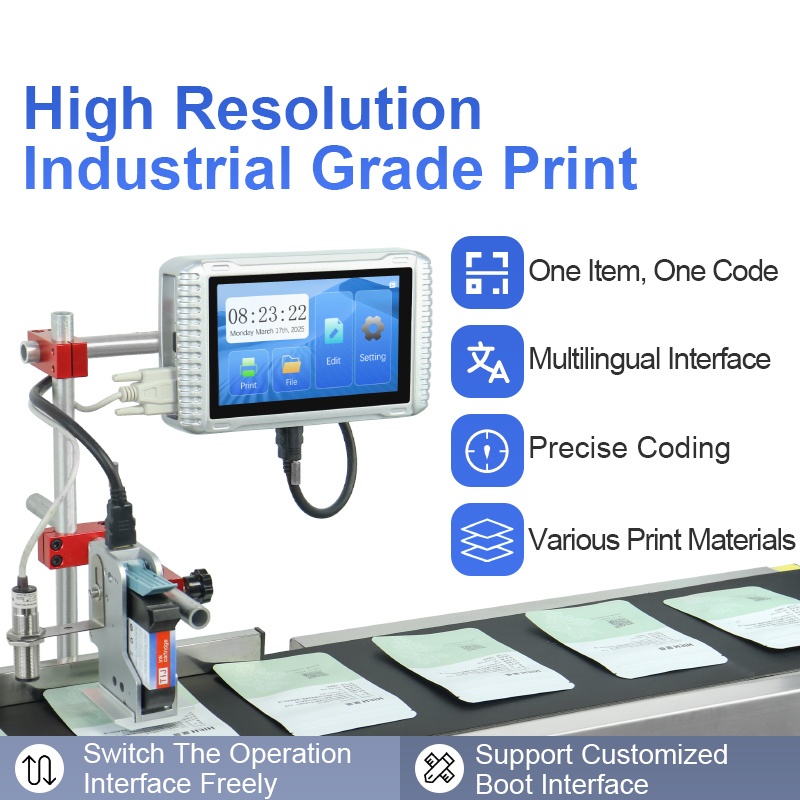
L10 Online inkjet printer
the build we send when the belt genuinely runs at speed:
- Prints up to 120m/min
- 600dpi print accuracy
- 2-12.7mm/2-25.4mm print height
- 7-Inch Capacitive Touch Screen
- 2-5mm throw distance
The seven-inch screen is a pace feature, not a luxury. Recipes get recalled by name on a screen that a gloved hand can hit, and that is what keeps a changeover under a minute.
Send the Belt Speed You Run At, Not the One You Want
- How do we size the print window
- Take the peak belt speed over a full cycle, then divide the available millimetres by that number.
- Can one head cover two rows
- Yes at moderate speed, and at a hundred metres a minute the second row usually needs its own pass.
- What if the line speed varies
- The delay has to track the belt, or the code drifts along the pack as the line ramps.
Send the peak speed, the code layout and the materials you switch between. We return the window, recipes and trigger setting, so the thermal inkjet printer automatic keeps its rating on your line, not on the bench.
For the belt end of the same problem, our note on running an inline coder on an existing conveyor covers the mounting side. The mechanism is described under thermal inkjet printing, and export builds follow ISO 9001.
Next Steps
- If the trigger is the weak point: four trigger rules for a conveyor line.
- Start at the contact page, on +86 17625427465 or kuangcy@126.com. We reply within 24 hours.