Last Updated: 2026-11-16
Rotating work changes the unit of throughput, and that is where quotes go wrong. A rotating inkjet printer is rated in parts per minute rather than metres per minute, so a line compared on belt speed alone buys a machine sized for the wrong job.
What a Rotating Inkjet Printer Changes About Throughput
On a flat carton the belt carries the pack past a fixed head, and speed in metres per minute describes the job completely. Turn the part instead and the belt stops being the clock.
Now the cycle is load, index, turn, print, unload, and the slowest of those five sets the rate. A machine quoted at four hundred metres a minute tells you nothing about how many tubes leave the station in an hour.
Parts per Minute Replaces Metres per Minute
Count the parts, not the metres. A tube of forty millimetres and a cap of twenty-five occupy the same fixture for very different fractions of a second, so the honest figure is parts per minute at the smallest diameter you run.
Time ten cycles with a stopwatch before you ask for a quote. The index motion, not the print, usually dominates, and a supplier who never asked for that number is quoting a print head rather than a station.
What the Turn Costs You Speed
Every part spends time being held still. A fixed head on a moving belt prints while the pack travels, and a rotating station prints while the part turns in place, so the two rates are not convertible by arithmetic.
That is not a fault in the machine. It is the price of printing a surface that curves away from the nozzle, and the way to buy it back is a second station in parallel rather than a faster head.
Diameter Change Is the Real Downtime
A change of part size moves the print distance. The gap between nozzle and surface is measured in millimetres, and a fixture set for a thirty millimetre tube will not hold a cap at the same throw.
Ask how the fixture is adjusted and how long it takes with a wrench in hand. Ten minutes twice a shift is worth more over a year than the difference between two suppliers on the machine price.
One Turned Head or Two Fixed Heads
Two fixed heads on opposite sides of a part cover more of the circumference without any rotation at all, which is the simpler answer when the code has to be readable from one side only.
A turned head wins when the code must follow the part, or when the fixture cannot hold the part at a fixed angle. Decide which of those is your problem before the station is designed.
The Build We Quote for Tube and Cap Work
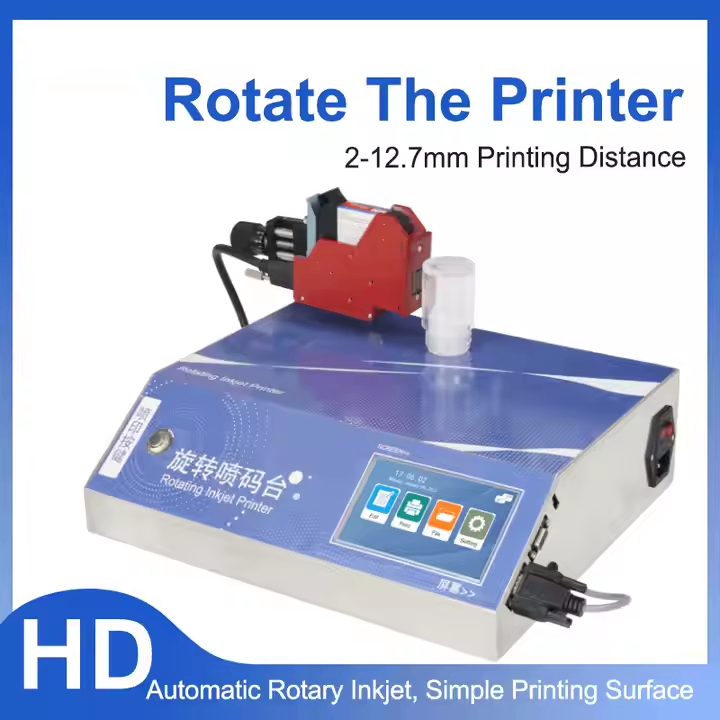
Rotating inkjet printer
the build for a part that has to be turned to be printed:
- 2-12.7mm print height
- Available in 7 ink colors
- Prints Chinese, English, date, QR code and logo
- Marks metal, plastic, tube, foam and carton
Twelve point seven millimetres is enough for a date line and a batch code on a tube, and the mark list covers the metal, plastic and foam parts that turn up on the same line.
Send the Diameter and the Target Rate
- How fast can a rotating station run
- It depends on the index motion rather than the head. Quote parts per minute at your smallest diameter and the supplier can size it honestly.
- Can the same station print caps and tubes
- With an adjustable fixture, yes. The throw has to be reset between the two, which is the changeover cost worth timing.
- Does rotation need a special ink
- No. The ink family follows the material, so a plastic cap and a metal tube may still need two different cartridges.
Send the diameter range, the parts per minute you need and the material of each. We return the fixture type and the cycle estimate, so the rotating inkjet printer you order is sized to the station rather than to the belt.
For the flat-pack case, our note on coding a round surface covers the mount itself. The print mechanism sits under inkjet printing, and export builds are checked against ISO 9001.
Next Steps
- Comparing coder types first: small codes at 400 metres a minute.
- Start at the contact page, on +86 17625427465 or kuangcy@126.com. We reply within 24 hours.