Last Updated: 2026-11-17
Printing a label web and winding it up used to take two machines. A label rewinding machine that does both jobs on one shaft removes the handling step entirely, and tension is what decides whether the second job ruins the first.
Why a Label Rewinding Machine Changes the Line
A print-and-wind line removes the moment where printed labels sit in a stack waiting for a second pass. Every extra handling step is a chance to mix two jobs and a chance to scratch a coated face.
It also shortens the floor. One shaft, one operator, one roll leaving the station instead of two rolls meeting somewhere in the middle of the plant.
Job One: Printing While the Web Moves
The head prints on a web that is already under tension, which is the good news and the hard part. A web that flutters by a tenth of a millimetre will print uneven strokes on a two millimetre character.
That is why the throw distance matters more here than on a carton line. Two to five millimetres keeps the head close without touching, and the guide roller in front of it has to hold the web flat rather than merely steer it.
Job Two: Winding to a Roll the Press Can Take
The finished roll has to fit the next machine. A rewinder that produces a roll the press cannot mount has moved the problem, not solved it, so the outer diameter is a specification rather than a detail.
Check the core size and the maximum diameter before the order. A roll of five hundred millimetres outer diameter on a sixty millimetre core is a common target, and a machine rated below it will stop the line at the busiest hour.
Tension Is the Whole Argument
Winding pulls, and pulling stretches. Stretch a film or a thin tape and the print spacing changes across the roll, so the label that looked right on the first metre is out of register at the last.
Look for a tension arm or a dancer roller rather than a fixed clutch. A fixed setting is correct for one web width and one material, which means it is wrong for the second job you bought the machine for.
What the Print Height Decides
Twelve point seven millimetres covers a date, a batch code and a short price line on one label. Beyond that the character count per label forces a wider web rather than a taller print.
Seven ink colours matter more on labels than on cartons, because a label often carries the brand colour and the code in the same pass. Ask which of the seven is food contact rated if the label touches the product.
The Unit We Quote for Print and Wind
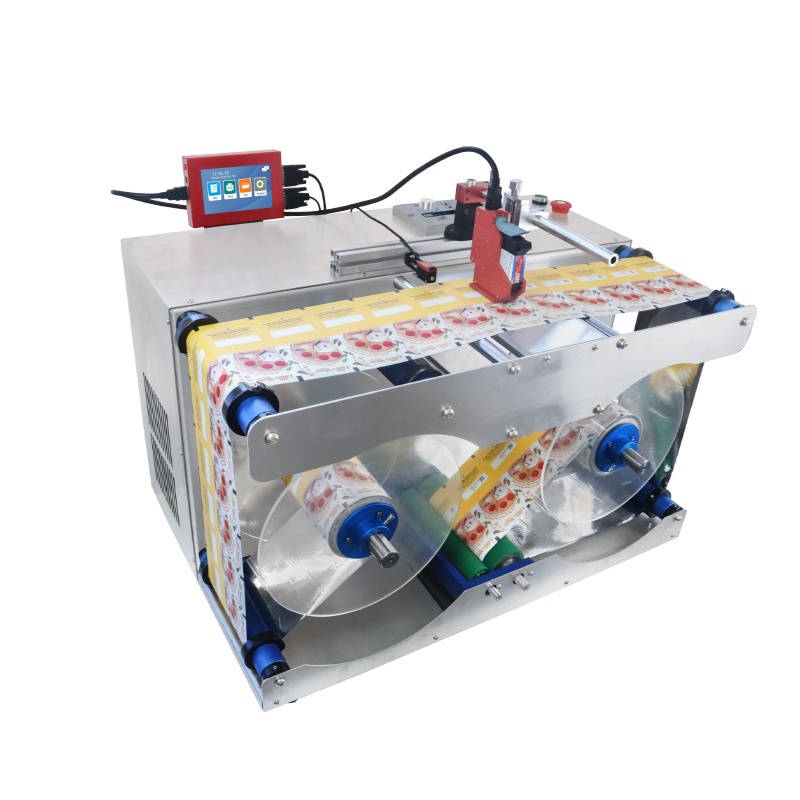
Automatic label spray coding rewinding machine
the build for a web that prints and winds in one pass:
- 2-12.7mm print height
- 2-5mm throw distance
- Available in 7 ink colors
- Marks paper labels, stickers, PVC film, tape and silver foil
The material list is the useful part of that sheet, because paper, PVC film and silver foil each take a different ink and a different tension setting on the same shaft.
Send the Web Width and the Finished Roll
- Can one machine print and rewind at once
- Yes, and that is the point of the build. The web is printed under tension and wound on the same pass, so no second handling step exists.
- What roll size can it produce
- It depends on the core and the outer diameter you specify. Send both numbers, because a roll the press cannot mount is not a finished roll.
- Does the ink suit film and foil
- Seven colours are available and they are not interchangeable across materials. Name the substrate and the ink follows from it.
Send the web width, the material and the finished roll diameter. We return the tension setting and the ink family, so the label rewinding machine you order leaves a roll your press can mount rather than a roll you have to rewind again.
For the printing side on a curved part, our note on coding a round surface covers the mount. The web handling itself sits under label, and export builds are checked against ISO 9001.
Next Steps
- If the code has to survive a wash: small codes at speed.
- Start at the contact page, on +86 17625427465 or kuangcy@126.com. We reply within 24 hours.