Last Updated: 2026-11-17
A continuous inkjet printer breaks ink into drops and charges them. TIJ boils a bubble behind the nozzle and PIJ flexes a crystal behind the ink chamber, and the three families answer different questions about ink, substrate and duty cycle.
What a Continuous Inkjet Printer Does to a Drop
The ink leaves the nozzle as a continuous jet, breaks into a stream of drops, and each drop is charged as it passes an electrode. A deflector then sends it to the substrate or to the gutter.
That is why the head can print at distance. The drop is steered in flight rather than pressed onto the surface, so a throw of three to thirty millimetres is normal and the head never touches the pack.
TIJ: The Head and the Cartridge Are One Part
A thermal head heats a thin film of ink into a bubble, and the bubble pushes a drop out. The nozzles are built into the cartridge, so a new cartridge is also a new head.
That single fact decides the whole maintenance model. There is no solvent to top up and no nozzle to flush, but the head is replaced on a schedule rather than cleaned, and the ink is whatever that cartridge holds.
PIJ: A Crystal Pushes the Chamber Wall
A piezo head applies voltage to a crystal bonded to the ink chamber. The crystal deforms, the chamber narrows, and a drop leaves without any heat at all.
Because nothing boils, the fluid range is wider than thermal allows. Piezo is the family that handles the aggressive and the high-solid inks, which is why it turns up where a thermal cartridge would fail.
Three Families, Three Consumable Models
CIJ charges for ink and make-up separately, and make-up is consumed by open time rather than by codes printed. A plant that runs one shift spends more on make-up per code than a plant that runs three.
TIJ bundles head and ink into one part number, so the cost per thousand codes is easy to see and hard to negotiate. PIJ sits between them: the head lasts, the ink is bought by the litre, and the price depends on the fluid rather than the cartridge.
Where Each One Strains on a Real Line
CIJ strains when the line stops and starts, because every idle hour costs make-up and a head left uncapped may need a flush. TIJ strains on tall print, since the cartridge has to cover the height in one pass.
PIJ strains on cost at low volume. It is the right answer for a difficult ink at a steady rate, and the wrong one for a few hundred codes a week on a carton that would take a thermal head.
The Build We Quote for CIJ Work
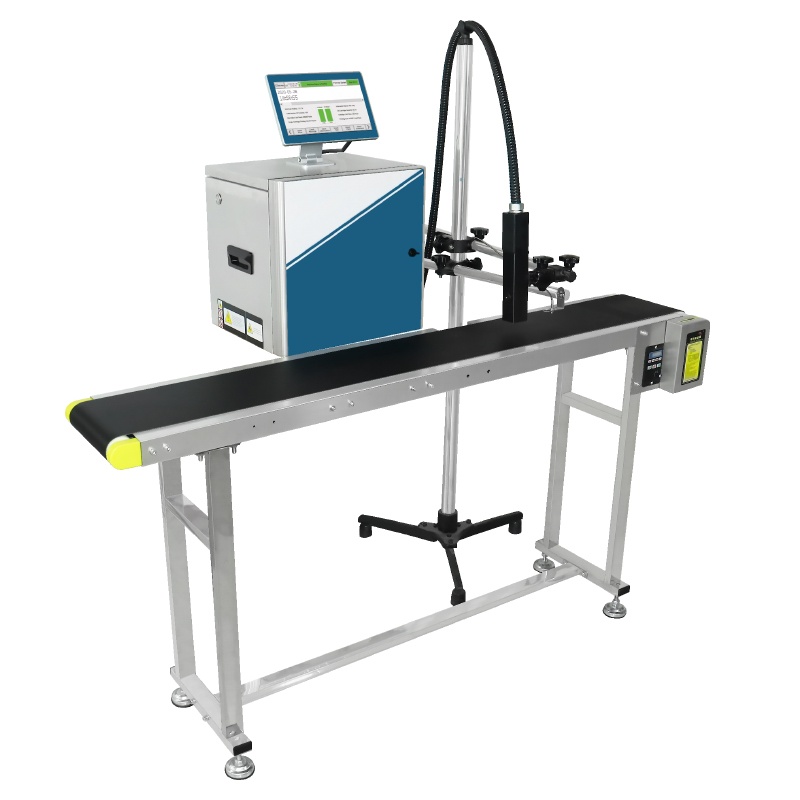
S1000 small character inkjet printer
the CIJ build for a line that never stops:
- Prints up to 400 Meters Per Minute
- 2-20mm print height
- 10.1-Inch Industrial Touchscreen
- 3-30mm throw distance
- Low 120W rated power
Three to thirty millimetres of throw is what the charging principle buys, and the twenty millimetre print height covers a two-line batch block without a second head.
Send the Ink and the Substrate, Not the Family
- Which family handles a solvent-resistant plastic
- Usually CIJ or PIJ, because both can carry an aggressive fluid. A thermal cartridge is limited to the ink it ships with.
- Does TIJ need maintenance between shifts
- Little. The head travels with the cartridge, so cleaning is a wipe at the nozzle plate rather than a flush routine.
- Why does make-up cost more on one shift
- Solvent leaves the system by open time, not by output. Fewer running hours per week means the make-up charge spreads across fewer codes.
Send the substrate, the ink you already use and the codes per shift. We return the family and the consumable estimate, so the continuous inkjet printer you order is chosen on fluid and duty rather than on a brochure ranking.
For the speed side of CIJ, our note on small codes at four hundred metres a minute covers the window. The thermal alternative is set out under pace rules for a thermal head. The principle sits under continuous inkjet, and export builds follow ISO 9001.
Next Steps
- If the job is a round part: coding a round surface.
- Start at the contact page, on +86 17625427465 or kuangcy@126.com. We reply within 24 hours.