Last Updated: 2026-11-18
An egg coding machine that loses one head still prints five. The line keeps running, the trays keep coming, and the miss is only found at the packer. Three checks find the silent head before the shift ends, and only one of them needs a tool.
Why an Egg Coding Machine Loses One Head, Not All Six
Six heads share a frame and a screen, and almost nothing else. Each nozzle has its own ink path, so a failure that takes one head leaves five printing perfectly.
A tray line hides that gap well. One column of six eggs arrives unmarked, the packer sees the date on the rest, and the box ships. The cause is usually one of three.
First Check: Which Head Is Actually Silent
Do not trust the eye at line speed. Run one empty tray through and look at the print. A head that fires weakly shows a pale column that reads as fine in motion and as incomplete when stopped.
Number the heads on the frame and write the number against each column, so a complaint names a head instead of a direction.
Second Check: Throw Distance and Tray Height
The specification for this family of build is a 2 to 5 mm throw, and a tray riding two millimetres higher pushes the head outside it. A single head sits on an adjustable column, so it drifts when somebody leans on it.
Measure the gap at the head that missed, not at the one next to it. A mixed stack of trays is the most common reason one column fails while five are correct.
Third Check: The Red Water-Based Line
Food-grade red ink is the standard choice on a shell, and it settles. A head idle through a long break starts the shift with a partial column, which clears after a few trays or not at all.
A daily purge before the first tray costs seconds and settles the question. If the same head returns pale every morning, the fault is in the ink path and the answer is a service call.
What the Screen Reports, and What It Does Not
The 7-inch capacitive screen shows the job, the count and the settings. It cannot show a head firing outside the gap, because the electronics are working and only the transfer failed.
That distinction matters at 3 a.m. A screen with no alarm sends the operator looking for a board while the cause is a bracket that moved.
When to Call Instead of Adjust
Adjust the column, the tray and the purge. Call when the same head repeats within one shift after all three, or when it stops firing entirely rather than weakly. Those two patterns point inside the head, so keep the head number and the tray count in the message.
The Six-Head Build We Quote
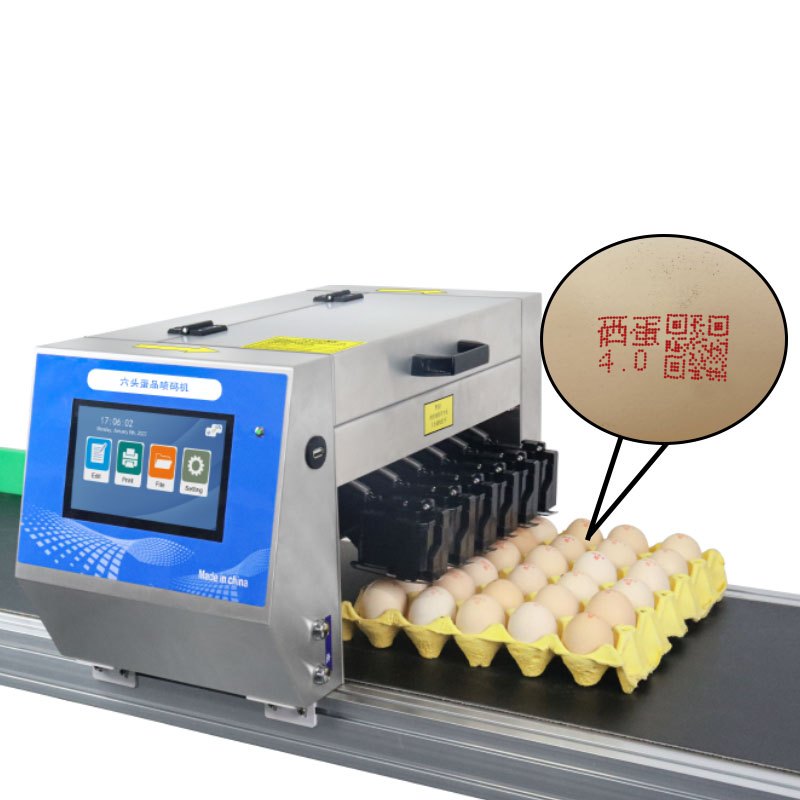
Six head egg inkjet printer (D100-6)
six independent nozzles on one electric lift:
- Prints up to 20 trays per minute (5 x 6 trays standard)
- 2-5 mm optimal throw distance
- Food-grade water-based red ink
- Marks eggshells with dates, batch and traceability codes
Six independent nozzles are why one head can fail alone, and why the check above works on a column rather than on the whole print. The electric lift sets frame height once; the fine gap stays per head.
Send the Tray and the Layout
- Can I run five heads while one is down
- That is a production decision rather than a machine limit. Five heads keep the line moving but leave one column unmarked, so the trays need segregating until the sixth is back.
- How often should the heads be purged
- Once before the first tray of a shift is the baseline. Add a purge after any break long enough for the ink to settle, which on a warm line is shorter than most operators expect.
- What tells me a head is failing
- A pale column rather than a missing one. Full stops are easy to see, and partial transfer is the pattern that reaches the packer unnoticed.
Send the tray size, the number of columns and a photo of the frame. We return the head spacing and the gap setting, so the egg coding machine you install names its own faults.
For the rate question on a grader-fed line, the numbers sit in where the rate is won. Background sits under egg marking, and export builds follow ISO 9001.
Next Steps
- If the shed itself is the problem: the five site conditions.
- Start at the contact page, on +86 17625427465 or kuangcy@126.com. We reply within 24 hours.