Last Updated: 2026-11-19
An egg date printing machine is bought for the date, and the date is the setting nobody gets wrong. What goes wrong is the handover: the day rolls over at midnight, two shifts disagree about which date is loaded, and a whole pallet leaves with yesterday on the shell.
Why an Egg Date Printing Machine Fails at 6 a.m.
The machine is warm, the line is running and the first tray of the morning carries a date typed by somebody who started twenty minutes ago. Every failure below happens in that window.
It is a process fault dressed as a machine fault. The unit prints exactly what it was told, which is why a change of shift is the most dangerous moment on a coding line.
The Date Is the Easy Setting
Loading a date takes seconds on a touch screen. That ease is the problem: because it is trivial to change, it is also trivial to leave unchanged, and nothing on the machine announces that midnight has passed.
A unit printing a date, a batch and a traceability code carries three fields on three schedules. The date moves daily, the batch moves when the flock changes, and the trace block may come from the line rather than an operator.
What the Shift Card Has to Carry
Write four values on a card at the machine and have the incoming shift read them aloud: date, batch, code format and tray count. Reading aloud is what catches the mistake, because a person reading a wrong date notices it as they say it.
Pair the card with a first-tray check. The outgoing shift prints one tray, signs the card and leaves it with the tray. If the two are ever separated, the argument about who printed what ends immediately.
Who Is Allowed to Change the Menu
Every operator needs the date and the batch. Almost nobody needs the print height, the throw distance or the code layout, and those are the settings that quietly degrade a print over a week of small adjustments.
Set a two-level menu if the build offers one, and write down who holds the second level. A plant where any operator can reach every parameter is a plant where the settings drift and nobody can say when it started.
Six Heads, Six Chances to Print the Wrong Day
A six-head frame carries one job and six print positions. On most builds the job is shared, so a corrected date reaches every head at once, and that is the argument for buying a frame rather than six separate units.
Check that assumption before the order. Ask whether the heads share one job file or hold their own, because a frame with six independent files turns one date change into six, and the handover card has to say so.
The Build We Quote for a Two-Shift Shed
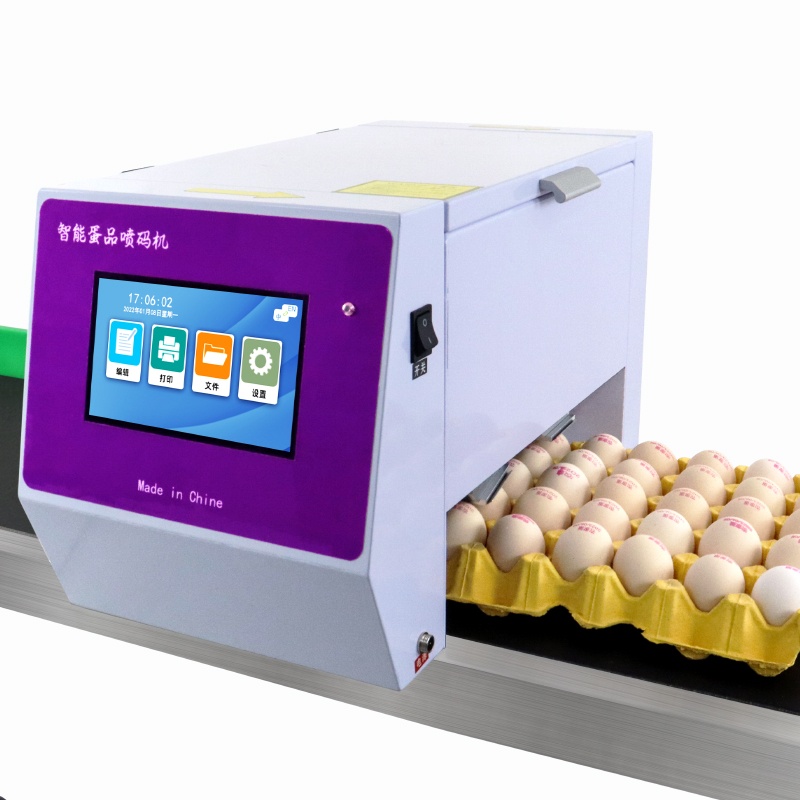
Six head egg inkjet printer
six nozzles on a frame, run from one screen:
- Six individual nozzles print in parallel
- 7.0-inch capacitive screen
- Food-grade ink safe for eggshell contact
- Prints Chinese/English characters and dynamic QR codes
The screen matters more than the head count at handover, because one 7-inch panel is where the date is read, the batch checked and the count taken. A small display pushes all three back onto paper.
Send the Shift Pattern
- Do the heads share one job file
- On a single-frame build they normally do, and one date change reaches all six. Confirm it in writing, because six independent files turn a one-minute handover into six.
- Can we lock the print settings
- Ask for a two-level menu rather than a lock. Operators keep the date and the batch, and the height and throw settings stay with the maintenance lead.
- What belongs on a handover card
- Date, batch, code format and the tray count, read aloud by the incoming shift. Add the first-tray print, signed by the person who made it.
Send the shift pattern and the number of product changes a week. We return the menu levels and the head arrangement, so the egg date printing machine you install changes date once per shift rather than once per tray.
For the fault side on a six-head line, the checks sit in when one head drops out. Shell marking background is under egg marking, and export builds are checked against ISO 9001.
Next Steps
- If the rate is the constraint rather than the handover: where the rate is won.
- Start at the contact page, on +86 17625427465 or kuangcy@126.com. We reply within 24 hours.