Last Updated: 2026-09-28
A line held for a tall mark is a different failure from a line held for a faint one. An alternative to Kortho is judged here on large character grounds: how many heads carry the height, how much ink the surface can accept, how far the stand-off has to sit, and what happens when a wear part fails overnight.
Why Height Is a Volume Problem
Doubling the character height does not double a coder. It multiplies the droplets laid down per metre of product, which lengthens the time that film stays open, and it pushes the head farther from the pack, which widens every tolerance the line has. A frame that holds registration at 12.7 mm can drift visibly once the same head is asked to cover half a carton face.
That is why a tall-block quotation is only meaningful once the height is stated in millimetres and the head count follows from it. Ask a supplier to price a height instead of a model and the conversation becomes arithmetic.
Five Things to Prove
| Item | What it decides | How it is proven |
|---|---|---|
| Head count | Whether the block lands in one pass or two | Measured print of your tallest block, not a spec line |
| Ink volume | How long the film stays open on your board | Stack or wrap after a timed pause, then inspect |
| Stand-off | How much conveyor bounce the mark absorbs | Run at throughput, count misplaced marks per hundred |
| Surface porosity | Which grade the coating on your carton demands | Grade chosen against the pack supplied, not the artwork |
| Mounting rigidity | Whether the bracket holds overnight settings | Re-measure placement at the start of a second shift |
Three Ways to Get a Tall Mark
Buyers usually have more than one route to the same panel. A pre-printed carton carries the design cheaply but locks it weeks ahead of the batch, so a changed code means stock nobody can use. An applied label keeps the data variable and adds an applicator plus a label roll to resupply. Splicing heads on a coder keeps both the height and the data variable, at the cost of a wider frame over the line and more ink per metre. Which of the three is cheapest is a question about your changeover rate, not about the machine.
Frames for This Duty
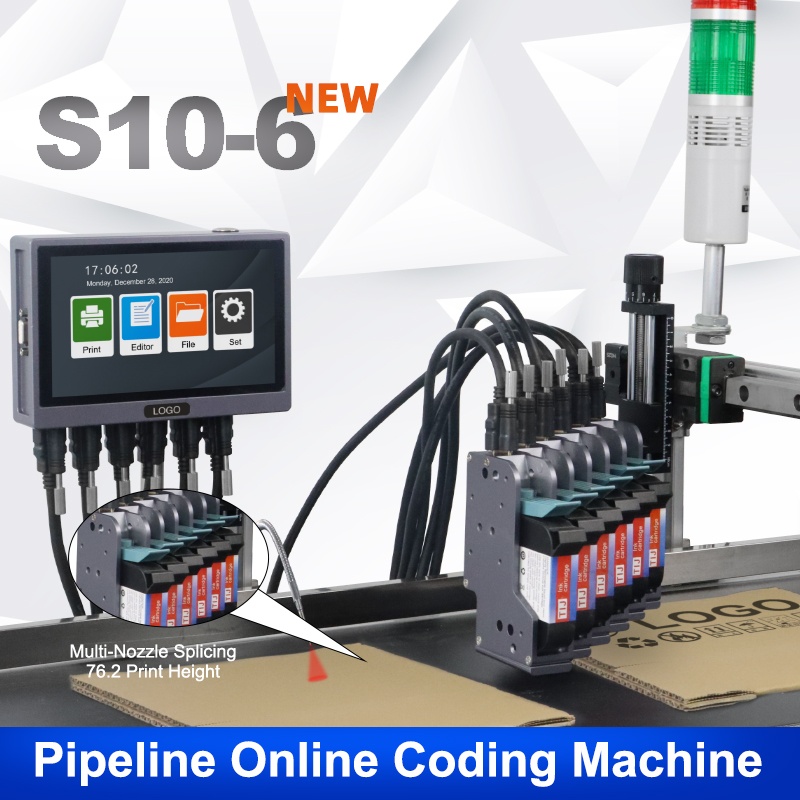
S10-6 online inkjet printer (splicing)
where 76.2 mm covers the face:
- 2-76.2mm print height
- 2-5mm throw distance
- Available in 7 ink colors
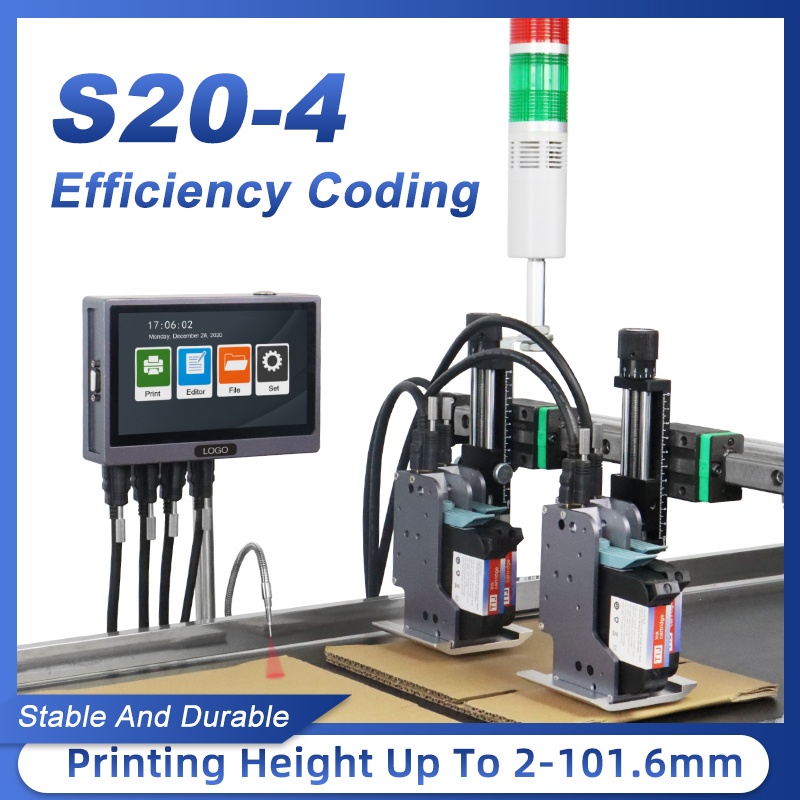
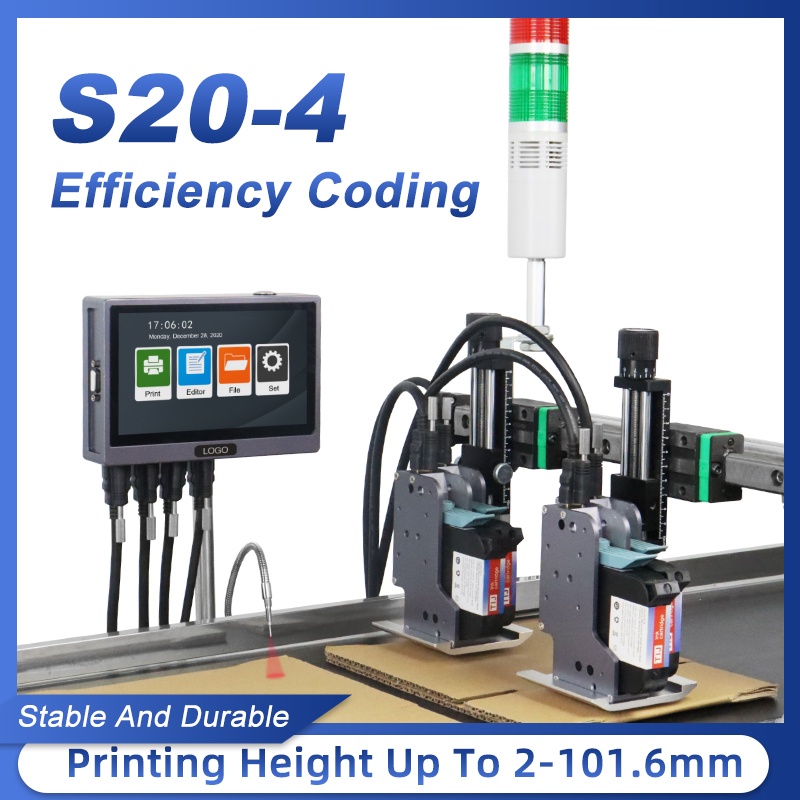
S20-4 online inkjet printer (standalone)
for tall blocks on a moving line:
- Prints up to 120m/min
- 2-101.6mm print height
- Available in 7 ink colors
S20-6 online inkjet printer (splicing)
when the whole panel prints in one pass:
- Prints up to 120 m/min
- 2-152.4 mm print height with six spliced heads
- Available in 7 ink colors
Head count is the only variable that changes between them: four spliced heads reach 101.6 mm, six reach 152.4 mm, and both run the same seven ink colours so the grade follows the board rather than the artwork. Narrower blocks sit comfortably on the C110 mini online inkjet printer in a bench footprint.
What an Honest Comparison Looks Like
Two claims deserve a document and one deserves a demo. Ask for the wear-parts list with lead times to your site, since that is where an ownership year is really spent. Ask which quality framework the build runs under, recorded rather than asserted, which is what ISO 9001 quality management supplies. Then ask for your own pack under the head at your own throughput. The mechanics of droplet formation make a useful neutral yardstick when two suppliers describe the same duty in different words. SHICAI answers all three asks on its own large character frames, so the wear-parts list, the quality record and the demo on your pack come from the same party that answers the service call.
Questions on the change
- What should an alternative to Kortho prove first?
- Print height on your actual pack. A tall block needs more heads spliced together, so the difference between a two-head and a six-head frame decides whether the job is one pass or two.
- Is large character coding the same on every surface?
- No. Porous corrugated board absorbs most grades quickly, while coated board, film and pipe hold the droplet on the surface and need a grade matched to them, with a drying window before the next handling step.
- Does the stand-off change with print height?
- It does. A taller mark is printed from farther away, which widens the tolerance for conveyor bounce, so head angle and trigger position are confirmed at commissioning rather than assumed.
Where to start
Send a carton, the block height in millimetres and the throughput. We return the head count that covers it in one pass, the matching ink grade and the wear-parts list in writing, and we will say if staying put is the better answer for your site. Two earlier notes apply the same method to other buying questions: what the installed cost hides and TIJ vs CIJ on a production line. Start from the contact page, free of charge, reply within 24 hours.