Last Updated: 2026-10-06
A lot code that reads wrong sends a whole batch back through inspection. A lot number printer keeps that code on the package without slowing the line, and on a standard line the difference is usually setup rather than hardware. The five checks below separate the two.
What a Lot Number Printer Has to Hold
The code itself is short, which is exactly why it is unforgiving. A lot string of ten characters has to sit at a fixed height, at a fixed angle and in the same place on every unit, because the person reading it later is matching it against a record under time pressure.
Three properties decide that. Print height sets how much of the band the string occupies, throw distance sets how far the head can sit from a package that is not perfectly square, and the trigger sets when the drop fires relative to the package edge. Get the third wrong and a clean code still lands late on one carton in fifty.
Where Lot Codes Earn Their Keep
Lot marking turns up in three ordinary duties, and each places the code differently:
- Food and beverage cartons A lot code beside a date, both read by the same downstream scanner.
- Pharmaceutical and medical packs Traceable strings that have to survive handling and be legible years later.
- Industrial components Lot IDs on parts that are later assembled into a larger unit and never seen again.
All three reward the same thing: a code that is placed the same way every time, which is what the selection below is really about.
Lot Code Printer or Lot Number Printer: How to Choose
A lot code printer and a lot number printer are the same machine under two names, so the decision is not the name. It is whether the line is fixed or moving, and how much of the band you need at once:
| Question | Points to | Watch for |
|---|---|---|
| Is the package moving on a belt? | A fixed inline head with a sensor trigger | Missed triggers at belt joints |
| Is the pack already sealed and flat? | A standard single-head build is enough | Band too narrow for a long string |
| Does the code change every batch? | An editable job stored on the panel | Operators retyping the string by hand |
| How far is the head from the pack? | A build rated from 2-5 mm of throw | Skew at the edge of the tolerance |
Work down that table before comparing prices, because a standard build that is set correctly outperforms a wider one that is not. ISO 9001 quality management is where the ink grade for your substrate gets approved and recorded, and the inkjet printing process explains why the drop behaves differently on board and on film.
How SHICAI Sets a Standard Coder
SHICAI builds inline coding frames for export lines, and a standard lot job is specified from the customer’s own packaging. The string is test-printed while packs move, the trigger point is measured from the pack edge, and the job is stored on the panel so an operator selects it rather than retypes it.
Frames in this class use a TIJ thermal inkjet head with no maintenance-heavy ink system, and the panel is sized so a full-shift run can be started by one person. The build below is the standard single-head workhorse.
Questions on Lot Codes
- What is the difference between a lot code and a batch code?
- Practice varies by market. A lot code usually ties a group of units to one production run; a batch code often does the same job under a different rule. Use whichever your buyer’s paperwork names.
- Why does one carton in fifty carry a late code?
- Almost always the trigger. A mechanical sensor reading a belt joint fires a few milliseconds late, and the code lands closer to the trailing edge.
- Can I move the coder between two lines?
- Yes, if the frame is light and the job is stored on the panel. Re-levelling the head and resetting the trigger takes minutes, not hours.
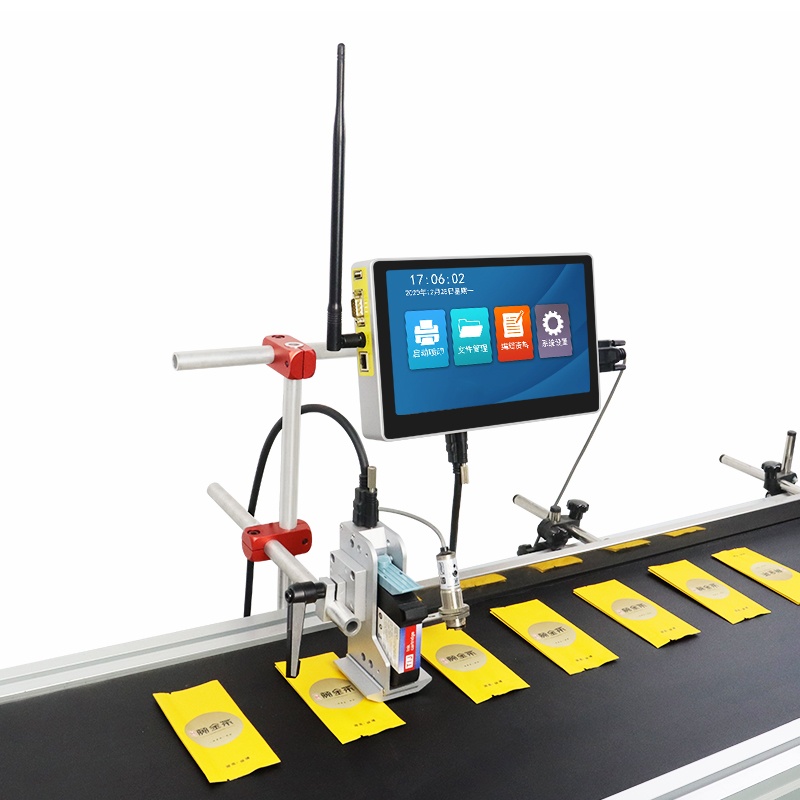
S100 Online inkjet printer
the standard single-head coder for a fixed line:
- Prints up to 100 m/min
- 600dpi HD print accuracy
- 10-inch touchscreen
- Weighs only 3 kg
Match the Coder to Your Line
- See the product: S100 Online inkjet printer
- Read next: the five fields inside a lot number, which is what your reader is actually matching against
- Talk to us: send a photo of your pack and belt through our contact page. We return the trigger setting and head gap for your line, free of charge.