Last Updated: 2026-10-19
Most buying time is spent comparing an egg printer for sale against another listing, when the two documents answer different questions and neither answers the ones that decide a deposit. SHICAI builds egg coders for export markets, and the seven questions below are the ones we ask buyers to put to every supplier, ours included. A unit that marks well in a demonstration and fails in week three costs more than the difference between two quotations.
What an Egg Printer For Sale Listing Shows, and What It Hides
A listing usually names a technology, a print height and a nozzle count. Those three describe the head. They do not describe the purchase, which also includes the trigger arrangement, the ink grade against the shell, the data path that loads a batch string, the spares that arrive with the crate and the paper that clears customs.
The gap is where quiet failures start. The machine lands on time, marks cleanly on the sample tray, and then the first production week produces a code that smudges in the chiller, a date format the retailer rejects, or a batch sequence somebody has to type forty times a shift.
Seven Questions Before a Deposit
Put the seven answers in one column per supplier. The useful answer is a named item, a document or a tested sample, never an assurance.
| Question | What a usable answer looks like | Why it decides the outcome |
|---|---|---|
| Which nozzle count matches my tray? | The count and the shell spacing it covers, stated against your tray format | Too few nozzles means walking across the row; too many is money spent on capacity you cannot feed |
| How is the trigger taken from my line? | Sensor type, mounting point and the pulse it expects | A good mark fired at the wrong moment is a reject |
| Which ink grade is declared for shell contact? | A grade named against the shell, in writing, with a material safety sheet | A carton grade on a shell is a food-safety problem, not a cosmetic one |
| How is a batch string loaded? | File, line signal or panel edit, and who does it | Retyping at every changeover is the most common hidden labour cost |
| What ships in the crate as spares? | A list, with the items an operator can fit alone | Determines whether a fault costs an hour or a week |
| What documentation travels with it? | Manual language, declaration of conformity and the marks on the unit | Customs and commissioning both stall without it |
| Can I see my own string printed on my own shell? | A sample returned before the order is placed | The only test that reflects your surface, your ink and your date format |
The last row is the one to insist on. A supplier who cannot return a marked shell has either not run your substrate or does not want the result on record.
Three Build Routes, Three Different Questions
A tray-line build carries six nozzles that fire in parallel, and the question is whether your grader can release a full row at once. A small-character build trades nozzle count for reach, and the question becomes throw distance across a shell that sits off centre in its cup. A handheld build covers the work that never reaches a conveyor, and the question is weight and battery life rather than throughput.
Buyers who compare the three on model name alone end up with a tray head nobody feeds, or a handheld unit asked to do eight thousand shells a day. The route has to follow the packing shed, not the price list.
Ink on a Shell Is Not Ink on a Carton
The shell is a porous, curved and slightly damp surface, and it behaves differently from board in three ways: the drop spreads, the colour shifts, and the mark has to survive a chiller without flaking. That is why a food-grade declaration belongs in the specification rather than in a later email, and why a print trial on one real tray answers more than a datasheet.
It also sets consumption. A grade chosen for adhesion on a shell may need a different drop volume than one chosen for speed on a carton, and the difference shows up in cartridge cost per thousand eggs rather than in the unit price.
How SHICAI Ships a First Order
Ink is agreed in the same conversation as the machine, and the first step asked of a buyer is a sample tray rather than a purchase order. Builds follow ISO 9001 quality management, and the code content itself is defined by the GS1 application identifier list where traceability is required.
Three builds cover most first orders, and each is quoted against a stated tray format rather than a generic capacity figure.
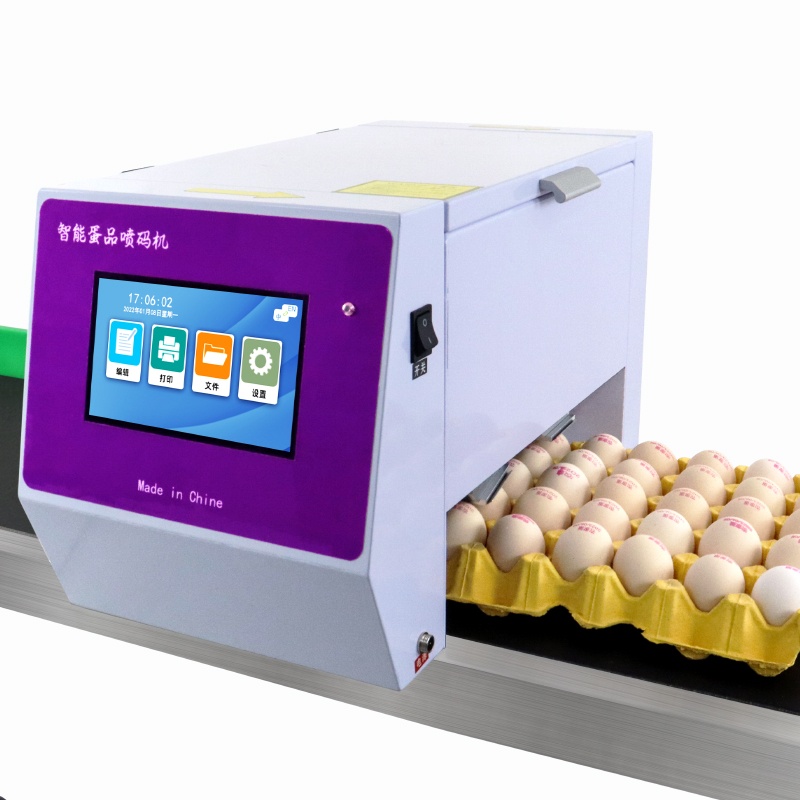
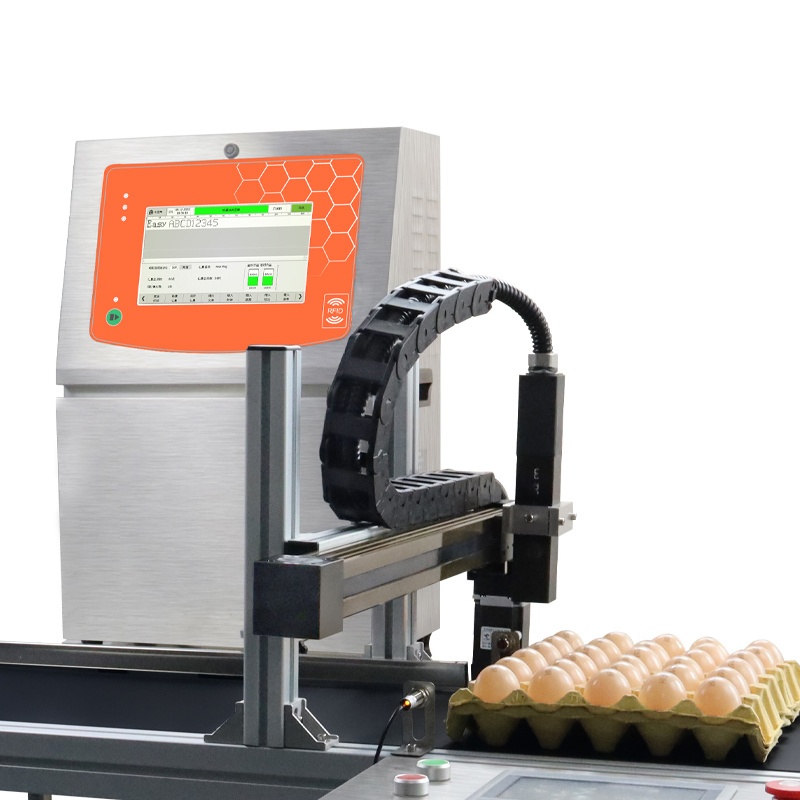
Six head egg inkjet printer
the parallel-head route for a tray line:
- Six individual nozzles print in parallel
- 7.0-inch capacitive screen
- Food-grade ink safe for eggshell contact
- Prints Chinese/English characters and dynamic QR codes
Small character egg printer
the low-draw route for a continuous shed:
- 2-20mm print height
- 3-30mm throw distance
- Low 150w rated power
- Marks eggs
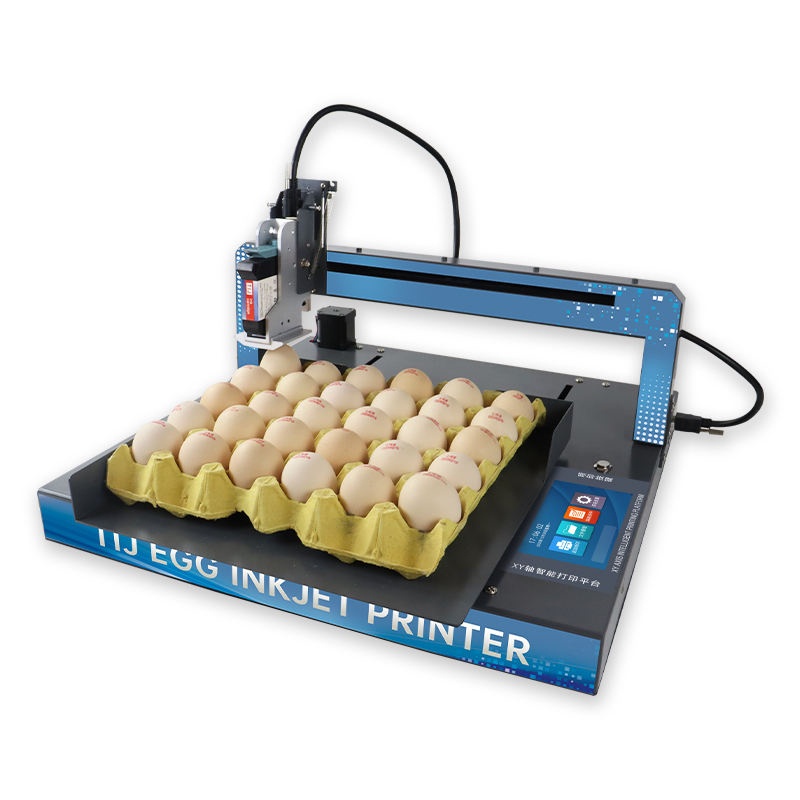
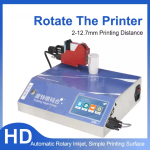
XY110 Egg inkjet printer
the compact route for short runs:
- 2-12.7 mm adjustable print height
- 5.0-inch touch screen
- Food-grade, water-based and oil-based ink options
- Prints letters, numbers, logos, QR codes and dates on eggs
Questions Buyers Ask First
- Should an egg coder be bought new or used?
- New, where the ink path is sealed and the firmware carries your date formats. Used, where a shed is closing and the seller can show print samples on your own tray.
- Is an egg coding machine for sale on a marketplace the same unit?
- Sometimes, but the listing rarely carries the ink grade, the trigger arrangement or the spares list, which are the three items that decide the first month.
- How long does commissioning take?
- A tray-line build is usually marking within a day of arrival, provided the tray format and the trigger signal were agreed before shipping.
Related Reading
- Verifying who is behind a listing: six proofs before you order.
- What the code has to carry: traceability and QR codes on shells.
- Where rate is actually won: the high-speed egg printer.
Next Steps
- Send one loaded tray and the string you print. We mark the shells and return the sample, free of charge and with no commitment.
- Ask for the seven answers in writing before comparing quotations. We answer ours on the specification sheet rather than in an email summary.
- Start at the contact page, on +86 17625427465 or kuangcy@126.com. We reply within 24 hours.