Last Updated: 2026-11-10
A pack that shifts two millimetres smears every code on it. A batch coding machine squeezed onto a tight line has to solve that inside thirty centimetres of rail, and five mounting rules decide whether it does: throw distance, trigger point, print window, bracket rigidity and changeover room.
Why a Batch Coding Machine Lives or Dies on Mounting
The printer is rarely the weak point. The head is set, the ink is proved, and the code still drifts because the pack was never held at a fixed distance from the nozzle plate.
On a wide line a stand and a guide rail fix that. On a short line the same job falls to a bracket, a sensor and a print window with no margin for a wobbling carton.
Rule 1: Throw Distance Sets the Gap to the Pack
Throw is the air gap between the nozzle plate and the surface. Short throw makes a compact mount possible, and it demands a flatter surface, since a two millimetre bow in a carton can eat most of a five millimetre gap.
Measure the bulkiest pack in the batch, not the best. A case that bulges at the seam sets the real number, and a head set for the flat face prints light along that seam all shift.
Rule 2: Where the Trigger Sits
The trigger is a sensor that fires the print. Its distance from the head, divided by line speed, gives the delay the controller holds, and that delay is where most first-week faults come from.
Set it on a mechanical feature that does not move, not on a printed band or a shrink sleeve. A trigger that sees the film fires late when the film rides up, and the code lands near the fold.
Rule 3: Line Speed Against the Print Window
A wider code needs a longer window, and the window is set by line speed. Two lines of text at ninety metres a minute is a different job from one line at thirty, on an identical box.
Buyers here over-specify resolution and under-specify time. A 600 DPI head gives a sharper character, but a short window forces fewer passes and a thinner code than the sample that closed the order.
Rule 4: Bracket Rigidity and the Cable Route
A bracket that flexes under a case packer holds aim for a week and drifts for a month. The head weighs little, so a short arm bolted to the frame beats a long arm on a pedestal, with the ribbon routed clear of the conveyor edge.
Rule 5: Changeover Room to the Left of the Head
Cartridge changes happen mid-shift, by hand, often in gloves. Leave a hand width clear on the operator side and check that the guard opens without unbolting the bracket.
The same space serves the sensor. A trigger set close to the head is easy to reach and easy to knock, so guard and adjustment screw should not share one gap.
The Unit We Mount on Tight Lines
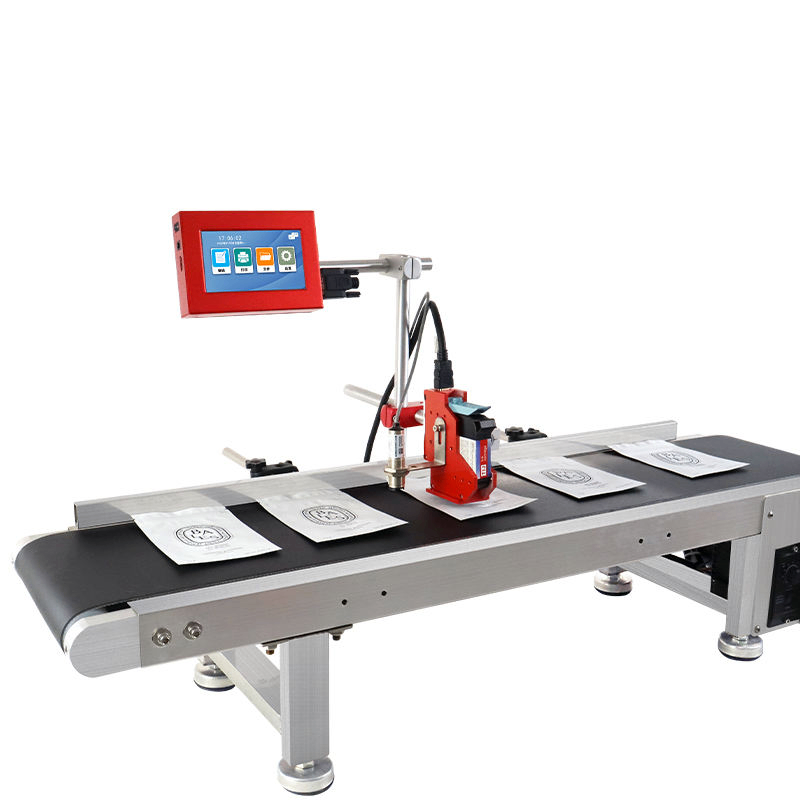
T110-Mini online inkjet printer
the build for a rail where thirty centimetres is the whole budget:
- Prints up to 100 m/min
- 600DPI HD print accuracy
- 2-12.7mm print height
- 5-inch touch Screen
- 2-5mm throw distance
The two to five millimetre throw is the number that matters. It lets the head sit inside a guard instead of in front of it, which is what makes a compact mount work on a line never designed to carry a coder.
Send the Rail Dimensions, Not the Catalogue
- Can we keep the old bracket
- Sometimes, but the throw and the trigger distance both have to be re-measured before the head goes back on.
- What if the pack face is curved
- The gap widens at the edges, so the sensor has to fire on the crown and the code is set one size down.
- Do we need a guide rail
- On a short run yes, because a thirty centimetre mount has no room to absorb sideways wander.
Send the rail length, the belt speed at the marking point and the loosest pack in the batch. We return the throw and the bracket height in writing, so the batch coding machine you order fits the space you have.
For line integration, our note on splicing a coder onto an existing conveyor covers the joints. The mechanism sits under inkjet printing, and export builds are checked against ISO 9001.
Next Steps
- If the trigger keeps missing: mounting an online printer on a conveyor.
- Start at the contact page, on +86 17625427465 or kuangcy@126.com. We reply within 24 hours.