Last Updated: 2026-11-20
Egg printer cost arrives as one number per machine and is paid back per egg, which is why two farms with the same quotation reach opposite conclusions. The useful figure is cost per thousand shells, and it moves with flock size.
What an Egg Printer Cost Really Covers
A quotation covers a cabinet, a head and a delivery week. Coding an egg costs four things: the machine spread over its life, the ink, the minutes of a person, and the shells lost when a code is wrong.
Only the first of those is on the quotation. The other three arrive monthly and nobody totals them, which is why the cheaper machine sometimes turns out to be the expensive one by the second year.
Four Lines, and Only One Is on the Quote
The machine line divides the purchase over the shells it will print. A one-head build coding two million shells a year carries a very different per-egg figure from the same build coding two hundred thousand, and the machine has not changed.
The ink line follows printed area, so a short date costs less than a two-line code with a batch. Labour is where a hand-fed table and a six-head frame separate: one needs a person per shift, the other per break.
Under 10,000 Hens: One Head at a Table
At this size the machine is idle most of the day, so per-egg cost is dominated by the purchase rather than by the ink. A single head at a packing table is the right shape, because a second head buys capacity that will not be used.
The number to watch is not the machine but labour. If one person codes by hand for two hours a day, that cost is fixed however good the head is, and it decides whether coding in-house beats pre-printed trays.
10,000 to 50,000: Where Heads Multiply
Here the table stops fitting and the tray line sets the rate. One head cannot cover six columns, so the choice is a six-head frame or a slower line, and the frame pays back when labour drops by one person.
Ask what the extra heads do to the ink line. Six heads print six columns in one pass, so ink per tray stays close to one head printing six times while minutes per tray fall. That gap is the return.
Above 50,000: The Line Sets the Number
At this volume the coding station constrains a grading line that costs more per hour than the coder. Downtime dominates the arithmetic, and twenty stopped minutes a shift costs more than any ink difference.
So the question changes: not what the coder costs but what an hour of the line costs, and a spare head on a shelf is cheaper than a stopped grader. Our note on where the rate is won runs the same sum from the speed side.
The Unit Behind the Arithmetic
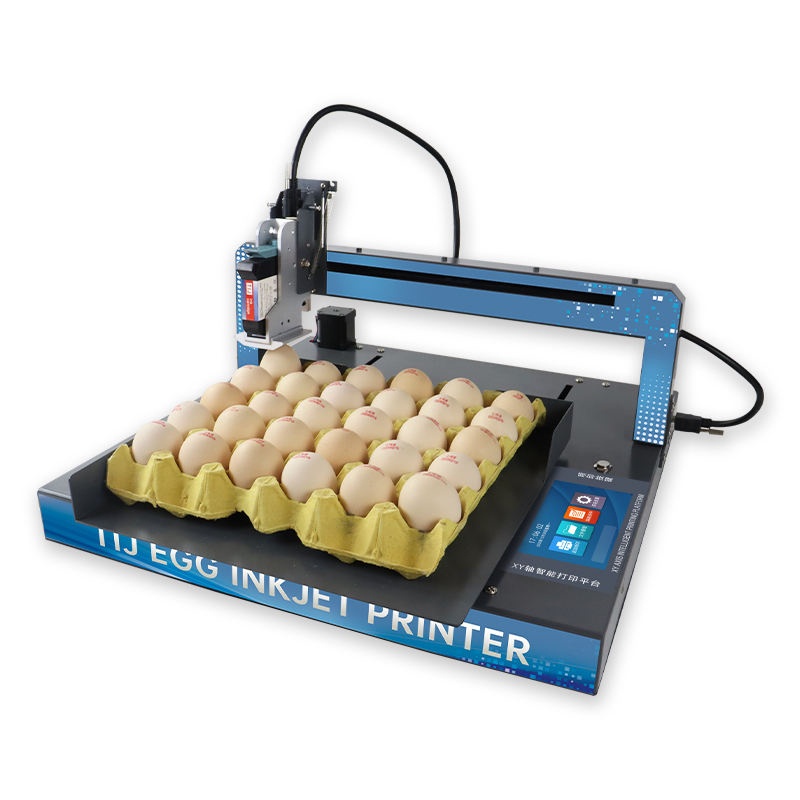
XY110 Egg inkjet printer
the one-head build the model starts from:
- 2-12.7 mm adjustable print height
- 5.0-inch touch screen
- Food-grade, water-based and oil-based ink options
- Prints letters, numbers, logos, QR codes and dates on eggs
Two ink families matter at this end, because a water-based and an oil-based option consume differently on the same shell. Ask for both figures per thousand shells before choosing, not after the first invoice.
Send the Flock and the Shift
- How do I get a per-egg figure
- Divide the machine over the shells it will print in five years, then add ink, minutes and rejects. We send the first two; the seconds come from your own shift sheet.
- Does a second head always pay back
- Only when the labour line falls. If the table is staffed anyway, a second head adds capacity nobody uses and moves the per-egg figure the wrong way.
- What usually blows the model
- Rejects. A code that smears or lands off-centre throws away a shell that cost money to produce, and that line is invisible until somebody counts the tray.
Send the flock size, the shells coded a day and the minutes the table takes now. We return the two cost lines we can size, so the egg printer cost you compare is a figure per thousand shells rather than a figure per cabinet.
The sample and acceptance side sits in what a sample run proves. Background on shell handling is under egg as food, and export builds are checked against ISO 9001.
Next Steps
- If the trace, not the cost, is the driver: the chain behind the code.
- Start at the contact page, on +86 17625427465 or kuangcy@126.com. We reply within 24 hours.