Last Updated: 2026-09-29
An unreadable symbol at the depot is a returns problem, not a printing one. A handheld barcode printer earns its place only if four things hold at once: modules wide enough for the scanner, a head close enough to place them, a grade the surface accepts, and a mark that survives stacking.
Where a Handheld Barcode Printer Earns Its Place
A portable coder is a head, a controller and a cartridge in one hand-held case. The operator presents the pack, presses the trigger and the symbol prints where it stands. That makes it the practical answer for goods that were received without the code a customer now requires, for rework, and for pallet-side labels that never pass a fixed line.
What it is not is a substitute for an inline coder at volume. Every mark depends on a steady pass, so when throughput forces continuous feeding the same message belongs on a fixed frame. The four checks below decide which side of that line a job falls on.
Jobs That Land on a Portable Head
Three recur across the sites we work with. Received stock marked up before put-away, so nothing moves into racking unidentified. Case codes applied at the shipping desk when a customer adds a requirement mid-contract, which is also the most common reason a code has to match a spec nobody agreed in advance. And drum, bundle or profile marking where the item is too big to bring to a table and too irregular to convey. In each case the pack is found by the operator rather than the other way round, which is the whole argument for a portable head.
Four Checks for a Clean Scan
| Check | What it decides | MX3-G figure |
|---|---|---|
| Module sharpness | Whether edges stay separated | 600dpi print accuracy |
| Symbol height | Whether the block fits the panel | 2-12.7mm print height |
| Working gap | Whether placement holds on an uneven face | 2-5mm throw distance |
| Ink grade | Whether the mark survives handling | Available in 7 ink colors |
Work through them in that order, because the first two are set by the artwork and the last two by your surface. The GS1 application identifiers fix what data belongs inside the symbol, and ISO 9001 quality management is what makes a verification step recorded rather than assumed.
How SHICAI Specifies It
SHICAI builds coding and marking equipment for export markets. For a barcode job we ask for the pack and the scanner, because a pass or fail is decided at the reader, not on the head. The symbol is printed on your surface and scanned at your distance before a grade is proposed, and the same applies to the portable frame and the cartridges that feed it.
Scanning questions
- Can a handheld coder print a scannable barcode on a carton?
- Yes, where the modules are wide enough for the distance the scanner works at and the surface takes the grade. A 600 dpi head prints crisp edges on porous board, which is where most carton codes succeed or fail.
- Why does a code print fine and then not scan?
- Usually handling rather than printing. The film is still open when the pack is stacked, or the symbol has been scuffed by the next carton. Test with a rub after a timed pause, not straight off the head.
- Does the print head have to sit close to the pack?
- Within a few millimeters. A 2 to 5 mm working gap keeps modules where they were placed; widen it and the edges feather, and a feathered edge is a failed read before it is a failed print.
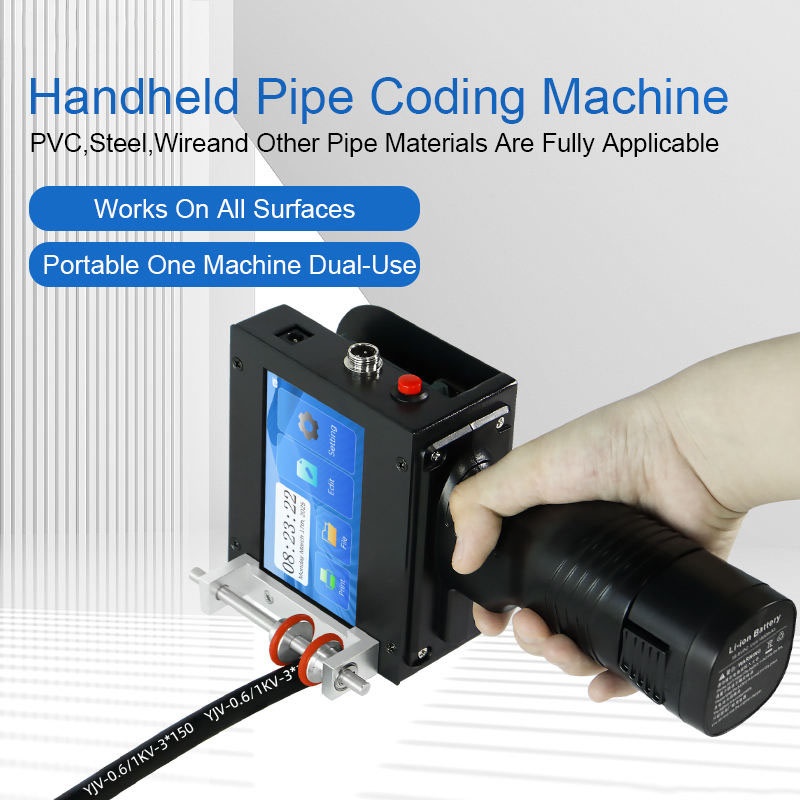
MX3-G Handheld Inkjet Printer
the portable build for this job:
- 600dpi print accuracy
- 2-12.7mm print height
- 2-5mm throw distance
Where to Go From Here
- See the product: MX3-G Handheld Inkjet Printer
- Read next: what a lot code printer marks, and when you need one.
- Talk to us: send one carton through our contact page. We print the symbol and scan it here free of charge, with no commitment.