Last Updated: 2026-09-28
A rejected pallet of unlabelled cartons costs a small business far more than the coder that would have marked them. A handheld inkjet printer small business owners can run without an engineer exists, but only if five things are decided before the order: print height, accuracy, ink grade, weight and cartridge supply.
Handheld Inkjet Printer Small Business Work: Where It Earns Its Place
A handheld unit is a portable print head with its own controller, trigger and ink cartridge. The operator presents the pack, presses the trigger and the block prints in one pass. That removes the integration work an inline coder needs, which is precisely why it suits short runs, mixed pack sizes and stock that has already been made.
The trade-off is repeatability. Every mark depends on how steadily the head is held, so a handheld coder is the right answer when presentation is manual and the wrong answer once volume forces continuous feeding. Height and accuracy ranges close that gap further, and how inkjet printing forms droplets explains why they are the first two checks.
Jobs a Small Line Actually Asks For
Most small-business marking is not exotic. It is a lot code and a date on a carton before it is stored, batch numbers on reused crates returning from a depot, an extra code on the odd pallet that a customer asks for, and stock received without the marking it should have arrived with. Each is a manual pass on a surface that is already fixed, which is exactly the workload a portable frame is built around.
Five Checks Before You Buy
| Check | What decides it | M6 figure |
|---|---|---|
| Print height | Tallest line in your block | 2-12.7mm adjustable print height |
| Accuracy | Scan grade and small characters | adjustable from 300-600dpi print accuracy |
| Ink grade | Porosity of the surface | food-grade/water-based/oil-based/42ml ink cartridge ink |
| Weight | How many passes per shift | Weighs only 1.9 kg |
| Interface | Who edits the message | 4.3-inch touch screen |
Run the five in order and most candidates eliminate themselves on height alone. Ink grade then decides whether the mark survives handling, and that question is settled by testing your own pack rather than by reading a datasheet. ISO 9001 quality management is the framework that makes that test recorded rather than improvised.
How SHICAI Specifies It
SHICAI builds coding and marking equipment for export markets, and the question behind a handheld inkjet printer small business search is usually capacity rather than price. We specify it from the pack you send us: the block is printed on your surface, the grade is confirmed against that surface, and the cartridge supply is agreed before the quote. That order matters, because an inkjet printer that cannot be resupplied locally becomes a spare parts request waiting to happen.
Small line questions
- Is a handheld coder enough for a small production line?
- It is enough while one person can present the pack and trigger the print. Once volume forces continuous feeding, the same head and ink belong on a fixed frame, because throughput then depends on the conveyor, not on the operator.
- Which ink should a small workshop start with?
- Start from the surface rather than the colour. Porous carton takes a water-based grade, coated and non-porous surfaces need an oil-based grade, and food contact packaging adds its own documentation. The M6 runs food-grade, water-based and oil-based 42 ml cartridges, so the grade can change without changing the machine.
- How heavy is too heavy for handheld coding?
- Judge it by a full shift, not by the catalogue. The M6 weighs only 1.9 kg, which is the range where an operator can still hold a steady pass at the end of the day.
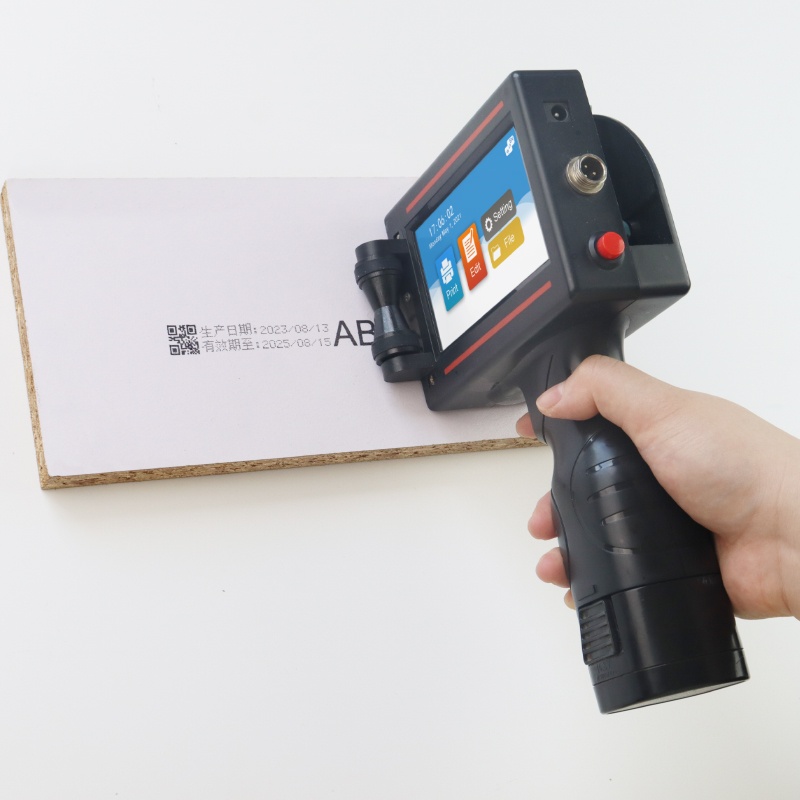
M6 Handheld inkjet printer
the build that fits this brief:
- adjustable from 300-600dpi print accuracy
- 2-12.7mm adjustable print height
- Weighs only 1.9 kg
Where to Go From Here
- See the product: M6 Handheld inkjet printer
- Read next: what a lot code printer marks and when you need one.
- Talk to us: send one carton through our contact page and we print your block on it free of charge, with no commitment.