Last Updated: 2026-10-29
An industrial printer automatic enough to be left alone overnight is not bought, it is set up. The head will fire without an operator, but the decisions that keep a code correct for eight hours, from job presets to alarm tiers, all happen before the shift starts.
What the Industrial Printer Automatic Night Asks For
A coder that runs unwatched has to fail loudly. A head that stops at two in the morning and resumes at six has produced four hours of unmarked product, and nobody knows until the pallets are wrapped.
So the design question is not speed but what happens between a drift and somebody walking past: whether the machine stops the conveyor, sounds an alarm, or keeps printing the wrong job.
Five Rules Before the Shift Starts
| Rule | What to set | What it prevents |
|---|---|---|
| Job presets | One saved job per product, locked | Operator edits at midnight |
| First-piece check | Mark, read, sign, then run | A whole shift of the wrong date |
| Consumable life | Dots used per shift, not days | A cartridge dying mid-pallet |
| Alarm tiers | Stop, warn, log, in that order | Silent drift for hours |
| Handover card | Five lines the next shift reads | Assumptions passed as facts |
The second rule is the cheapest and the most skipped. A first piece that is marked, read with the customer’s own scanner and signed off turns a coding error into a two-minute correction instead of a recall conversation.
The third rule is where consumable data earns its place. Cartridge life quoted in days means nothing when the same cartridge prints a three-line date on one line and a dense block on another, so an industrial printer automatic enough to run alone should be planned on dots consumed.
Alarms That Page, Alarms That Wait
Tier the alarms before the first night run. Anything that stops production should stop the conveyor and call the phone on duty, while anything cosmetic should log and continue, because an operator paged for a smudge stops trusting the pager. It is inkjet printing on demand, so an empty cartridge is a hard stop, not a fade.
Two signals deserve a stop: no product detected while the line is running, and a print head that reports a fault while the conveyor still moves. Both produce unmarked product, and unmarked product is the failure a customer finds at the dock rather than the operator at the machine.
How SHICAI Sets an Automatic Line
We ask for the shift pattern, the number of code changes per week and the scanner the customer uses, then return a job list and an alarm sheet with the machine. Spares and support are organised for export markets under the ISO 9001 quality management route.
The setting that surprises buyers most is the first-piece check, because two minutes at shift start saves the run. A line that skips it is not more automatic, only less supervised.
The Unit Most First Lines Start On
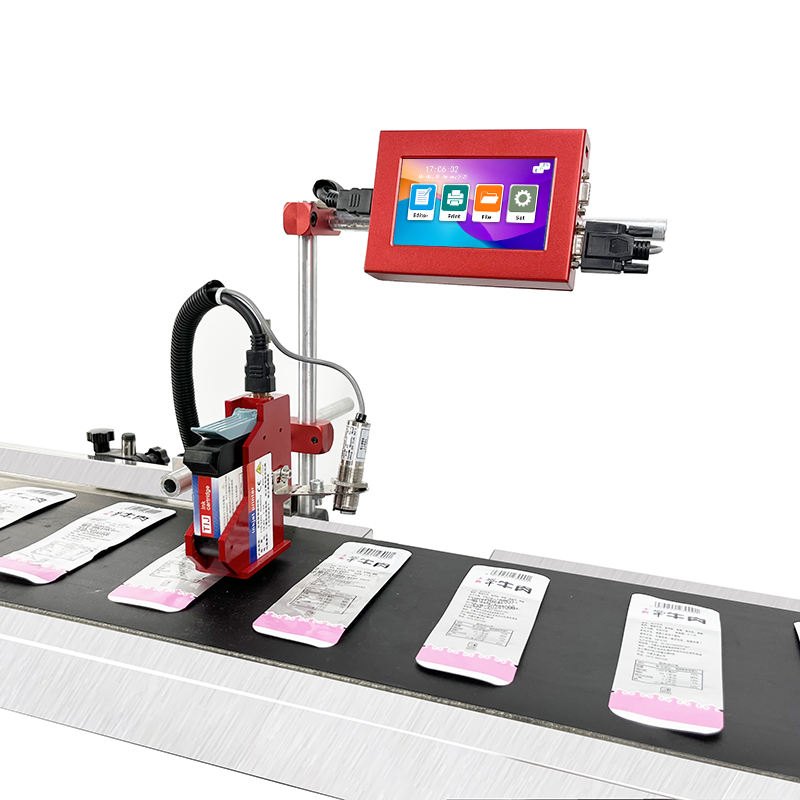
Y110 Online inkjet printer
the compact online build used for unattended runs:
- 300-600dpi print accuracy
- 2-12.7mm print height
- 4.3-inch touch screen
- Weighs only 3.0 kg
- food-grade/water-based/oil-based/42ml ink cartridge ink
A 3.0 kg body mounts on a light bracket, which matters when the head has to sit outside a guard and be reachable at shift change. The 4.3-inch screen is where the saved jobs live, and 600 dpi is enough for a three-line date at the block heights this class of line uses.
The cartridge range decides which products a single head can serve. A water-based grade for cartons and a solvent grade for film are not interchangeable, so a line that codes both needs two grades on the shelf rather than one spare.
Send the Shift Pattern, Not the Datasheet
- Can it run without a PLC
- Yes, a product sensor and the job list inside the coder are enough for a single-code line.
- What stops the line
- Whatever you wire to the alarm relay, and the two signals above are the ones worth wiring.
- How many jobs can be saved
- Enough for a week of product changes, and the limit worth testing is the time to switch between them.
Send the shift pattern, the code changes per week and the scanner in use. We return a job list, an alarm sheet and the mounting height in writing, so the industrial printer automatic you install is one the night shift can actually leave alone.
Next Steps
- What the head has to clear on a carton line: the marking window on a conveyor.
- Start at the contact page, on +86 17625427465 or kuangcy@126.com. We reply within 24 hours.