Last Updated: 2026-10-01
Half the marks on a fast line fail at the edge, not the middle. An inkjet printer for production line, sized on width, not speed, splits the work across heads: the printed band grows while the pass stays the same. Four rules decide how far.
Why Line Width Decides an Inkjet Printer for Production Line Work
A single head is a fixed window. Anything it does not cover in one pass costs a second pass, a second machine or a slower line, and all three cost more than the head that avoided the problem. The choice is made from the widest mark backwards, not the fastest one.
Splicing is the usual answer. Two heads fire as one band, so print width doubles without a second pass or a wider gate. The trade is alignment, which is why thermal inkjet print heads are paired rather than mixed. Get it right and the line keeps its speed with a wider mark.
How much width a line needs depends on the job.
Where Head Count Changes the Answer
The same machine serves very different jobs, and the deciding variable is almost never speed. It is how much of the face must carry a mark in one pass.
| Job | Why one head is not enough | What the second head buys |
|---|---|---|
| Wide carton panels | A logo and a date do not fit one narrow band | The full face marked in a single pass |
| Pallets and drums | The face is taller than the head window | Height stacked without a second station |
| Multi-language packs | Two scripts cannot share one narrow column | Separate bands for each script |
| Lines not being rebuilt | A wider gate would mean new brackets | More coverage inside the same opening |
Those rows say how many heads the job needs, not whether the pair stays true at speed.
The Rules That Keep a Wide Mark True
A spliced band is only as good as the discipline behind it.
- Match the heads. A fresh head beside a worn one shows as a density step at the seam, so heads are replaced in sets rather than singly.
- Hold the gap. A 2-5 mm throw distance for tight line layouts leaves little room for a bouncing product, so the guide rail belongs in the plan.
- Calibrate the seam once. The overlap is tuned against a printed sample, then fixed; chasing it in production turns a stable job into a moving target.
- Keep the ink simple. A TIJ thermal head with no maintenance-heavy ink system is why a paired band can sit idle over a weekend and still fire.
What remains is who calibrates the pair before it ships.
What SHICAI Checks Before It Quotes
SHICAI builds coding and marking equipment for export markets under an ISO 9001 quality system, and a paired band is quoted from the widest mark the line has to place. We ask for a product sample, the widest code it carries and the opening the fixture allows. Two heads are then aligned and test-printed as a pair, and the seam calibration ships with the machine. Where one head would cover the job, we say so. An inkjet printer for production line is sized from the product, and the head count follows.
The Splicing Build
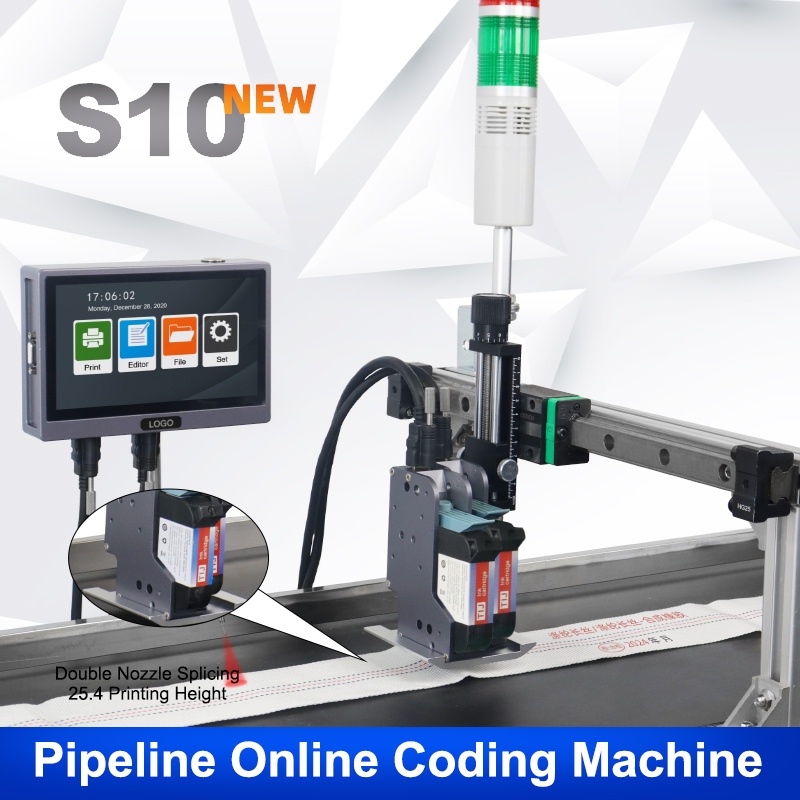
S10-2 online inkjet printer (splicing)
the paired TIJ frame for a line running at its own speed:
- 2-25.4 mm print height
- Splicing design doubles print width on existing lines
- TIJ thermal inkjet, no maintenance-heavy ink system
Production line coding questions
- Does splicing slow the line down?
- No. Both heads fire within the same pass, so the band grows while the product keeps its speed. What changes is the mark width, not the rate.
- Can the two heads be replaced separately?
- They fit separately but should be replaced as a set. A new head beside a worn one prints a density step at the seam, visible long before it fails a scan.
- Is splicing only for wide codes?
- It suits any job one head cannot cover in a single pass: two stacked languages, a logo beside a date, a tall drum panel. A date-only line usually does not qualify.
Where to Take It Next
- See the product: S10-2 online inkjet printer (splicing)
- Read next: what splicing facts change on an existing conveyor, the same seam seen from the line side.
- Talk to us: send the widest mark your product carries through our contact page and we will size the head pair for free, with no commitment and a reply within 24 hours.