Last Updated: 2026-10-02
A rejected sack of product costs the freight both ways. An online inkjet printer for bags has to mark a face that flexes, is often coated, and changes height as it fills. Four checks decide whether a given frame handles that or quietly fails once a week.
What Makes an Online Inkjet Printer for Bags a Different Problem
A carton presents the same flat plane every time it reaches the head. A bag does not. Woven or film packaging is low-absorption, so the ink has to set on the surface instead of being pulled into fibres, and the face itself moves with fill volume and with how the sack is presented on the belt. That combination puts the burden on two parts of the machine that are easy to overlook when a quotation is read: the trigger method and the drying window. That pairing is the whole job of an online inkjet printer for bags: the surface decides both of them.
Then there is the print area. Bag coding rarely has a clean wide panel, so the ceiling of the height range matters more than on cartons, and a build that splices several heads covers a narrower face in one pass where a single head would have to step down and print twice.
Three Bag Jobs This Covers
Fertiliser and feed sacks dominate, because the lot and best-before have to be readable at a farm gate and not only in the plant. Then granulated goods packed in coated woven bags, where the seam is the only repeatable edge. And pouches and lightweight bags leaving a vertical form-fill-seal machine, where the product is still moving as the mark goes on.
Four Checks Before You Buy
| Check | What it has to absorb | S10-4 figure |
|---|---|---|
| Print height | Whether the block fits between seam and valve in one pass | 2-50.8mm print height |
| Working gap | How much face movement the placement tolerates | 2-5mm throw distance |
| Substrate list | Whether plastic and foam are named, not only board | Marks metal, plastic, pipe, foam and carton |
| Code content | Date, lot and a scannable symbol together | Prints Chinese, English, date, QR code and barcode |
The GS1 application identifiers settle what the lot and best-before sit inside a scannable symbol, and ISO 9001 quality management is the framework that records which grade was approved against which bag.
How SHICAI Specifies It
SHICAI builds inline coding equipment for export markets, and a bag line is specified from the sample rather than the catalogue entry. The face is measured where the mark has to be read, the grade is chosen for a low-absorption surface, and the block is printed while the bags move at your rate before any figure is written down. Frames for this duty carry an industrial protective body in aviation aluminium and stainless steel, which is what a dusty bag hall needs.
Questions on bag coding
- Can an inkjet coder print on a woven sack?
- It can, where the grade suits a coated, low-absorption face and the head is held steady while the bag moves. A woven or film surface holds the droplet on top rather than pulling it in, so drying time sets the pace.
- Why does a code on a bag shift position?
- Because a filled bag is not a rigid box. Its face flexes and its height changes with fill volume, so the trigger has to fire on something the conveyor actually repeats, such as a seam or an edge locator, rather than on a timed delay.
- Does print height matter more on bags than on cartons?
- Yes, because the printable face on a bag is often narrower and sits between a seam and a handle or valve. The upper limit of the height range decides whether the block fits where it must be read.
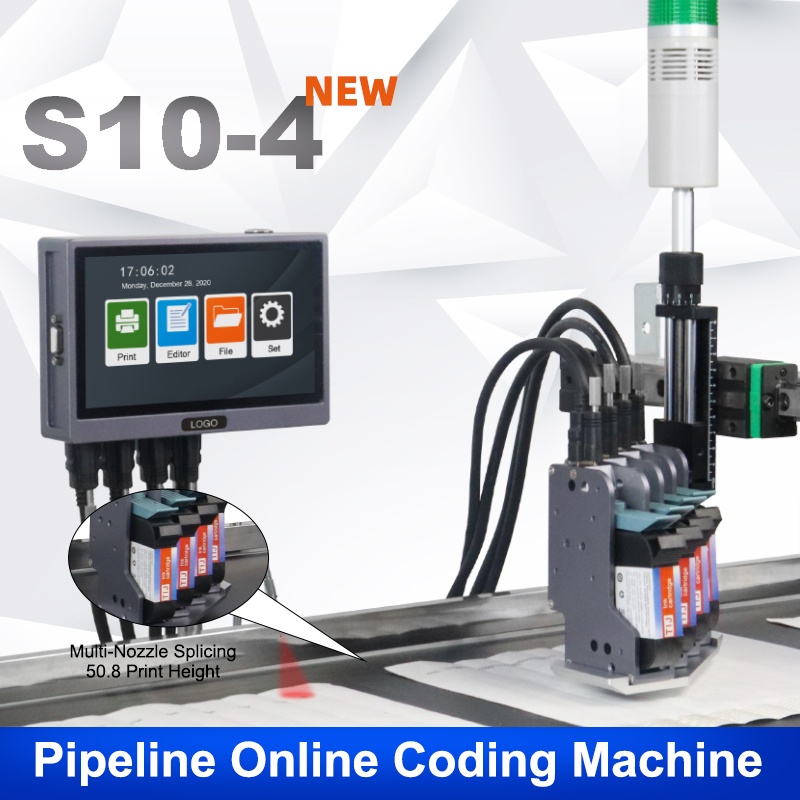
S10-4 online inkjet printer (splicing)
the spliced build for a narrow bag face:
- 2-50.8mm print height
- Marks metal, plastic, pipe, foam and carton
- 2-5mm throw distance
Where to Go From Here
- See the product: S10-4 online inkjet printer (splicing)
- Read next: how an inkjet printer behaves on a curved, non-absorbing surface, which is the same drying problem in a different shape.
- Talk to us: send an unfilled and a filled bag through our contact page. We print both and report the grade and gap that held, free of charge.