Last Updated: 2026-11-11
An entry line that prints slowly still costs money by the hour. An inkjet printer for production line work is usually bought on the machine price and paid for on the consumables, so the five cost lines below decide whether the first year is cheap or expensive.
What an Inkjet Printer for Production Line Work Really Costs
The quote covers a box and a head. It rarely covers the sensor, the spare cartridge or the afternoon spent aligning the trigger, and those items turn a cheap machine into an average one.
So compare total spend across a year, divided by codes printed. That is the number the five lines below build up to.
Cost 1: The Machine and What Ships With It
Ask for the packing list in writing. A coder arriving without a mounting bracket or a sensor looks cheaper until both are bought separately, and a stand quoted late costs more than one quoted with the machine.
The cleaning kit follows the same rule. It is needed in the first month, and a supplier who lists it up front says something about the invoice that follows.
Cost 2: Cartridge Spend per Thousand Codes
This line decides the year. A single row of date code uses a fraction of the ink a two-line batch block does, and the gap compounds across a shift.
Count characters per pack, then multiply by packs per day. Doubling the character count roughly halves the packs one cartridge covers, so the honest figure is cost per unit, not cost per cartridge.
Cost 3: The Operator Time Nobody Books
Every coder costs operator minutes: a cartridge swap, a recipe change, a nozzle wipe at shift start. None of it is on a datasheet, and all of it lands in the labour line.
Time one changeover with a stopwatch before buying. Ten minutes twice a shift is over eighty hours a year on two shifts, which is a real number to set against a cheaper head.
Cost 4: Downtime at Fifteen Metres a Minute
A slow line hides its own stops. At fifteen metres a minute a jam clears quickly, but the same line produces less per hour, so each stop is spread over fewer packs and hits them harder.
This is where a cheap machine and a standard one separate. A head that fires reliably at the speed you run beats a faster head that needs watching, since nobody stands beside it all shift.
Cost 5: The Second Year
Year one is dominated by the purchase and year two by consumables, spares and whether the cartridge you standardised on is still the one being shipped.
Ask how long the ink has been in production and whether the same part number will exist in two years. A coder tied to one bespoke cartridge is a five-year commitment dressed up as a machine purchase.
The Unit We Quote for a First Line
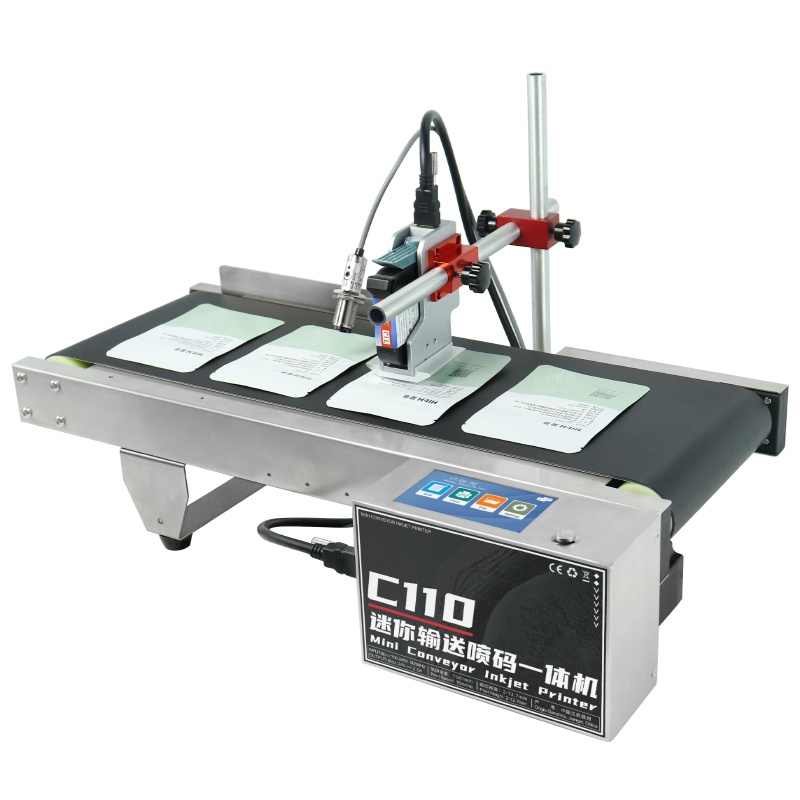
C110 Mini online inkjet printer
the build we put on a line running below twenty metres a minute:
- Prints up to 15m/min
- 600DPI print accuracy
- 2-12.7mm/2-25.4mm print height
- 4.3-inch Touchscreen
- 2-5mm throw distance
Fifteen metres a minute is the honest rating, and it suits a packing table rather than a high-speed wrapper. The short throw keeps the head inside the guard.
Send the Monthly Code Count, Not the Brochure
- How do we work out cartridge cost
- Characters per pack, multiplied by packs per month, divided by the coverage one cartridge gives at that height.
- Is a slow machine cheaper to run
- On labour yes, on consumables no, because the ink per code does not change with line speed.
- What belongs in the first order
- A spare cartridge, a bracket, a sensor and a cleaning kit, quoted together rather than later.
Send the code layout, the packs per shift and the belt speed at the marking point. We return the coverage per cartridge and the year-one parts list, so the inkjet printer for production line you order is priced against your own volume.
For the belt side of the decision, our note on sizing a conveyor by speed rather than length explains where the money goes. The process sits under inkjet printing, and export orders are checked against ISO 9001.
Next Steps
- If the line already has a belt: five checks before fitting a coder.
- Start at the contact page, on +86 17625427465 or kuangcy@126.com. We reply within 24 hours.