Last Updated: 2026-10-19
An egg printing machine for farms is chosen against the shed it stands in, not against a brochure capacity figure. Four shed types cover most of the market, and each one puts a different demand on the head, the ink and the trigger.
What a Shed Demands That a Lab Does Not
A packing shed is a wet, cold and dusty environment that runs on a seasonal clock. Eggs arrive from houses at a rate set by the flock, not by the machine, and the trays that come in at the end of a collection are often the ones with the most shell variation. A coder that holds up in a demonstration can still lose a shift to condensation on the head or to a bracket that walks after a wash-down.
Three demands follow. The unit has to survive a wash-down cycle without being dismantled. It has to hold its throw distance while the conveyor vibrates. And it has to be serviceable by the people on site, because a technician who arrives in three days costs more than a part that swaps in ten minutes.
Four Shed Types, Four Different Builds
The shed type decides which egg printing machine for farms actually fits, because it sets the head count, the mounting and the trigger. It is the first question worth answering, and it is rarely asked in a quotation.
- Tray-line sheds. Eggs are graded and packed into 5 by 6 trays, and a parallel-head build marks a full row in one pass. The constraint is whether the grader can release a whole row on a single signal. Where it cannot, the line runs at the speed of the slowest nozzle bank.
- Continuous single-file sheds. Eggs travel one by one past a single head, and reach matters more than nozzle count. A build with a 3 to 30 mm throw distance tolerates a shell that sits slightly off centre in its cup. The related question is how the mark survives the chiller, which is covered in the ink question on date coding.
- Small and mixed farms. Volume is measured in hundreds of trays rather than thousands, and the machine often shares a shed with other work. Here the deciding factors are footprint, power draw and whether one operator can move the unit between two lines. The definition of an egg coding machine covers the categories in more detail.
- Hatching and breeder sites. The code is not a retail date but a flock and collection reference that has to stay readable through incubation handling. Marks are read by people rather than scanners, so character height matters more than code density.
What Has to Be on the Shell
Almost every market asks for three things: a date, a lot or collection reference, and an identifier for the farm or house. Where traceability is regulated, a machine-readable code joins them, and the payload is defined by the GS1 application identifier list rather than by the printer supplier.
Two practical limits shape what fits. The first is shell area: a curved surface that is often already stamped or stained leaves less room than a flat pack, and a dense code in that space is near the floor of what a print head resolves cleanly. The second is contact safety. A food-grade declaration has to be made against the shell, not against a carton, and the food-safety requirements for shell coding set out what that declaration has to contain.
A third limit is often discovered later: the mark has to survive handling without breaking the shell. Pressure from a bracket, a mis-set throw distance or a tray that rides up on a guide all produce cracks, and the no-break checklist covers the mechanical side of that.
Choosing an Egg Printing Machine for Farms Build
The table maps each egg printing machine for farms route to the shed that needs it and the failure it prevents when the two are mismatched.
| Shed type | Head arrangement | What decides the choice | Typical failure if mismatched |
|---|---|---|---|
| Tray line, high volume | Six nozzles in parallel | Whether the grader releases a whole row | Rate set by the slowest bank |
| Single file, continuous | One head, wide throw window | Shell position variation in the cup | Marks drifting to the shell edge |
| Small or mixed farm | Compact single head | Footprint, power draw and mobility | A unit too large to move between lines |
| Hatchery or breeder | Single head, tall characters | Readability by eye, not by scanner | Dense codes nobody can read at arm length |
The right-hand column is worth reading twice. Most mismatches do not show up as a broken machine; they show up as a line that runs below its rated rate, or a mark that is technically present and practically useless.
The Builds That Cover These Sheds
Four builds cover the four routes above. Each is quoted against a stated tray or line format rather than a generic capacity, and each is available with the food-grade inks declared for shell contact.
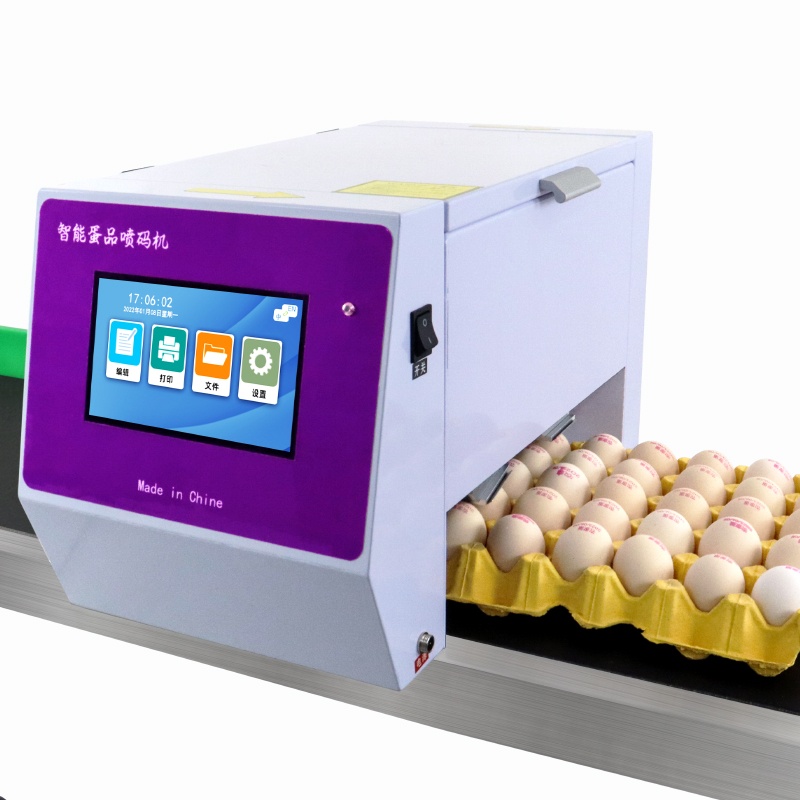
Six head egg inkjet printer
the tray-line route:
- Six individual nozzles print in parallel
- 7.0-inch capacitive screen
- Food-grade ink safe for eggshell contact
- Prints Chinese/English characters and dynamic QR codes
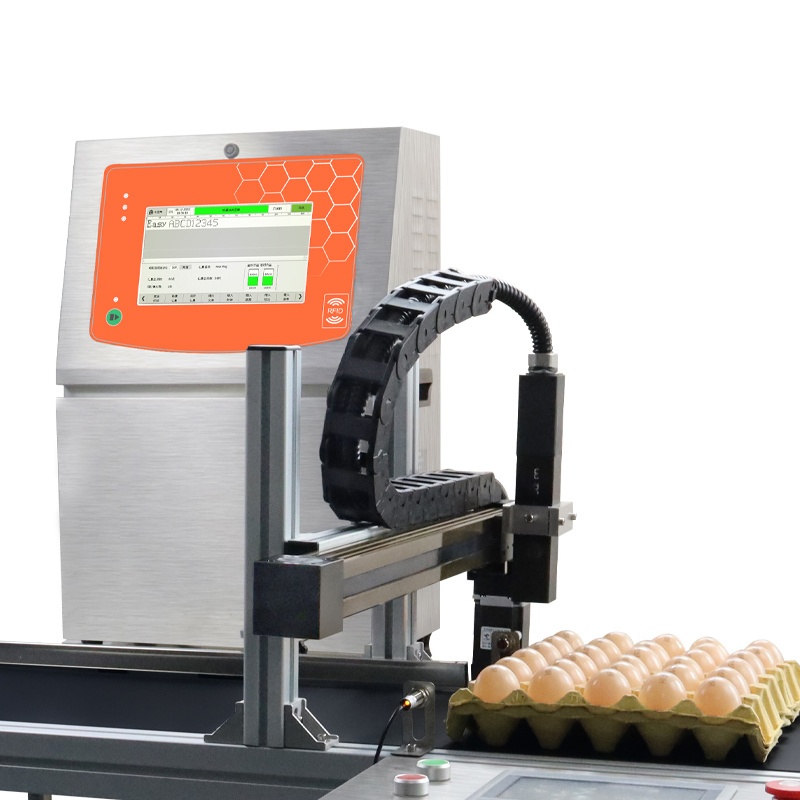
Small character egg printer
the continuous single-file route:
- 2-20mm print height
- 3-30mm throw distance
- Low 150w rated power
- Prints text, date, pattern, dynamic barcode and QR code
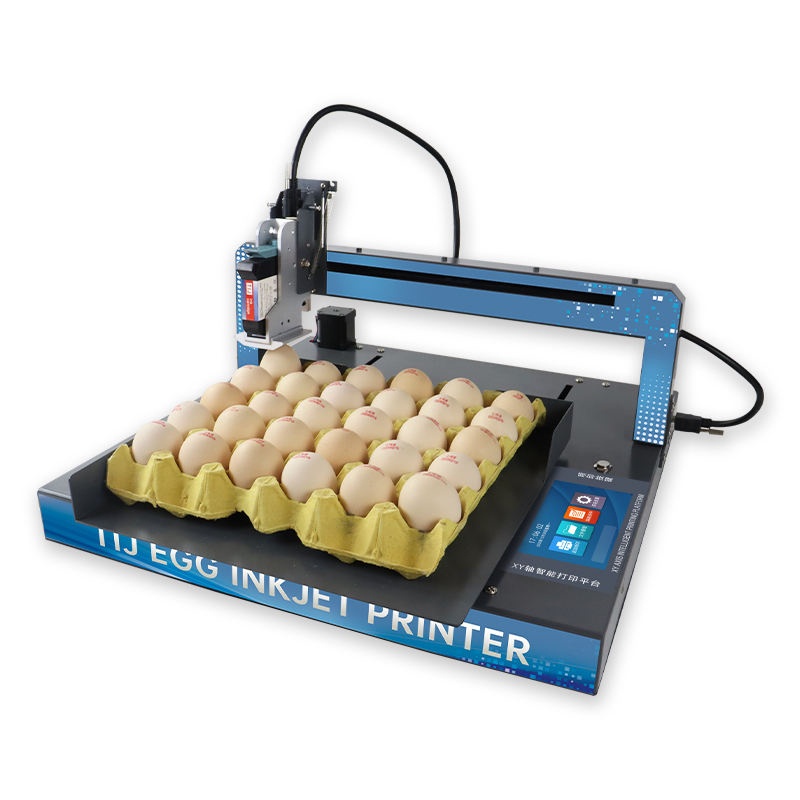
XY110 Egg inkjet printer
the compact route for a small farm:
- 2-12.7 mm adjustable print height
- 5.0-inch touch screen
- Food-grade, water-based and oil-based ink options
- Prints letters, numbers, logos, QR codes and dates on eggs
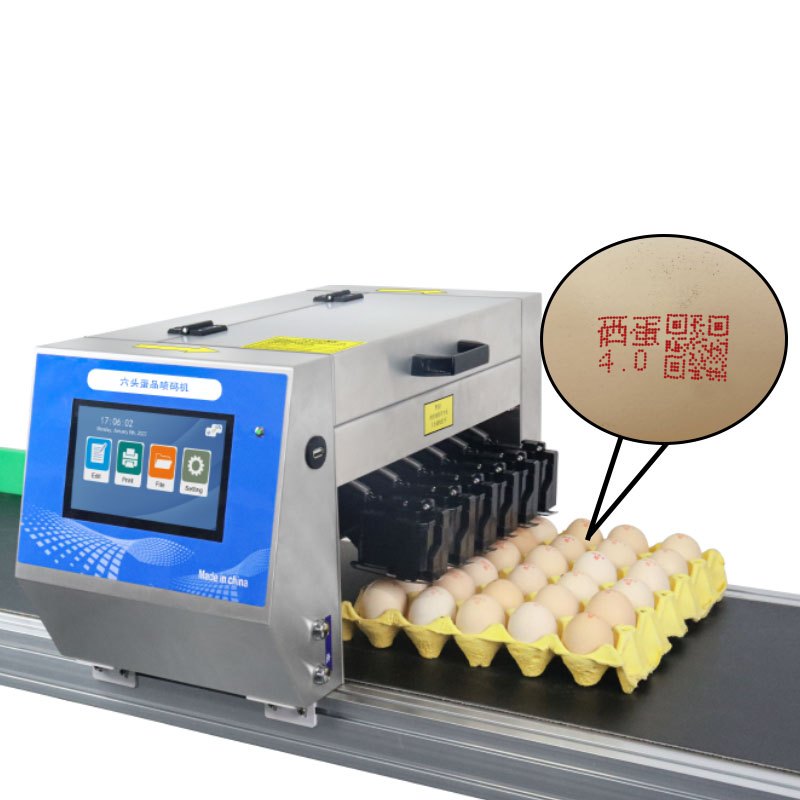
Six head egg inkjet printer (D100-6)
the high-rate tray route:
- Prints up to 20 trays per minute (5 x 6 trays standard)
- 2-5 mm optimal throw distance
- Food-grade water-based red ink
- Marks eggshells with dates, batch and traceability codes
Farm Questions
- What size of farm justifies an automatic trigger?
- The trigger pays for itself when one operator is feeding and firing at the same time. Below a few hundred trays a shift, a manual unit with a pedal is usually the cheaper answer for an egg printer small business.
- Can one machine serve two sheds?
- A compact build can, provided both sheds use the same tray format and the unit is light enough to move. A six-head tray build is normally fixed to one line.
- Does the rate on the datasheet assume a full tray?
- Yes on tray builds, and that matters. A half-loaded tray still costs one trigger, so the real rate depends on how consistently the grader fills a row.
Next Steps
Tell us the shed type, the tray or line format and the code that has to appear on the shell. That is enough to name a build and to say which of the four routes fits before a quotation is written. If the choice is still open, the analysis of where rate is won explains which constraint binds first on a high-volume line, and the verification checklist covers how to test a supplier before an order.
Talk to SHICAI
- Send one loaded tray from the hardest end of your range. We mark it and return the sample free of charge.
- Ink is agreed in the same conversation as the machine, with the grade declared against the shell.
- Start at the contact page, on +86 17625427465 or kuangcy@126.com. We reply within 24 hours.
Builds follow ISO 9001 quality management, and the published account of inkjet printing explains how a drop behaves on a curved, porous surface.