Last Updated: 2026-11-13
One head prints the code and nobody looks again until the pallet is wrapped. A visual inspection inkjet printer puts the camera in the same station, so a missing or smeared character is caught while the case is still on the conveyor and a reprint costs nothing.
What a Visual Inspection Inkjet Printer Adds to a Line
Most coders are trusted rather than checked. The operator looks at the first carton of a run, turns back to the palletiser, and from that moment the line prints blind for the rest of the shift.
The camera does not make the printer better. It makes the failure visible while the case is still on the belt, which is the only moment a reprint costs nothing.
Check 1: Missing Codes
A pack that leaves the head without a code is the failure an audit looks for first. A print trigger that misses one carton in five hundred leaves no mark on any counter.
The station counts codes against packs breaking the sensor beam. When the two numbers part company, the alarm fires on a case that can still be pulled rather than a pallet already wrapped.
Check 2: Broken Characters
A nozzle that drops out does not stop the line. It thins one stroke, and a date that reads 2026 at arm length can read 2028 from a metre away on the pallet.
Defect detection compares the character against what the recipe says belongs there. A partial stroke becomes a fault instead of a font, which is the difference between a reprint and a recall.
Check 3: The Barcode Read-Back
Reading the code back proves the other three checks at once. A barcode that scans at the station will scan at the distribution centre, and one that does not is stopped here.
This is what closed-loop verification means in practice. The head writes, the camera reads, and the result decides whether the pack keeps moving or leaves the conveyor.
Check 4: Position Drift Against the Pack Edge
A code that walks two millimetres toward the fold across a shift still scans, until the day it crosses the edge and lands on the flap where the scanner cannot see it.
Drift reads as a trend, not a fault, so position has to be logged. A camera that records the offset turns a slow mystery into a bracket that needed tightening in week two.
What Closed Loop Means on a Shift
Closed loop is simple to describe and awkward to run. It needs a reject signal, a defined action for whoever is on the line, and a record that survives the handover.
Without the record the camera is a light on a panel. With it, the plant can show an auditor what was printed, what was read and what was pulled.
The Unit We Put on the Line
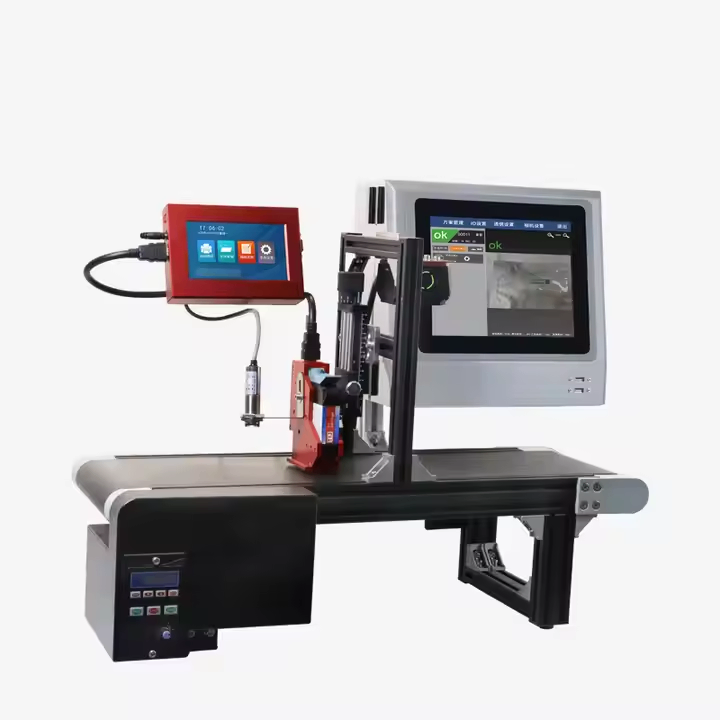
Visual inspection Inkjet Printer
the build for a line that has to prove every code:
- Detects missing or defective codes automatically
- 2-12.7mm print height
- Reads barcodes for closed-loop verification
- Coding and inspection in one station
Twelve point seven millimetres of print height covers a date line and a batch block on most cartons, and one station keeps the camera inside the same guard as the head.
Send the Code Layout, Not the Brochure
- Does the camera slow the line down
- No. It reads on the same pass that prints, so the line speed at the marking point does not change.
- What happens when a code fails
- The station sends a reject signal. Whether the pack is pushed off or the line stops is a decision your side makes once and the panel repeats.
- Can it read a code printed by another machine
- It reads what passes the lens, so an existing coder upstream can be checked by the same station.
Send the code layout, the pack material and the reject method you already use. We return the camera position and the signal wiring, so the visual inspection inkjet printer arrives as one station instead of two projects that have to be married on site.
For the belt side, our note on five checks before fitting a coder covers the joints and the trigger. The short answer on verifying codes with vision inspection sits in the FAQ. The reading side is documented under barcode, and export builds are checked against ISO 9001.
Next Steps
- If the line has no belt yet: size the conveyor by speed, not length.
- Start at the contact page, on +86 17625427465 or kuangcy@126.com. We reply within 24 hours.